EUR/USD Forecast: Euro set to extend falls after the breakdown, US stimulus becomes dollar booster
- EUR/USD has been failing to recover as Europe's vaccination campaign lags.
- Democrats may opt to pass the full stimulus bill, pushing yields and the dollar higher.
- Wednesday's four-hour chart is pointing to further losses after the breakdown.

Taking full responsibility – European Commission President Ursula von der Leyen has reportedly acknowledged her mistakes in the bloc's vaccine debacle. That is unlikely to help the euro. The old continent's lag in immunizing its population has been raising fears of a double-dip recession and is weighing on the common currency.
Britain's inoculation campaign has already reached 14% of the population – and its vaccination strategy seems to have been vindicated. Spacing AstraZeneca's shots have proved more efficient in preventing COVID-19 than injections only a month apart. The EU has a substantial amount of AZ's doses in the pipeline, so that is good news also for the continent – but deliveries are still delayed. Malta, the bloc's leading country in the field, has only reached 4.9% of its population.
EUR/USD had been supported by the upbeat market mood, partially driven by hopes for US stimulus. The safe-haven dollar dropped on hopes that the US would recover faster and that it would pull the entire world forward. However, President Joe Biden's relief package may turn into a greenback booster.
Democrats have advanced the full package in the Senate using a partisan reconciliation process – raising the chances for approving $1.9 trillion of new funds as Biden originally suggested. That is far above a package of roughly $600 billion that a group of ten Republicans suggested. Investors are upgrading their outlooks in response to prospects of additional spending, buying stocks and selling bonds – and the resulting increase in Treasury yields makes the dollar more attractive.
Is it a lose-lose situation for EUR/USD? Not so fast. First, nothing in Washington is decided until the last moment, and moderate Democratic Senator Joe Manchin may still oppose parts of the relief package such as a substantial increase to the minimum wage.
Secondly, the positive development around AstraZeneca's vaccine mentioned above may still weigh on the dollar. Moreover, there are growing signs that Israel's immunization effort – the world's most advanced – is bearing fruit. Among those over 60, who were prioritized, hospitalizations and rates of severe illness are falling.
Apart from the vaccine and political developments, two hints toward Friday's US Nonfarm Payrolls are eyed. ADP's private-sector jobs report is set to show a return to job growth in January after a disappointing drop in December. The ISM Services Purchasing Managers' Index is forecast to edge lower, yet reflect ongoing growth despite the virus's impact on the sector.
See
- ADP Employment Change January Preview: A return to hiring?
- Purchasing Managers' Index January Services Preview: No reason to pull back now
All in all, market optimism is not necessarily positive for euro/dollar.
EUR/USD Technical Analysis
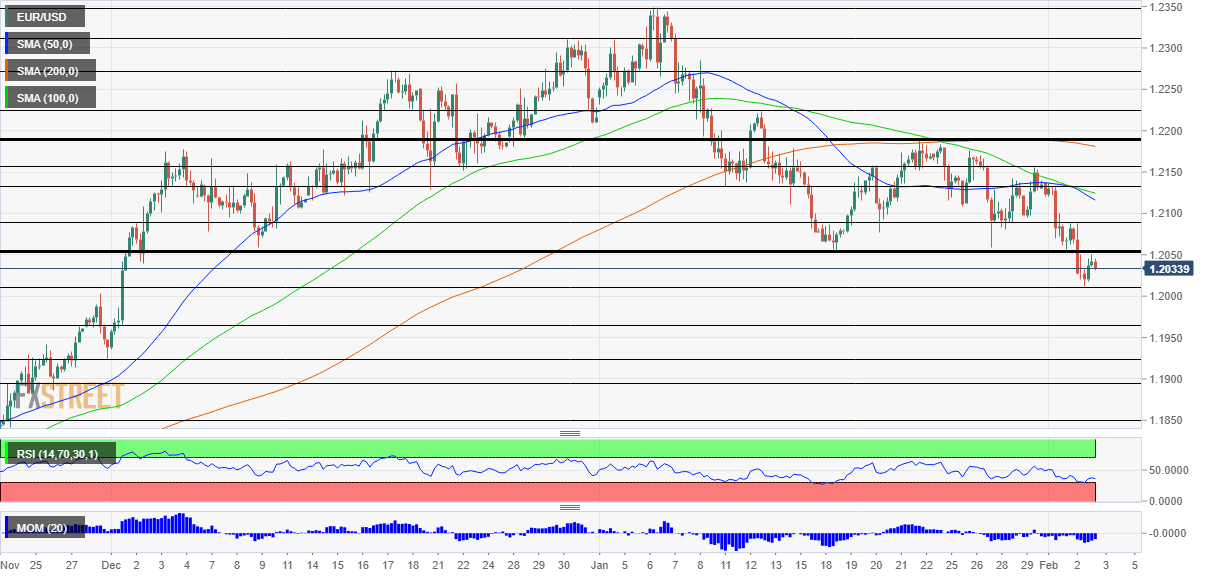
Momentum on the four-hour chart remains to the downside and the pair remains on the back foot after convincingly falling below the triple-bottom of 1.2050. It is essential to note that the currency pair failed to climb back above this level, giving it extra importance.
Support awaits at the new 2021 low of 1.2010, followed by 1.1960, 1.1930 and 1.1890, which were all in play in late 2020.
Above 1.2050, the next resistance lines to watch are 1.2090, 1.2130 and 1.2190.
EUR/USD Price Forecast 2021: Euro-dollar long-term bullish breakout points to 1.2750
Author

Yohay Elam
FXStreet
Yohay is in Forex since 2008 when he founded Forex Crunch, a blog crafted in his free time that turned into a fully-fledged currency website later sold to Finixio.