Why Hungary’s chances of fulfilling its economic potential are growing


December's Retail Sales and industrial data were disappointing – but we think a potential upturn is closer than ever. Soft data suggests that industry may contribute positively to economic growth, while retail sales could pick up the pace in terms of growth in 2026.
The Hungarian Central Statistical Office (HCSO) has released figures on retail sales and industrial production for December. As this is the last hard data to emerge from the fourth quarter, it did not come as a huge surprise after the disappointing GDP data. While not a big surprise, it was certainly a negative one on both sides compared to what we expected at the beginning of the quarter.
When it comes to the outlook for Hungarian GDP in 2026, the latest retail and industrial data suggest favourable progress. In retail sales, low-speed growth has been stabilised and may pick up speed in the future, while the decline in industrial production may come to an end soon, and growing external demand could lead to an upturn. This means that there is still hope that the average annual economic growth rate will be positively affected by both sectors.
Hopes emerging around Hungarian industry

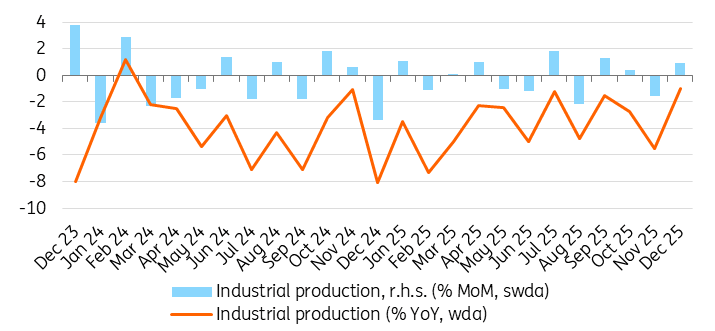
December's industrial statistics have emerged, and the data release did not reveal many surprises. Growth in volume of production was 0.9% on a monthly basis, which seems favourable at first glance. However, given the 2% MoM decline in November, Hungarian industry as a whole was unable to make up even for this with the December improvement. Due to last year's extremely low base, the year-on-year index improved significantly, with production volume in December down only 1% compared to last year.
Volume of industrial production
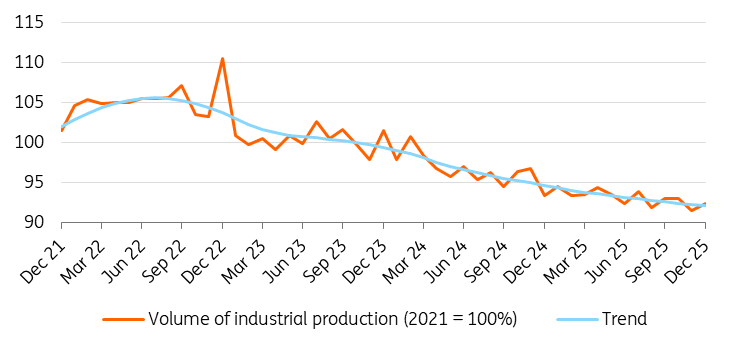
The suggestion that the overall outlook isn't so positive is clear when performance is compared to the monthly average for 2021. The fixed-base index continues to paint a bleak picture; production volume is currently 7.7% below the 2021 average. The best that can be said is that the rate of decline appears to have slowed in recent months. Given the earlier release of fourth-quarter GDP data, it is hardly surprising that there was no major rebound in December after the slump in November.
Performance of Hungarian industry
However, there are many positive signs across Europe, as it seems that a cyclical upturn in industrial performance has begun. While the latest German data doesn't suggest this, Carsten Brzeski attributes it to a one-off negative surprise. Order books are rising, inventories are falling, and lending is picking up in most European industrial countries.
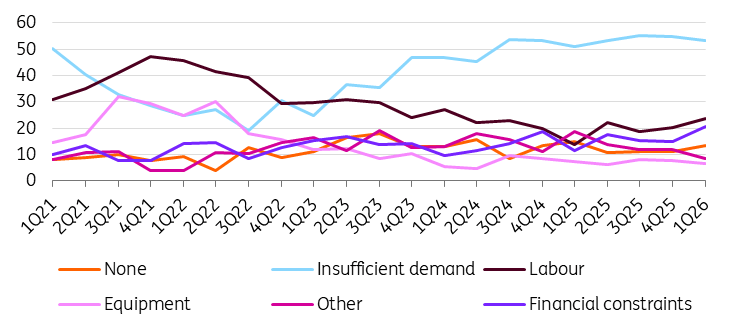
Interestingly, all of this has already been reflected in Hungarian data, at least at the survey level. Capacity utilisation in domestic manufacturing has improved for the third consecutive quarter. Meanwhile, although many still complain about a lack of demand, the number of companies citing labour shortages or financing constraints as hindering factors has also started to rise. The latter is a new and surprising phenomenon. The last time the proportion of survey participants complaining about this was as high as at the beginning of 2026 was in 2016.
Factors limiting the production in Hungarian industry (% of respondents)
Overall, it seems as if there is a glimmer of light at the end of the tunnel. Given the new export capacities that have become available throughout this year, we can perhaps be optimistic about a more lasting improvement. We do, however, believe this is more likely to occur in the second half of the year. By the end of the year, the fixed-base index could approach the monthly average for 2021.
In turn, while not explosive, the overall annual performance of Hungarian industry in 2026 may see sectoral growth of around 3% on average. In other words, after three years of industrial recession, we may once again be able to say that industry is contributing positively to the overall performance of the Hungarian economy.
Hungarian Retail Sales growing steadily, but still hold potential to grow faster

Examining the GDP data for the fourth quarter, it was clear that strong figures should not be expected in December. Domestic retail trade grew by just 0.2% month-on-month in December. The silver lining is that we have now seen modest growth for three months in a row, so the sector's performance is more consistent. However, the end of the year was disappointing overall, as the calendar-adjusted year-on-year growth of 3.5% fell short of the analyst consensus.
Looking at the longer-term trends, retail sales volume in December 2025 was 3.4% higher than the monthly average for 2021, indicating that the sector is growing slowly but surely. This growth trend has continued since the end of 2023, with some ups and downs. However, at the end of last year, the growth rate stabilised – albeit at a low level.
Retail Sales volume in detail (2021 = 100%)
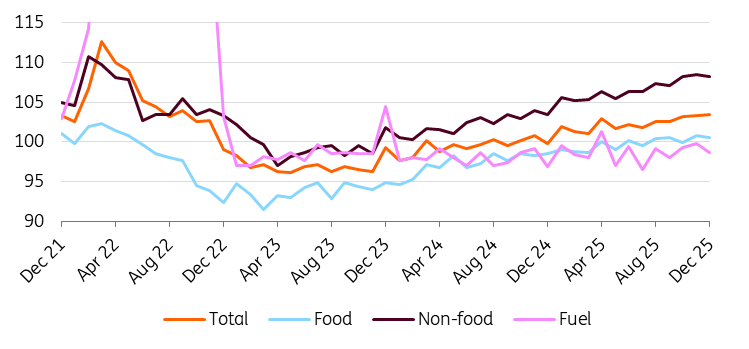
Looking more closely at the details, food store sales showed a slight monthly decline, which was clearly an unexpected development. Additionally, sales volume in non-food shops declined on a monthly basis, indicating generally weak retail performance. Once again, the largest increase was seen in the second-hand goods trade, presumably reflecting consumers' price sensitivity. Meanwhile, sales of mail order and internet purchases also fell sharply, suggesting that it was a weak end to the year for the sector.
The onset of the flu season boosted sales of pharmaceutical and medical goods. Sales at textile, clothing and footwear stores — which typically perform well at the end of the year — declined again in December. So, a new trend seems to be emerging as both the 2024 and 2025 sales data was pretty weak in the sector. It is quite possible that the tradition of giving socks and sweaters as Christmas gifts is slowly coming to an end. Finally, fuel sales also fell significantly compared to the previous month, even after seasonal effects were filtered out.
A phenomenon has emerged whereby examining the data for the three main sectors individually reveals a decline in all three areas, though examining total sales suggests a slight increase on a monthly basis. This highlights the uncertainty and difficulty of seasonal adjustments.
Breakdown of Retail Sales (% YoY, wda)
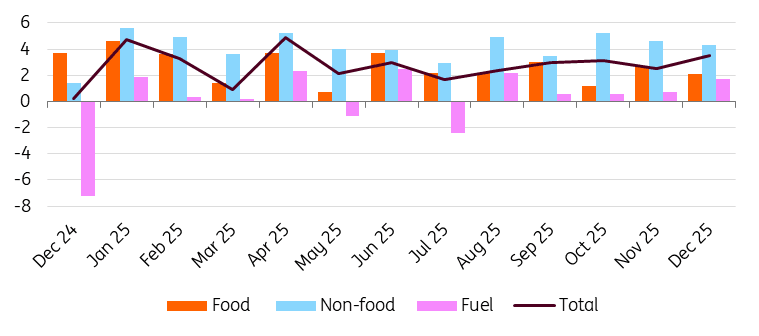
Overall, the December retail data shows some positive aspects (the sawtooth pattern is coming to an end), but the general feeling is rather negative. While retail sales still lack real momentum, the trend among consumers of prioritising experiences over purchasing objects may continue, with most of the increase in purchasing power being spent on services rather than on physical goods. We will only be able to confirm this once the detailed GDP data is available.
The improving consumer confidence trend in recent months may indicate a more sustained upturn in consumption, which would put the economy as a whole on a steeper growth path. However, if the demand stimulus induced by this improving confidence fails to materialise, it could pose a serious real economic problem, since consumption is the only factor capable of driving the Hungarian economy in the short term. Without this growth, achieving our already lowered 1.9% GDP growth forecast for 2026 would be challenging.
Read the original analysis: Why Hungary’s chances of fulfilling its economic potential are growing
Author
ING Global Economics Team
ING Economic and Financial Analysis
From Trump to trade, FX to Brexit, ING’s global economists have it covered. Go to ING.com/THINK to stay a step ahead.