Gold is fixing the trade deficit, but only on paper

Summary
Soaring gold prices and heavy overseas demand have pushed large volumes of physical gold out of the U.S., mechanically narrowing the trade deficit. But don’t mistake this for an economic improvement.
Gold transfers reflect asset reallocation under geopolitical stress, not real economic activity, which is why the Bureau of Economic Analysis largely strips it out of GDP. When gold is excluded, the trade deficit looks worse than the headline suggests.
All that glitters is not growth
From 2000 through 2020, the spot price of gold averaged less than $1,000 per ounce. In 2020, gold broke above $2,000 for the first time. By March 2025 it crossed $3,000, by October it surpassed $4,000, and today gold is trading near $5,000 per ounce.
Gold and other precious metals are now at- or near-record highs as investors and central banks seek protection from geopolitical risk, policy uncertainty, and declining real interest rates. Offering forward‑looking price guidance is outside the scope of this report. The boneyard of economists who have tried to forecast gold prices is already crowded enough without adding ours to the pile.
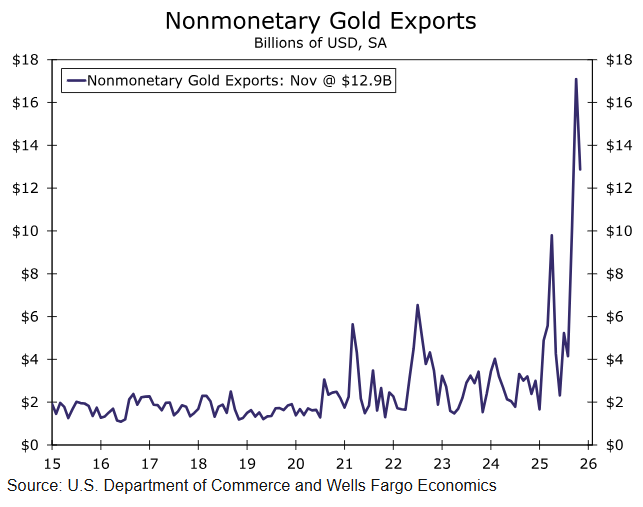
What matters for understanding gold right now is not the price forecast, but the composition of demand. The appetite for gold is increasingly being driven by large institutional buyers and ETFs, as well as by overseas investors. Some crypto‑related firms are also purchasing physical gold to back gold‑linked tokens.1 As a result, substantial quantities of gold are being shipped out of the United States.
This surge in precious-metals exports has mechanically narrowed the U.S. trade deficit. Under normal circumstances, a narrowing trade deficit would be supportive of measured GDP growth. In this case, however, appearances are misleading.
The reason is straightforward: most gold moving across borders reflects asset reallocation, not real economic activity. Non‑monetary gold trade does not represent the production of new goods or services, so it does not meaningfully contribute to GDP. Consequently, the recent “gold rush” will not show up as stronger economic growth, even though it is having a visible impact on headline trade statistics.
This distinction matters because it underscores why the apparent “normalization” in the trade deficit is anything but.
Why Gold trade is largely excluded from GDP
The Bureau of Economic Analysis (BEA) is tasked with measuring economic production, not the reshuffling of existing assets. Gold generally serves one of two purposes: it is either used as an input into production (for example, jewelry or electronics), or it is held as a store of value (bullion, bars, and coins). The bulk of gold crossing borders lately falls squarely into the second category (Figure 1).
Because most non‑monetary gold trade represents investment flows rather than production, the BEA strips gold imports and exports out of GDP. Instead of relying on volatile trade flows, the BEA uses a simpler proxy for gold net exports: domestic gold production minus industrial use.2 Under normal conditions, this adjustment is small enough to go unnoticed. When gold trading surges, however, the wedge between headline trade data and GDP‑relevant activity can become large.
That is precisely what is happening now. Large swings in gold imports and exports are distorting the trade numbers without signaling any meaningful change in underlying economic activity.
Author

Wells Fargo Research Team
Wells Fargo
















