EUR/USD Forecast: Bears take advantage of Biden's benevolence, vaccine news eyed
- EUR/USD has been falling amid concerns that of a delay in US stimulus.
- Vaccine and virus developments in Europe are set to move the euro.
- Tuesday's four-hour chart is showing that bears are gaining ground.

Ready to negotiate – President Joe Biden's willingness to discuss his $1.9 trillion stimulus bill with Republicans – and lower the final package scope – is worrying investors. Stocks are on the back foot and the safe-haven dollar is gaining ground across the board.
Specifically, the president said he is willing to lower the income threshold for the $1,400 government check, and another point of contention is the raise of the minimum wage to $15. While settling on somewhere between $1.1 to $1.5 trillion was probably priced by markets, any delay is causing jitters in markets.
The Senate approved Janet Yellen's nomination as Treasury Secretary and her initial deliberations with moderate Democrats and Republicans will be key to understanding where the wind blows. The White House may also decide to go it alone – passing the full package even without broad support.
For markets, the calculation is simple – the sooner and the bigger, the better. In such a scenario, the dollar would fall, while protracted talks would boost the greenback.
EUR/USD has been on the back foot also due to European political developments. Italy's Prime Minister Giuseppe Conte is set to resign on Tuesday, in what may prove only a "tactical move" before forming a new government. However, political instability during the crisis is never a positive development. Both France and Germany are considering tightening restrictions as covid cases and deaths remain elevated in the old continent.
European leaders are also growingly frustrated about delays to vaccine supplies from both Pfizer and AstraZeneca. The continent is lagging behind the UK and the US and far behind Israel, the world leader – which is beginning to see promising results from its immunization scheme. Over 80% of people aged 60 or higher have received at least one dose, and their share of hospitalizations has dropped sharply.
Johnson and Johnson is set to report its covid vaccine Phase 3 results during the week with preliminary data being promising. Its one-shot solution would serve as a fourth immunization in the EU, once regulators approve the AstraZeneca jab on Friday. Any positive developments would weigh boost the euro – which is in need of positive developments – and weigh on the safe-haven dollar.
Later in the day, the Conference Board's Consumer Confidence gauge for January is set to show how Americans feel at the beginning of the new year. It will feed into the Federal Reserve's decision on Wednesday.
See Conference Board Consumer Confidence January Preview: Mirror to the labor market
All in all, concerns about Biden's stimulus and Europe's slow vaccination are pushing EUR/USD down, but that may change.
EUR/USD Technical Analysis
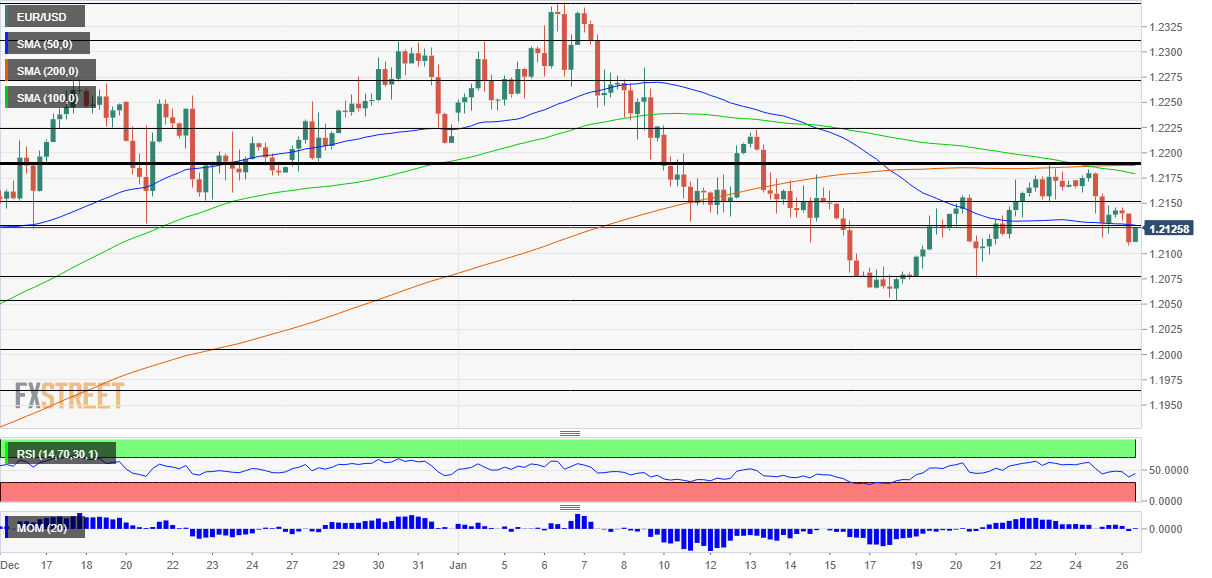
Momentum on the four-hour chart has turned negative and euro/dollar slipped below the 50 Simple Moving Average – two bearish developments The rejection at 1.2190 proved critical.
Support awaits at 1.2075, a swing low from last week, and then by 1.2050, the 2021 trough. Further down, 1.2005 and 1.1960 await.
EUR/USD faces resistance at 1.2150, which separated ranges in recent days, followed by 1.2190 mentioned earlier. The next levels to watch are 1.2225 and 1.2275.
EUR/USD Price Forecast 2021: Euro-dollar long-term bullish breakout points to 1.2750
Author

Yohay Elam
FXStreet
Yohay is in Forex since 2008 when he founded Forex Crunch, a blog crafted in his free time that turned into a fully-fledged currency website later sold to Finixio.