|

EUR/USD Forecast: back to sell the dollar

Financial markets started the week with stable after last week woes in Europe, with the dollar back under pressure across the board. The common currency is a lager, barely 20 pips above Friday's close, and having printed so far a daily high of 1.1227. A scarce macroeconomic calendar in Europe and the US, and with market's attention still centered in the UK, the pair will likely remain range bound this Monday, with the scale lean towards the upside amid dollar's weakness.
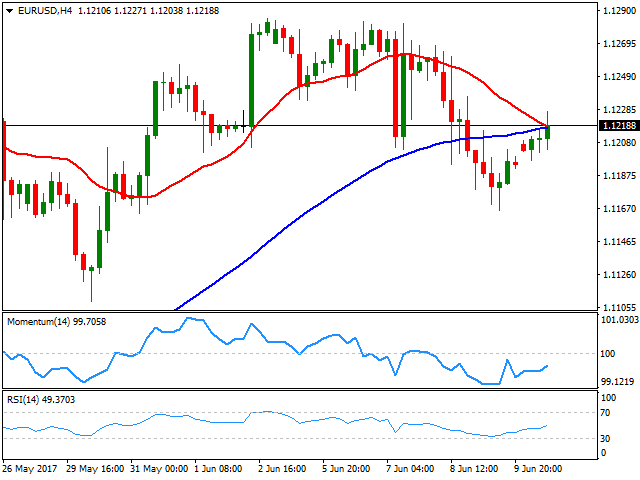
Later this week, the US Federal Reserve is having a "live meeting" with new forecasts, a press conference and a probable rate hike included, which may keep investors side-lined in the next 48 hours, although with the pair at current levels, the risk remains towards the upside.

Get Forex Headlines by Email

The hottest stories of the currency markets in your inbox

Subscribe

From a technical point of view, the pair is stuck around a bearish 20 SMA that converges with the 100 SMA in the 4 hours chart around 1.1220, while technical indicators are recovering, but within bearish territory, indicating that buying interest is still limited. Should the pair accelerate through 1.1230, the pair has scope to return towards the 1.1280 region, but it will take a break above 1.1300 to confirm additional gains ahead, towards the 1.1340/50 region.

The downside remains well limited by buying interest around 1.1160, with the next intermediate support at 1.1120 and a stronger one at 1.1080. This last could come in play next Wednesday with the Fed, but seems unlikely that the pair will approach to it ahead of the event.  

View live chart of the EUR/USD

Author

Valeria Bednarik

Valeria Bednarik was born and lives in Buenos Aires, Argentina. Her passion for math and numbers pushed her into studying economics in her younger years.


More from Valeria Bednarik
Share:

Editor's Picks

GBP/USD ranges below 1.3450 amid US-Iran uncertainty, ahead of US data

GBP/USD keeps its range below 1.3450 in the European session on Tuesday. Uncertainty surrounding US-Iran talks drives traders toward a safe-haven currency such as the US Dollar, while undermining the risk-sensitive British Pound. All eyes remain on the US JOLTS data and Mideast headlines.

EUR/USD flatlines above 1.1500, awaits US jobs data

EUR/USD holds steady around 1.1505 in European trading hours on Tuesday. Markets remain cautious ahead of a slew of US jobs data, starting with the JOLTS Job Openings Survey later today. However, the downside appears capped by hot Eurozone inflation in July, bolstering the case for a European Central Bank rate hike at the next meeting.

Gold consolidates above $4,050 amid Fed hike bets and Iran uncertainty

Gold seesaws between tepid gains and minor losses during the Asian session as traders seem hesitant and opt to wait for further developments surrounding the Middle East crisis. The US Dollar struggles to build on the previous day's solid bounce from the lowest level since Mid-June and acts as a tailwind for the bullion. However, the uncertainty over US-Iran peace talks helps limit the downside for the buck.

Ripple and Stellar steady as derivatives data points to easing downside pressure

Ripple and Stellar show mixed price action, with XRP holding above the key $1 support zone while XLM faces rejection at $0.173. Meanwhile, improving derivatives metrics alongside fading bearish momentum suggest that the downside pressure may be easing for both altcoins. Derivatives data shows mild bullish sentiment among traders.

US JOLTs report in focus
In the US, the June JOLTs report will be in the spotlight. Job openings have increased modestly this year, which has historically predicted rising wage cost pressures ahead. June trade balance data will also be released in the afternoon and the preliminary reading pointed towards a stable trade deficit from May. The Fed's Schmid (non-voter, hawk) will be on the wires overnight.
9-3: Is the Federal Reserve’s vote tally Warsh's new forward guidance?
The rate did not move. Neither did the statement, and that’s the more interesting fact. Set the July 29 Federal Open Market Committee (FOMC) statement beside the one issued on June 17, and the two documents are identical apart from a single verb and a paragraph at the bottom naming three dissenters.