Dollar Prospects Improving as the US Economy Does

The US Dollar may be set for a revival this week as recent economic statistics point to stronger economy in the first quarter than depicted in the marred reporting around the January government closure.
American consumers and their doings are about 70% of US economic activity. For many retailers the Christmas and holiday shopping season is tantamount to a successful, profitable year. If the season goes well, if the shelves and warehouses are cleared of stock, then the bottom line is rewarded and black.
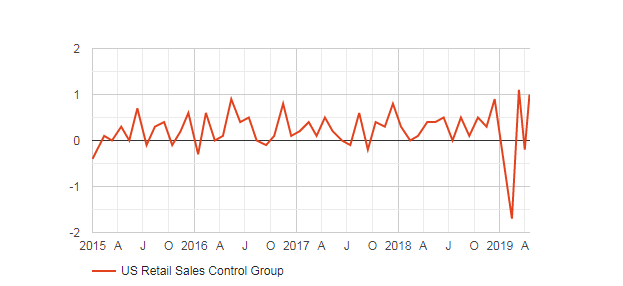
When December’s retail sales came in at -1.2% on February 14th, delayed by the shutdown they were far below the 0.2% consensus forecast. The control group number, which is the consumption component of the Bureau of Economic Analysis’ (BEA) gross domestic product calculation, posted at an equally unexpected -1.7%. Projections of first quarter retail activity based on these numbers were abysmal.
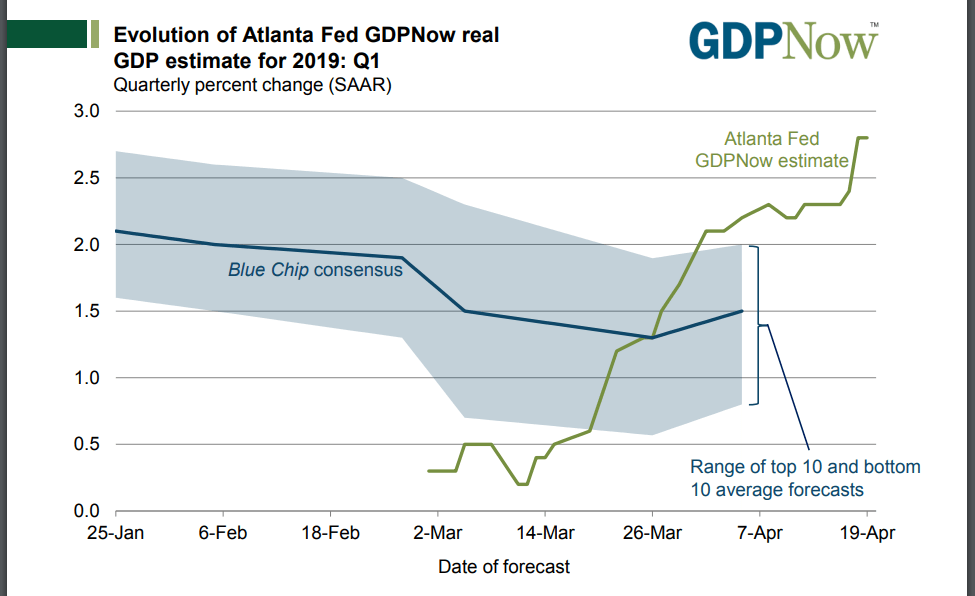
The Atlanta Fed GDPNow model reported its first estimate for Q1 GDP on March 1st at 0.3% annualized.
On March 11th when the January retail numbers were issued, the improved reading of 0.2% in overall sales and 1.1% for control market response was negated by the negative revisions to the December statistics. Total sales dropped to -1.6% from 1.2% and the control group sank to -2.3%. The GDPNow estimate the n fell to 0.2%.
When the February retail numbers were issued on April 1st the January figures were revised higher, total sales to 0.7% from 0.2% and control was adjusted to 1.7% from 1.1%. The February numbers themselves were -0.2% for sales and the same for control. The GDPNow projections moved up to 2.1% based largely on the January revisions.
The March retail sales figures reported on April 18th were 1.6% for overall sales and 1.0% for the control group. Revisions left the February sales unchanged and dropped control to -0.3% from -0.2%. The GDPNow forecast went up to 2.8%.
The control group record for the first quarter is now 1.7% in January, -0.3 for February and 1.0% in March. The 0.8% 3-month moving average for the first quarter is the strongest retail trade showing for the control group since October 2005.
FXStreet
The GDPNow estimate in the bank’s description, “Is best viewed as a running estimate of real GDP growth based on available data for the current measured quarter.” It utilizes about 25 different statistics from the US economy updating its estimate as the new data becomes available. It has proven to be one of the most accurate forecasts for GDP.
The more traditional means of arriving at the market consensus estimate for a major economic statistic is a poll of analysts and economists conducted by a news organization. The consensus market estimate for first quarter annualized GDP is 1.8%.
The initial 1st quarter GDP figure will be issued by the BEA this Friday April 26th at 8:30 am EDT, 12:30 GMT.
The 1.0% discrepancy between the general forecast and the Atlanta Fed’s GDPNow projection of 2.8% leaves a great deal of room for a better than expected performance.
If US GDP is indeed better than the market thinks it could give the dollar the impetus it needs to break out of its five months of the doldrums.
Author

Joseph Trevisani
FXStreet
Joseph Trevisani began his thirty-year career in the financial markets at Credit Suisse in New York and Singapore where he worked for 12 years as an interbank currency trader and trading desk manager.