|

Dollar hovers near 2-1/2 low as traders eye US stimulus talks

Global risk sentiment continues to remain upbeat with Dow, S&P and NASDAQ hitting new record highs. Record low real rates across the globe is causing the huge amounts of liquidity infused by central banks to chase riskier assets. 

Safe haven assets such as the US treasuries, DXY and the Yen are underperforming. Fed chair Powell in his testimony to the Senate Banking Committee said the US economy continues to remain in a 'damaged and uncertain state' despite progress on the vaccine front. Reluctance to read anything at all into the recent recovery suggests that the Fed is likely to remain in ultra dovish mode for the foreseeable future.  

On the domestic front, Cash USD inflows related to MSCI index rebalancing  along with aggressive selling by foreign custodian banks caused the Rupee to strengthen. 

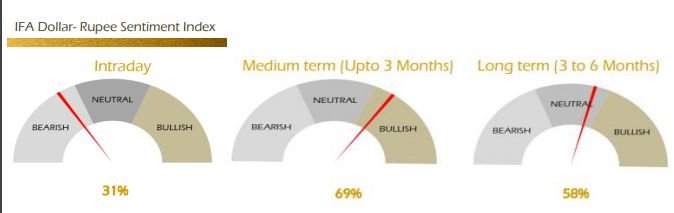
Nationalized banks who had been supporting USDINR were missing in action for most part of the session, causing a brisk move lower to 73.44. Nationalized banks stepped in towards the end of session to get USDINR to close at 73.66. We may see outflows related to MSCI index rebalancing today. The reaction function of the central bank will be interesting to see. We expect the Rupee to trade between 73.35-73.70 range. 

Strategy: Exporters are advised to build long term exposure in 74.60-75.50 range. Importers are advised to cover through options. The 3M range for USDINR is 73.00 – 75.40 and the 6M range is 73.00 – 76.00.
Chart

Download The Full Daily Currency Insight

Author

Abhishek Goenka

Abhishek Goenka

IFA Global

Mr. Abhishek Goenka is the Founder and CEO of IFA Global. He pilots the IFA Global strategic direction with a focus on relentlessly improving the existing offerings while constantly searching for the next generation of business excellence.


More from Abhishek Goenka
Share:

Editor's Picks

AUD/USD bulls regain control above 0.6950 amid USD retreat

AUD/USD regains traction and extends the previous day's bounce from the weekly low, aiming for 0.7000 in Asia on Friday. The overnight pullback in US bond yields keeps the US Dollar below an 18-month high, which in turn offers some support to the pair. Meanwhile, hawkish RBA expectations also keep the major underpinned.

USD/JPY holds gains near 158.00 after Japan's weak Household Spending data

USD/JPY clings to gains around 158.00 after data showed on Friday that Japan's Household Spending fell for the ninth straight month, undermining the Japanese Yen. Meanwhile, the US Dollar remains depressed as the overnight fall in US bond yields counters a hawkish Fed and geopolitical uncertainties, could cap any downside in the pair.

Gold remains range-bound below $4,200

Gold has given up some ground after an initial bullish attempt to reach weekly highs, returning to below the $4,200 mark per troy ounce on Friday. The US Dollar’s strong upside momentum, combined with rising US Treasury yields across the curve, seems to keep further gains in the yellow metal under scrutiny.

Has Bitcoin really escaped the macro forces it was built to fight?
Over 17 years ago, Satoshi Nakamoto designed Bitcoin (BTC) on the back of a global financial crisis as an alternative to the global monetary system outside the control of central banks, governments and traditional intermediaries. This raises a key question: has Bitcoin really become independent of the macroeconomic forces it was built to challenge?
The Euro is not the sick man of Europe. France's bond market is
EUR/USD remains under pressure, near the 17-month low of 1.1161 reached on Monday. The pair has lost more than 7% since its yearly peak, as concerns over France's public finances increasingly weigh on the single currency. But behind the weakness of the Euro (EUR), the problem does not necessarily lie with the European economy as a whole.
Has Bitcoin really escaped the macro forces it was built to fight?
Over 17 years ago, Satoshi Nakamoto designed Bitcoin (BTC) on the back of a global financial crisis as an alternative to the global monetary system outside the control of central banks, governments and traditional intermediaries. This raises a key question: has Bitcoin really become independent of the macroeconomic forces it was built to challenge?














