Commodities are flashing buy – And most traders will miss the move [Video]
![Commodities are flashing buy – And most traders will miss the move [Video]](https://editorial.fxsstatic.com/images/i/discover-51.png)
Every generation produces one market opportunity that looks obvious in hindsight – but is ignored, doubted or underestimated while the real money is still being made.
In the 1990s, it was Technology. After 2008, it was ultra-cheap Equities. In the 2020s, it’s Commodities.
Right now, one of the most powerful wealth creation opportunities of our lifetime may be unfolding in plain sight across Gold, Silver, Copper, Oil and Natural Gas. Yet most traders are still looking in the wrong direction.
They are crowded into stocks, chasing overhyped technology, sitting in cash or waiting for perfect confirmation that may only arrive after prices have already exploded higher.
That is the danger and the opportunity.
Commodities are not just another trade. They are the raw materials of global survival. They protect wealth, power economies, build infrastructure, fuel artificial intelligence, secure nations and underpin the entire financial system. Without energy, metals and hard assets, there is no AI revolution, no industrial expansion, no energy transition and no economic resilience.
Yet despite this, Commodities remain undervalued, underowned and dangerously mispriced. For traders paying attention, this could be the best entry point of the year.
“Most people only wake up to Commodities after the breakout has already happened,” says Lars Hansen, Head of Research at The Gold & Silver Club. “But the biggest opportunities are created before the crowd understands the scale of the move. That is where we believe the market is right now.”
The greatest market opportunities rarely appear when conditions feel comfortable. They emerge when prices are temporarily discounted, sentiment is cautious and the long-term fundamentals are getting stronger beneath the surface.
That is the setup Commodities may be offering now.
Inflation risk has not disappeared. Government debt is still climbing. Central banks are diversifying reserves. Supply chains remain fragile. Energy security is back at the centre of national policy. Artificial intelligence is creating a historic surge in electricity demand. Meanwhile, the world remains structurally short of critical metals, reliable energy supply and real assets.
This is not ordinary volatility. It is a potential accumulation window.
“When hard assets pull back during a structural bull market, seasoned traders do not panic,” Hansen says. “They prepare. The crowd sees uncertainty. Savvy traders see opportunity.”
Unlike paper assets, Commodities cannot be created instantly. Gold cannot be printed. Silver cannot be diluted. Copper mines cannot be built overnight. Oil fields require years of investment. Natural gas infrastructure demands huge capital, regulation and time.
Scarcity is not a theory. It is becoming the defining investment theme of this decade.
Gold remains the anchor of the hard-asset rotation. It is no longer simply a safe haven. It is becoming a monetary reset trade for a world drowning in debt, currency risk and geopolitical uncertainty.
“Gold is telling traders that confidence in paper promises is fading,” Hansen says. “Those who wait for perfect confirmation may discover that the best prices have already disappeared.”
Silver could be even more explosive. It carries the monetary appeal of precious metals, but also benefits from industrial demand linked to solar panels, electronics, electrification, batteries and advanced manufacturing.
“If gold is the wealth protection trade, Silver is the acceleration trade,” Hansen says. “The Silver market is smaller, tighter and far more sensitive to inflows. When momentum arrives, it can move fiercely.”
Then there is Copper – the metal the artificial intelligence revolution cannot function without.
AI is not only a technology story. It is an electricity story. Data centres require grids, transformers, cooling systems, cables and power infrastructure. Copper sits at the centre of it all.
“The AI boom cannot scale without Copper,” Hansen says. “The market has not fully priced that in.
The idea that Oil and Natural Gas are losing momentum may become one of the most expensive mistakes of this decade.
The world still needs energy. Aviation, shipping, logistics, agriculture, manufacturing, defence and power generation all depend on reliable supply. At the same time, Natural Gas is becoming increasingly important as electricity demand accelerates.
Energy transition has not removed the need for Oil and Gas. It has made energy security even more urgent.
“Energy is no longer just a Commodity story,” Hansen says. “It is a national security story. That is extremely bullish for traders who understand the setup.”
By the time Commodities become front-page news again, the easiest money may already have been made.
That is why this moment matters.
Commodities are cheap relative to the scale of the macro opportunity. They are underowned relative to the risks building across the world. They are essential to inflation protection, AI infrastructure, monetary security, industrial growth and geopolitical resilience.
This could be one of the greatest wealth creation opportunities of our lifetime.
Gold protects capital. Silver accelerates upside. Copper powers the future. Oil secures the global economy. Natural gas fuels the next electricity boom.
Together, they represent a rare Hard-Asset opportunity hiding in plain sight.
As Hansen puts it: “The question is not whether Commodities matter. The question is whether traders are positioned before everyone else finally wakes up.
This may be the best entry point of the year. The window is open right now. Do not miss it.
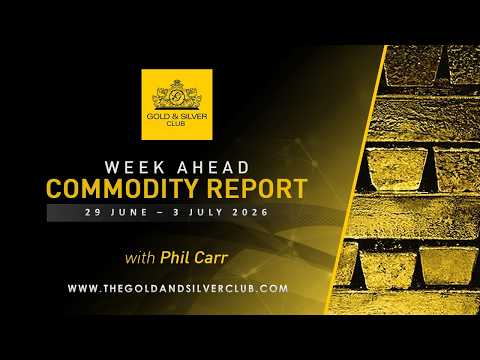
Where are prices heading next? Watch The Commodity Report now, for my latest price forecasts and predictions:
Author

Phil Carr
The Gold & Silver Club
Phil is the co-founder and Head of Trading at The Gold & Silver Club, an international Commodities Trading Firm specializing in Metals, Energies and Soft Commodities.