China sheds light on its 2025 fiscal policy focus

Markets have been long awaiting more details on China's fiscal policy specifics. A key document shows resources will be focused on supporting equipment renewal and consumption and looks to help China's economy further build on existing areas of strength.
Policymakers begin to flesh out the targets for fiscal stimulus
China's National Development and Reform Commission and Ministry of Finance have published a document outlining the government's plan to support large-scale equipment renewal and household consumption.
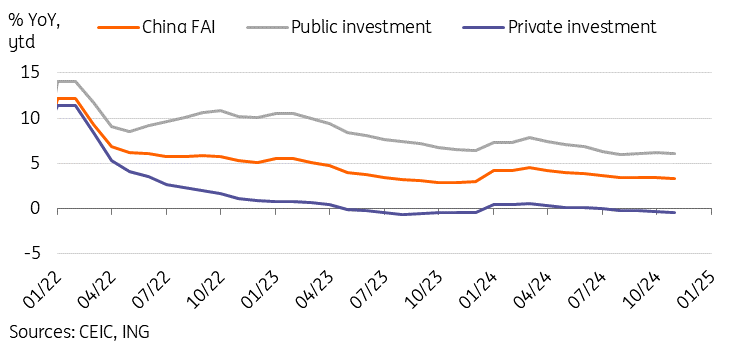
Amid very sluggish investment growth, the government will ramp up special treasury bond issuance to support equipment renewal. The support will take the form of investment subsidies and interest subsidies for equipment renewal loans. The support will continue for the current industries already benefiting from existing policies, such as energy, transportation, and logistics, but the document indicates that there will be further expansion of the industry coverage to include IT, manufacturing safety, and agriculture. The equipment renewal will focus on high-end, smart, and green equipment.
Furthermore, there was a focus on scrapping and renewal for ships, trucks, and agricultural machinery, as well as ramping up subsidies for battery renewal for electric-powered city buses, with subsidies set to rise from RMB 60,000 to RMB 80,000 in the case of some agricultural machinery and the city buses.
The document suggests that hi-tech industrial sectors, as well as transportation equipment manufacturing, are likely to be beneficiaries; these categories have been outperforming the broader economy, and continued policy support should allow these sectors to continue to build on solid momentum.
Investment appetite has been very weak amid cautious sentiment
Consumption will be supported by expansion of trade-in policies
There is also some good news for those who have been long awaiting measures to support consumption. Recent policy communication suggests that there will be a greater focus on supporting consumption this year, and the NDRC’s document provides some details on what form this will take.
The primary focus of the document published today is on ramping up trade-in policies.
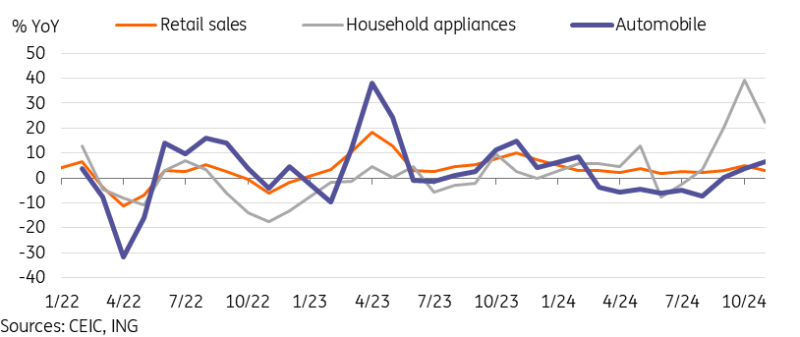
In 2024, these policies were almost wholly concentrated in household appliances as well as automobiles. The last several months of retail sales data have illustrated clear benefits in these subcategories as a result, and there is reason to believe that stronger support will continue to bear fruits for the sector. Those who took advantage of 2024 trade-in policies will still be eligible for the policies this year.
Importantly and as we previously expected, there was also an announced expansion of trade-in policies to other categories, including electronic devices and home renovation and decoration products. This expansion of trade-in policy categories should help broaden the consumption recovery, and in particular, given reports of a longer-than-expected replacement cycle, there should be some pent-up demand from consumers to upgrade electronic devices.
We expect that more policy support as well as a more favourable base effect will help retail sales growth rebound in 2025 compared to 2024, but we expect at most a modest acceleration, as household confidence remains very soft.
Trade-in policies helped target subcategories outperform headline growth in last few months
Policy support will decide whether China's economy can maintain momentum
Given the various high-level meetings and policy communiques over the past month, it appears a safe bet to expect more aggressive fiscal policy support from China in 2025, as well as continued monetary policy easing in the form of rate and RRR cuts.
There is the obvious and extensively discussed angle of a less favourable external environment with a high likelihood of additional tariffs and sanctions from the US once President Trump enters office. Another less discussed element is that there appears to be a greater consensus building domestically on the need for stronger policy support to shake the economy from its extended period of heightened pessimism.
Moving forward, it will be important to see how policymakers ultimately set 2025's growth target at this year's Two Sessions in March. As we covered in our 10 questions for China in 2025 piece, we think there is a high probability that policymakers will once again target growth of "around 5%" or at the least "above 4.5%" in order to send a message of confidence that China will be able to keep growth steady regardless of external challenges. If this is indeed the target, we expect we will see various policies roll out at a faster pace this year.
Read the original analysis: China sheds light on its 2025 fiscal policy focus
Author

ING Global Economics Team
ING Economic and Financial Analysis
From Trump to trade, FX to Brexit, ING’s global economists have it covered. Go to ING.com/THINK to stay a step ahead.

















