Brexit: Leaving is departure for the British pound
- Brexit is expected to be official on January 31st.
- UK PM Johnson's big win in UK Election was received with sterling euphoria.
- The European Union will need to prioritize avoiding a recession over hard-talk in future trade deal negotiations.
- Expect more pound upside for the upcoming year.

The United Kingdom will leave the European Union on January 31st, surrendering its voting rights in the organization and commencing a year of transition. During 2020, EU law will still run in the British Isles, nothing will change for citizens or businesses and the UK will be able to negotiate and sign trade deals with other nations.
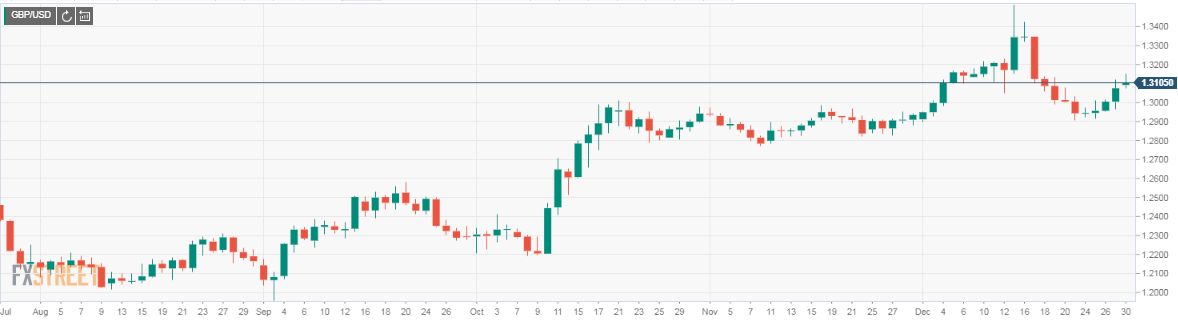
For the British pound, the most important date in the past three years was July 24th, when Boris Johnson became Prime Minister after winning the Conservative party vote, following the resignation of Theresa May.
Mr. Johnson’s success in renegotiating the exit deal with the EU brought about a eight-figure surge in the sterling from the close on October 9th at 1.2205 to 1.2985 on the 21st.
Despite the repeated and adamant assertions by the EU that substantive talks were finished and Michel Barnier’s condescending responses to Ms. May’s repeated entreaties for concessions, Mr. Johnson managed to secure what had been denied his predecessor.
The Prime Minister grasped what Ms. May denied, in the interest of good governance she said, that the EU had no reason to offer a deal acceptable to the Brexiteers in Parliament unless forced to do so.
First and foremost, Brussels wanted the Union, including the UK, intact. It was a long shot but there was always a chance that Ms. May’s failure to obtain a deal might end in a second referendum, one that Remain might win, or in a departure so weak as to be Remain in all but name. There was at least no downside in trying.
Second, simply as a negotiating assessment, the EU had, absent the threat of a no-deal exit, the stronger position. The UK was asking to retain all its preferential trading rights after leaving the Union but offering little but payment in return.
The UK came to the EU with its request, failing to realize that in the Brussels hierarchy of political desire a thwarted departure or in lieu of that a punitive one, ranked far higher than trade access for Mercedes, BMW, Armani and Saint-Emilion to the British market.
There are plentiful reasons why the EU wanted a humiliating divorce if it could have forced one.
Italy, Spain, France and even Germany have populist movements-so named for lack of a better term-that openly question the success and policies of the European Union. An acrimonious split with the UK might have discouraged its own domestic leavers from active advocacy, even if a continental divorce would be nearly prohibitive given the entwined financial arrangements after two decades of the united currency.
Matteo Salvini is Italy’s most popular politician and likely next Prime Minister. When Minister of the Interior he instituted immigration policies directly contravening Brussels dictates, exclusionary rules that are largely responsible for his popularity. In the past, he has been openly skeptical of the EU and the euro.
In Spain, Vox, founded in 2013 elected 52 deputies to the legislature in April 2019, gathering 10% of the national vote. Variously described as nationalistic and critical of multiculturalism, on the EU its leader Santiago Abascal argues that Spain should take back powers ceded to Brussels but has not backed Spanish exit from the EU.
In France, the ‘yellow vests’ movement and the current month-long union protest against pension reform have severely undermined the popularity and power of staunchly pro-EU President Emmanuel Macron.
In Germany, the rise of Alternative for Germany (AfD) to prominence in the 2017 national election with its third-place finish continued with second results in state elections in Saxony and Brandenburg in 2019. Described by critics as nationalistic, anti-immigration and euro-skeptic, AfD has seen an astonishing success since its founding in 2013. Like its Spanish, Italian and French colleagues, it has tapped veins of cultural and economic unease long dismissed or ignored by the established parties.
Having failed to prevent the UK from leaving, the EU’s attitude toward the trade relationship to be negotiated this year will evolve. Faced with massive populist dissension in each of its major national components, Brussels will recognize, if its national capitals do not already, that the greatest immediate threat to unity is no longer Brexit but recession.
Nothing will fuel anti-EU sentiment like a prolonged economic downturn.
The continental pretension that a no-deal Brexit was only a threat to the UK economy was always tissue-thin, a distractive veil thrown over the UK talks.
A disruptive departure of the UK would throw the EU into recession. Waiting and barely in the wings are the populist politicians and movements for whom unemployment in Italy, Spain and France are potent themes. So far, their rhetoric has mostly skirted the EU issue, noting the weak national economies but yet disguising the costs of the autonomy that has been ceded to the EU.
The one thing the Union cannot afford is a Brexit recession. No one is likely to be more forceful in that advice than Christine Lagarde, the new President of the ECB. She has already made clear that fiscal, not monetary, remedies are needed.
Sterling will rise and fall in the year ahead with the reports of the negotiations, but it should become clear by the second quarter that the EU needs to complete the talks, arrange the deal and move onto its own burgeoning economic and political problems.
The Sterling euphoria on the election triumph of the Boris Johnson and the Conservatives will be just a signpost on the rise of sterling in 2020.
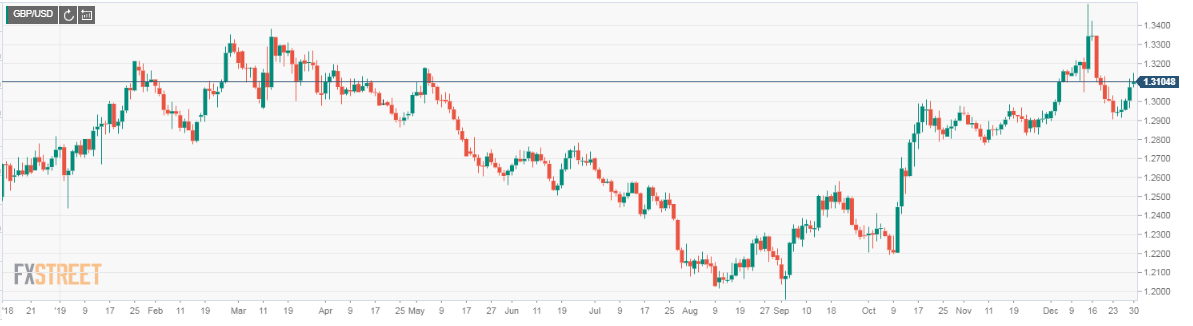
For the EU and the pound, leaving is departure. Brussels’ desire to prevent the UK from exiting has failed and the far more pressing need is to prevent departure from becoming the recessionary coda to the Union itself.
This article belongs to the 20 trading ideas for 2020 series. Check the full list of 2020 pieces.
Author

Joseph Trevisani
FXStreet
Joseph Trevisani began his thirty-year career in the financial markets at Credit Suisse in New York and Singapore where he worked for 12 years as an interbank currency trader and trading desk manager.