Bitcoin, the future or just a gamble?

Bitcoin (ticker: BTC) has been around since late 2008 but it only started making the news in early 2013. It is a Cryptocurrency and a payment system; its main advantage being that transactions are anonymous and peer-to-peer (i.e. made directly without an intermediary). Bitcoin’s unique architecture is set-up in such a way that their creation (or “mining”) gets progressively more resource-intensive and total production will be limited to 21 million Bitcoins.
It’s certainly an interesting concept with many advantages but also some important disadvantages. For example:
Given its pseudonymous nature and that Bitcoin address owners are not explicitly identified, such transactions are effectively anonymous. However, this anonymity has been known to attract transactions from illegal activities, the best-known example being that of the Silk Road website. This has been a problem with regulators and officials, as they recognise it as a medium for illegal transactions.
Bitcoin has been recognised as currency in many countries and as of today it’s the most liquid & widely accepted crypto currency in the world. However, there is a long list of alternate crypto currencies that are eager to grab market share and challenge Bitcoin’s dominance. And what about the 21 million Bitcoin limit? It’s possible that once that ceiling becomes severely limiting, users will turn to other crypto currencies, effectively increasing the global supply.
Bitcoin trades continuously on exchanges around the world in a very quick and straightforward manner, and it is conveniently stored electronically in “wallets”. However, having online wallet providers introduces an extra risk factor that cannot be ignored. One such example is the security breach at Mt. Gox in 2011, which sent shockwaves in the crypto currency community. At the time, Mt. Gox was handling around 70% of all Bitcoin transactions and one day it declared that around 850,000 Bitcoins had been stolen. Soon after the exchange suspended trading and filed for bankruptcy. It’s this potential security vulnerability that makes many people sceptical when it comes to crypto currencies.
Recent Price Action
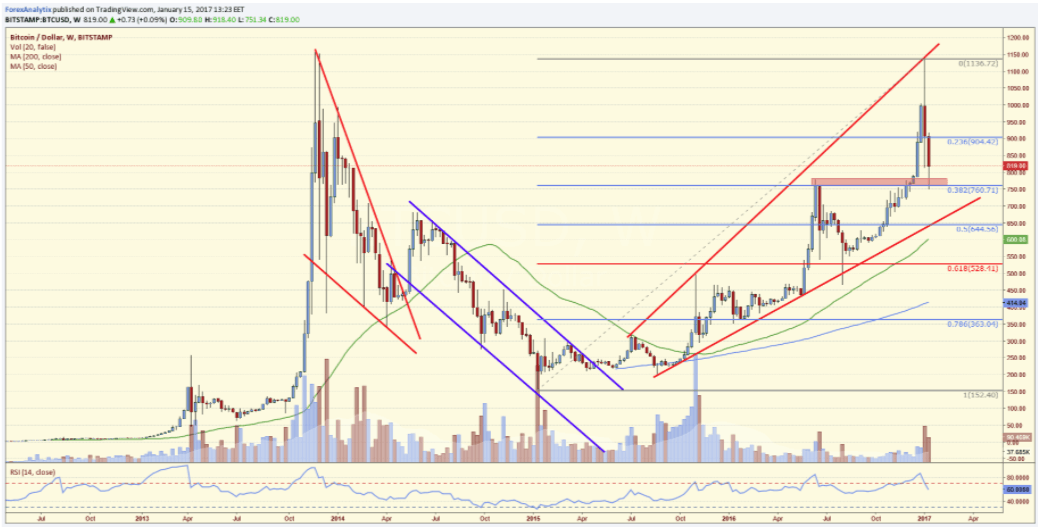
Bitcoin price has been very volatile since early 2013 when it was trading between $10 and $15, and soon afterwards it went on a parabolic rise to hit a high of $1163 within the same year. It spent the next 18 months dropping all the way back down to the $200s but then went on the ascent again as global uncertainty persisted.
It made the news once again in late 2016 when there was a China-led buying spree, mainly from people trying to escape the Yuan’s devaluation. Its simplicity, anonymity and transaction ease made it a very popular choice among the Chinese. In early 2017 it almost hit an all-time high, peaking at $1140 and at that point the Chinese central bank made an important announcement. The CB said that it wanted to investigate Bitcoin transactions in market manipulation, money laundering and unauthorised financing. At time of writing BTC is trading at $828, which represents a staggering 2-week drop of over 37%.
What does the future hold for Bitcoin?
So what’s next for Bitcoin? As outlined previously, it has many advantages and for this reason it will remain relevant as a currency. The vast majority of BTC transactions by volume are made in China so the two will remain interlinked.
We see the biggest risk to Bitcoin being its substitution and/or parallel use by other crypto currencies. Bitcoin die-hard fans claim that this is never going to be an issue since Bitcoin was the pioneer and as such enjoys first-mover privilege. This argument is probably flawed because although the BTC is used for payments, this is only a relatively small % of all Bitcoins. One of its primary uses is being a store of value and for this reason other crypto currencies can always step in and enjoy similar status if aggregate demand requires it.
Is Bitcoin simply a 21st century version of gold, only without the storage issues? Or is it just a short-lived popular fad that may soon evolve into something quite different? Only time will tell. The only certainty is that its price will remain very volatile in the future.
Author

Stelios Kontogoulas
Forex Analytix
Stelios was fascinated by computers from a very young age and went on to study Computer Science at Imperial College. Following a 5-year IT consulting career (having worked for Accenture among others), he felt unfulfilled and wanted to make a change.