Australian Dollar Price Forecast: Losses mitigated by the RBA’s hawkish hold
- AUD/USD clocks its fifth consecutive daily pullback, easing below the 0.6500 mark.
- The US Dollar keeps its march north unabated, hitting fresh highs vs. its rivals.
- The RBA delivered a hawkish hold, leaving its OCR at 3.60%, as widely expected.
The Australian Dollar (AUD) carried Monday’s gloomy tone into Tuesday, pushing AUD/USD back below the 0.6500 mark and to new two-week troughs.
This marks the pair’s fifth straight daily decline, once again driven by a stronger US Dollar (USD) as traders weigh the odds that the Federal Reserve (Fed) might hold off on rate cuts at its December meeting.
Meanwhile, uncertainty around the still unresolved US federal government shutdown continues to sour risk sentiment, keeping the Greenback underpinned.
Australia: resilience with a few cracks showing
Australia’s economy isn’t exactly booming, but it’s proving more resilient than expected. The October PMIs painted a mixed picture: manufacturing slipped back below 50 to 49.7 (from 51.4), while services improved slightly to 53.1 (from 52.4).
Additionally, Retail Sales rose 1.2% in June, and the August trade surplus narrowed only slightly to A$1.25 billion. Business investment picked up in Q2, helping GDP grow 0.6% on the quarter and 1.1% on a yearly basis. It’s not spectacular, but it does show there’s still some underlying momentum.
That said, the labour market is starting to show a few signs of fatigue. Unemployment edged up to 4.5% in September (from 4.3%), and job growth slowed to 14.9K. Nothing alarming yet, but the pace of hiring seems to be cooling.
RBA keeps it cool
The Reserve Bank of Australia (RBA) held rates steady at 3.60% for a second consecutive meeting earlier on Tuesday, just as markets expected. The decision was unanimous and came with a clear signal: the RBA isn’t in a hurry to move either way.
The central bank acknowledged slightly firmer inflation pressures and still sees the labour market as relatively tight, despite a small rise in unemployment. Governor Michele Bullock described policy as “pretty close to neutral” and said there’s no clear bias toward tightening or easing.
She also noted that the 75 basis points of cuts already delivered haven’t fully filtered through the economy yet. Policymakers will stay alert to any signs that demand is running ahead of supply. For now, markets expect only about 3 basis points of easing by the December 9 meeting, and roughly 13 basis points by early 2026
China still sets the tone
Australia’s outlook remains tied to China’s economic pulse. Chinese GDP grew 4.0% in the year to Q3, while retail sales rose 3.0% over the same period. Still, PMI figures were mixed, as manufacturing stayed below 50, and services hovered near that line.
The trade surplus narrowed from $103.33 billion to $90.45 billion in September, while CPI remained negative at –0.3% YoY in September. Earlier last month, the People’s Bank of China (PBoC) left its Loan Prime Rates (LPR) unchanged at 3.00% (one-year) and 3.50% (five-year), as expected.
Technical outlook
The Aussie Dollar remained on the back foot in the area of two-week lows, largely in response to dynamics around the US Dollar, while the hawkish hold by the RBA somewhat limited the losses.
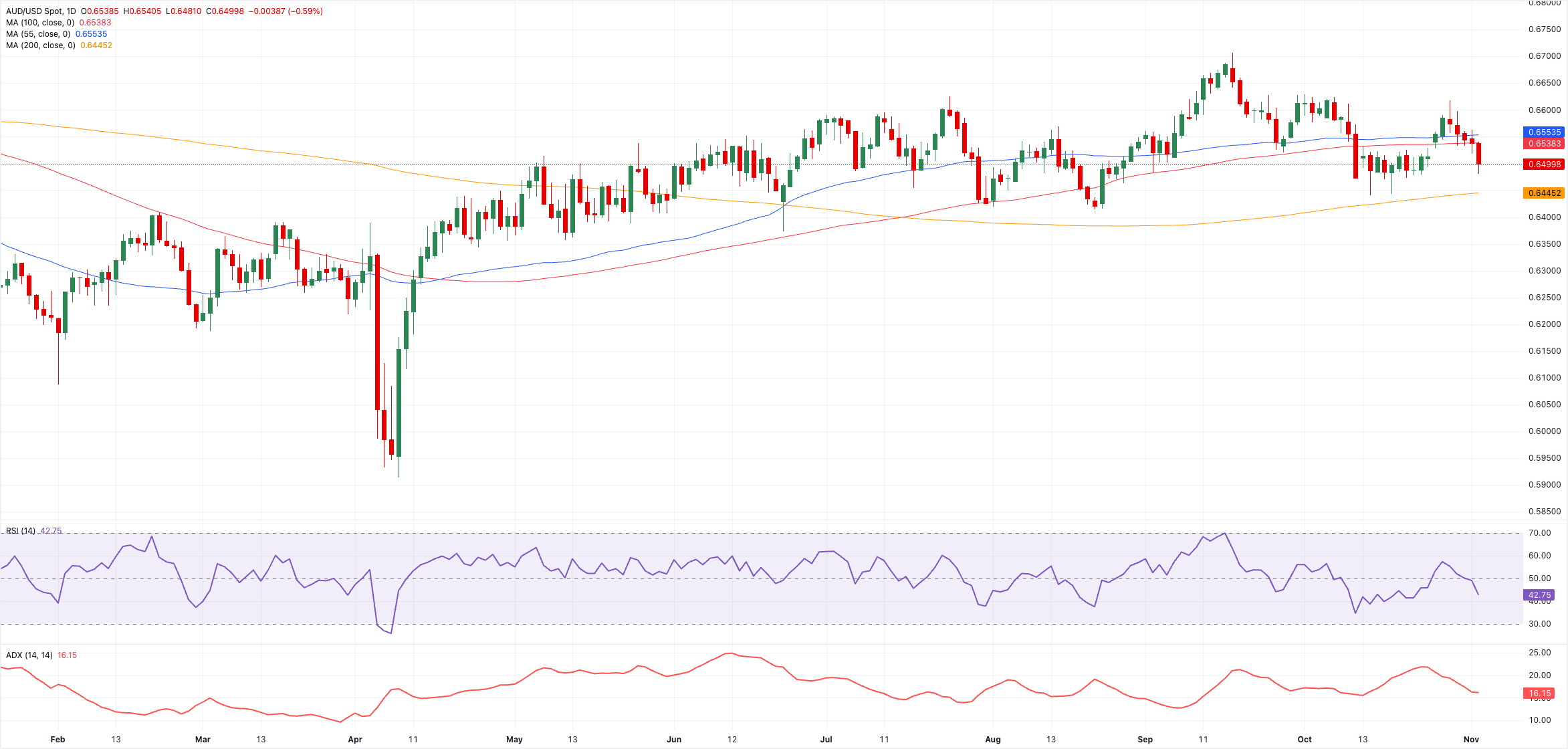
The continuation of the selling bias could motivate AUD/USD to retest its critical 200-day SMA at 0.6443, just above the October base at 0.6440 (October 14). Extra losses could pave the way for a move toward the August valley at 0.6414 (August 21), before the June trough of 0.6372 (June 23).
Occasional bullish attempts, on the other hand, should challenge the October peak of 0.6629 (October 1). Once cleared, the pair could head toward the 2025 top of 0.6707 (September 17), followed by the 2024 ceiling at 0.6942 (September 30), and the 0.7000 threshold.
Momentum indicators keep pointing southwards: the Relative Strength Index (RSI) loses further ground and approaches 43, suggesting room for further downside. In addition, the Average Directional Index (ADX) around 16 indicates a trend that lacks juice.
AUD/USD daily chart
The bottom line
For now, AUD/USD remains stuck in a 0.6400–0.6700 range, waiting for a clear catalyst, whether from China’s data, the Fed’s next step, the RBA’s tone, or a shift in the broader US–China trade backdrop.
RBA FAQs
The Reserve Bank of Australia (RBA) sets interest rates and manages monetary policy for Australia. Decisions are made by a board of governors at 11 meetings a year and ad hoc emergency meetings as required. The RBA’s primary mandate is to maintain price stability, which means an inflation rate of 2-3%, but also “..to contribute to the stability of the currency, full employment, and the economic prosperity and welfare of the Australian people.” Its main tool for achieving this is by raising or lowering interest rates. Relatively high interest rates will strengthen the Australian Dollar (AUD) and vice versa. Other RBA tools include quantitative easing and tightening.
While inflation had always traditionally been thought of as a negative factor for currencies since it lowers the value of money in general, the opposite has actually been the case in modern times with the relaxation of cross-border capital controls. Moderately higher inflation now tends to lead central banks to put up their interest rates, which in turn has the effect of attracting more capital inflows from global investors seeking a lucrative place to keep their money. This increases demand for the local currency, which in the case of Australia is the Aussie Dollar.
Macroeconomic data gauges the health of an economy and can have an impact on the value of its currency. Investors prefer to invest their capital in economies that are safe and growing rather than precarious and shrinking. Greater capital inflows increase the aggregate demand and value of the domestic currency. Classic indicators, such as GDP, Manufacturing and Services PMIs, employment, and consumer sentiment surveys can influence AUD. A strong economy may encourage the Reserve Bank of Australia to put up interest rates, also supporting AUD.
Quantitative Easing (QE) is a tool used in extreme situations when lowering interest rates is not enough to restore the flow of credit in the economy. QE is the process by which the Reserve Bank of Australia (RBA) prints Australian Dollars (AUD) for the purpose of buying assets – usually government or corporate bonds – from financial institutions, thereby providing them with much-needed liquidity. QE usually results in a weaker AUD.
Quantitative tightening (QT) is the reverse of QE. It is undertaken after QE when an economic recovery is underway and inflation starts rising. Whilst in QE the Reserve Bank of Australia (RBA) purchases government and corporate bonds from financial institutions to provide them with liquidity, in QT the RBA stops buying more assets, and stops reinvesting the principal maturing on the bonds it already holds. It would be positive (or bullish) for the Australian Dollar.
Author

Pablo Piovano
FXStreet
Born and bred in Argentina, Pablo has been carrying on with his passion for FX markets and trading since his first college years.

















