AUD/USD Weekly Forecast: The RBA and the Fed coming with surprises under their sleeves
- Central banks’ tightening cycle kick-started, the focus is now the pace of easing.
- The yield on the Australian April 2024 bond soared above 0.70%.
- AUD/USD is still poised to advance in the long term but may correct lower before recovering

The AUD/USD pair advanced for a fifth consecutive week to reach a three-month high of 0.7555, now trading a handful of pips below that level. The pair reached the high on Thursday, following the release of tepid US growth-related figures, as the country grew at an annualized pace of 2% in the three months to September, down from 6.7% in the previous quarter.
Wall Street rallying to record levels underpinned the aussie, as investors speculated that a poor US economic performance may force the Federal Reserve to take tapering with a pinch of salt. Inflation figures point in the same direction, as on Friday, the US released the annual core Personal Consumption Expenditures Price Index, which held steady at 3.6% in September. PCE inflation is the Fed’s favorite measure of price pressures, and a stable reading takes off the pressure from policymakers.
Tapering coming, but to what extent?
The US central bank is meant to have a monetary policy meeting next week and announce the outcome on Wednesday, November 3. Back in September, chief Jerome Powell anticipated that they could begin a gradual tapering process at their next summit, with the Minutes of the meeting indicating the central bank would probably start by cutting $10 billion a month in Treasuries and $5 billion a month in mortgage-backed securities.
Australian inflation unexpectedly soared in the third quarter of the year, with the RBA Trimmed Mean Consumer Price Index jumping to 2.1% from 1.6% in the previous quarter. Despite the Reserve Bank of Australia repeating it would not touch rates at least until 2024, market participants rushed to price in a move in tightening sooner.
The global tightening cycle kick-started with Canada, as the country put an end to its pandemic-facility program this past week, a much more aggressive move than what the market expected. It’s clear that other major central banks will soon follow such a path while juggling with supply chain bottlenecks and economic growth losing momentum.
Critical headlines coming up next
Other macroeconomic figures coming from Australia were encouraging, as Retail Sales bounced in September, up by 1.3%, much better than the 0.2% expected. The Q3 Producer Price Index came in at 2.9%, worse than the previous 2.2% but below the 3.2% expected.
The upcoming week will start with China publishing the official October NBS PMIs. The manufacturing index is foreseen at 52.9, while the services one is expected at 49.7. Australia will release the official AIG Performance of Manufacturing Index for September, previously at 51.6.
On Tuesday, Australia will release October TD Securities Inflation, while the RBA will announce the outcome of its Monetary Policy meeting. Market participants believe policymakers will officially drop the yield curve control regime after the central bank declined to defend its 0.1% target for the April 2024 bond, as it soared beyond 0.7%. Global near-term bond yields soared these days while long-term yields retreated, with the flattening curves sounding alarms among investors.
Beyond the Fed’s meeting, the US calendar will include the official ISM PMIs, with the Manufacturing index foreseen at 60.4 and the Services one at 61.5, both slightly below their September readings. On Wednesday, the country will publish the ADP survey on private job creation, while by the end of the week, the country will unveil the October Nonfarm Payroll report. Following the terrible September headline number of 194K, the country is expected to have added 385K new job positions, while the Unemployment Rate is foreseen steady at 4.8%.

AUD/USD technical outlook
The weekly chart for the AUD/USD pair points to a continued advance, as the pair has kept advancing beyond all of its moving averages, although with the 20 SMA still heading south. The longer moving averages lack directional strength, converging around 0.7200. At the same time, technical indicators maintain modest bullish slopes after crossing their midlines into positive levels.
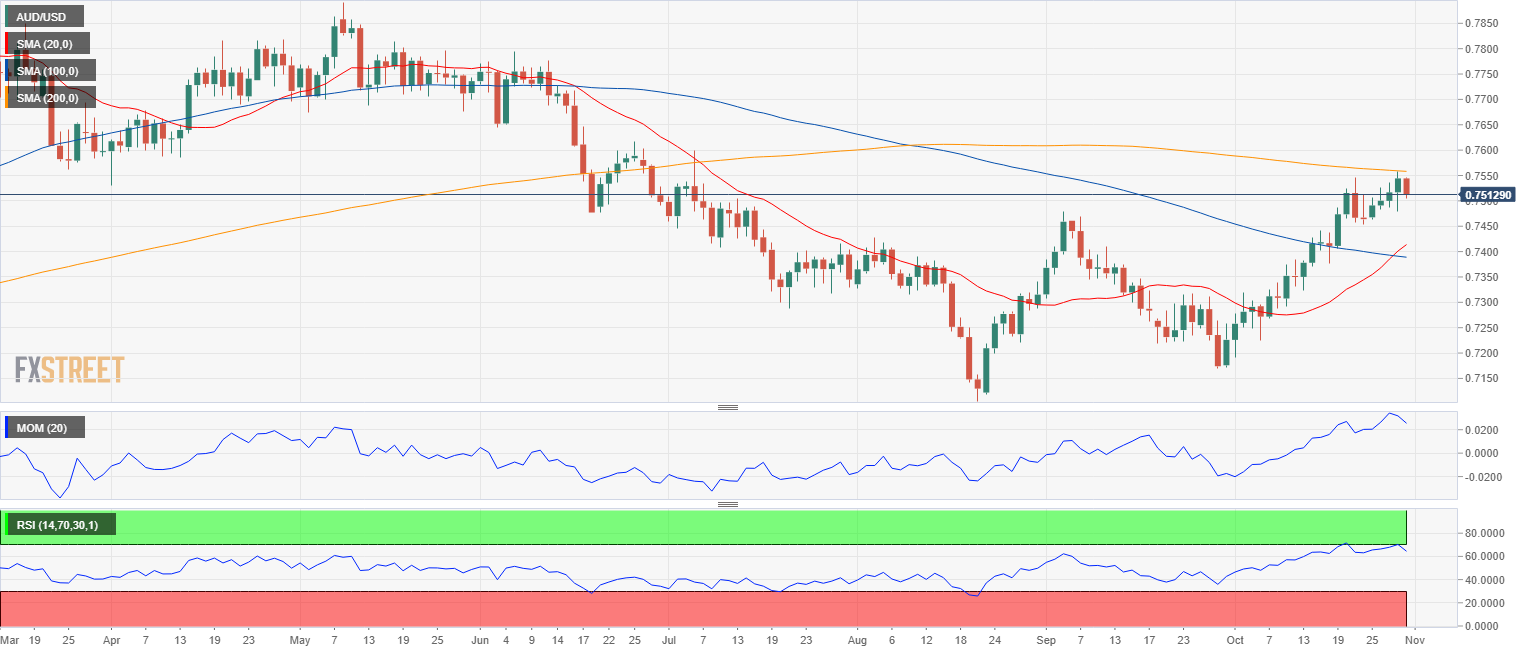
The daily chart shows that the pair met sellers twice this week around a flat 200 SMA, although the 20 SMA is crossing above the 100 SMA, usually a sign of strengthening buying interest. On the other hand, technical indicators are retreating from near overbought readings, reflecting the current retracement instead of suggesting an upcoming decline.
Bulls will retain their control as long as the pair holds above 0.7470. A break below the latter could see the pair falling towards 0.7400 first and 0.7330 later. Beyond the monthly high at 0.7550, the pair could extend gains initially towards 0.7610, en route to the 0.7700 figure.
AUD/USD sentiment poll
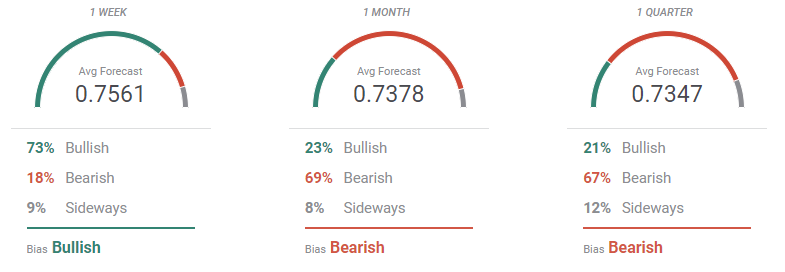
According to the FXStreet Forecast Poll, the AUD/USD pair will retain its positive momentum in the near term, as 73% of the polled experts are betting for higher levels, with the pair seen on average at 0.7561. The market’s sentiment takes a U-turn in the monthly and quarterly perspectives, with bears accounting for over 60% in both cases and the pair seen falling to the 0.73 area.
The Overview chart shows that the near term moving average maintains its bullish slope, with most targets accumulating around 0.7600, while the longer moving averages have turned flat. In the monthly view, most targets accumulate in the 0.71/0.73 region, while in the longer-term perspective there is a wide range of possible targets, although with an increased number of experts eyeing an approach to the 0.7000 price zone.
Related Forecasts:
EUR/USD Weekly Forecast: All eyes on Fed’s tapering and US employment data
GBP/USD Weekly Forecast: Duo of central banks and Nonfarm Payrolls promise wild action
Author

Valeria Bednarik
FXStreet
Valeria Bednarik was born and lives in Buenos Aires, Argentina. Her passion for math and numbers pushed her into studying economics in her younger years.