EUR/USD Weekly Forecast: All eyes on Fed’s tapering and US employment data
- The ECB maintained its monetary policy unchanged and failed to cool down inflation concerns.
- Tepid growth in the US cooled down expectations for aggressive tapering.
- EUR/USD has failed to sustain gains above a critical Fibonacci resistance level at 1.1670.

The EUR/USD pair trades in the 1.1600 price zone after hitting a fresh October high of 1.1691 on Thursday. The shared currency received some attention following the release of dismal US growth-related data and the European Central Bank monetary policy announcement, although mixed European figures and a flattening yield curve in the US put a cap on the EUR’s advance.
Long term US government bond yields kick-started the week with a soft tone, accelerating their decline as days went by. The benchmark on the 10-year Treasury note fell to 1.51%, while that on the 2-year bond surged above 0.50%. A narrowing spread usually hints at a rate-hiking cycle but also suggests slowing economic growth.
The gap between near-term and long-term bond yields is not exclusive to the US. The situation is similar in Germany, the UK, Canada and Australia, particularly when comparing 5-year and 30-year bond yields.
Central banks are facing mounting inflationary pressures amid post-pandemic supply chain issues and soaring energy prices, while at the same time, economic recoveries are losing momentum. Tighter monetary policies could be a double edge sword, and global policymakers have tried hard to down talk inflation-related concerns to no avail.
ECB down, Fed to go
The ECB had its meeting, while the US Federal Reserve will do so next week, announcing the outcome on Wednesday, November 3. The European Central Bank left its monetary policy unchanged as anticipated, while the accompanying statement was quite similar to the previous one.
The focus was on President Christine Lagarde’s press conference. Lagarde insisted that inflation will likely be temporary and decrease next year. However, when asked about what they have been discussing these days, her answer was "inflation, inflation, inflation," somehow indicating that policymakers are far more concerned than what they appeared. The EU Consumer Price Index reached a 13-year high of 4.1% YoY in October, while the German Consumer Price Index jumped to 4.6% YoY in the same month.
She also said that she believes the Pandemic Emergency Purchase Program (PEPP) will end on March 2022 as initially planned, adding that no rate hikes are to be expected throughout 2022. “What comes next, we will discuss in December,” she noted.
Meanwhile, the US published Q3 Gross Domestic Product, which posted an annualized 2.0% advance, missing the market’s expectations of 2.7% and below the previous 6.7%. The economic deceleration was blamed on slowing consumer spending and supply chain concerns, coupled with the resurgent number of covid cases in the country in the three-month to September. The unexpected result of a dismal report was Wall Street rallying to record highs, as speculative interest rushed to price in less aggressive tapering coming from the US Federal Reserve.
Also, the country released the annual core Personal Consumption Expenditures Price Index, which held steady at 3.6% in September. PCE inflation is the Fed’s favorite measure of price pressures.
Across the pond, German Q3 GDP came in at 1.8% QoQ, below the 2.2% expected, while the EU reading printed 2.2%, matching the Q2 figure and above the 2.0% forecast.
Busy calendar in the US up next
The first week of November will be a busy one in terms of macroeconomic releases. The US will publish the official ISM PMIs, with the Manufacturing index foreseen at 60.4 and the Services one at 61.5, both slightly below their September readings. On Wednesday, the country will publish the ADP survey on private job creation, while the US Federal Reserve will announce its decision on monetary policy. The central bank is expected to announce the tapering of its $120 billion in monthly bond purchases, aiming to finish it by mid-2022. US policymakers have made it clear that reducing financial facilities is a preliminary step before lifting rates, although rate hikes should not be taken for granted once the program ends.
Also, the US will publish the October Nonfarm Payroll report. Following the terrible September headline number of 194K, the country is expected to have added 385K new job positions, while the Unemployment Rate is foreseen steady at 4.8%.
On the other hand, Germany will publish September Retail Sales, Factory Orders and Industrial Production, all of which are meant to give clues on the local economic health. The EU will have a lighter calendar, with the focus on the European Commission Economic Growth Forecasts and September Retail Sales.

EUR/USD technical outlook
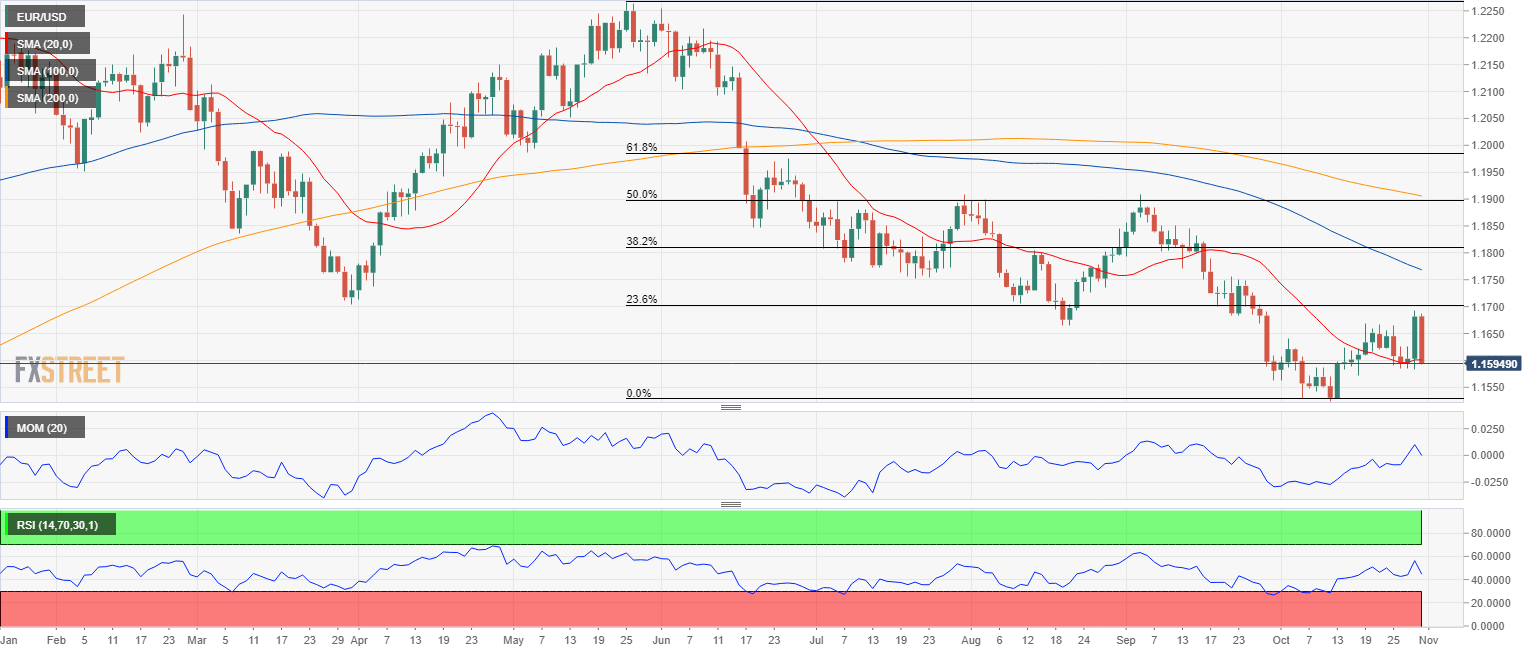
The EUR/USD pair is closing the week pretty much unchanged after advancing in the previous two. The pair has limited bullish potential in the long term, as it keeps trading below the 38.2% retracement of its 1.1908/1.1523 decline at 1.1670, and around the 23.6% retracement at 1.1615.
The weekly chart shows the exchange rate has settled above its 100 and 200 SMAs, with the shorter crossing above the longer one. However, the 20 SMA keeps heading firmly south above the current level and converging with the 61.8% retracement of the mentioned slide at 1.1760. Meanwhile, technical indicators keep lacking directional strength within negative levels, reflecting the absence of buying interest.
Technical readings in the daily chart hint at an upcoming decline amid decreasing bulls’ interest. The chart shows that EUR/USD is currently developing above a flat 20 SMA, while the longer moving averages maintain their firmly bearish slopes far above the current level. The 100 DMA converges with the mentioned 61.8% retracement, further reinforcing the static resistance level. Finally, technical indicators remain within positive levels but have already rotated to the downside, reflecting increased selling interest.
Below 1.1570, the pair has room to retest the year low at 1.1523, while a break below the latter exposes a long-term static support area at around 1.1470. Failure to sustain gains above 1.1670 now means the pair will need to clear the 1.1760 Fibonacci resistance level to gain bullish traction.
EUR/USD sentiment poll
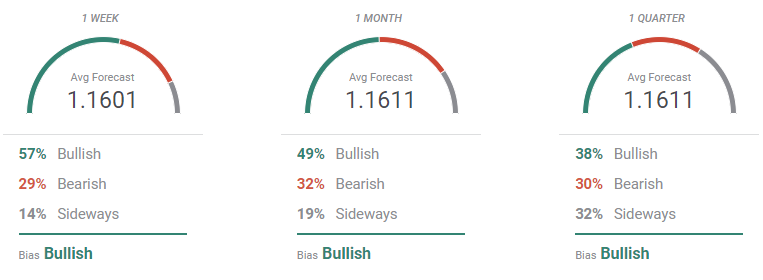
The FXStreet Forecast Poll indicates that the sentiment is bullish, as the number of bulls outpaces that of bears in the three time-frame under study. Still, and on average, the pair is seen barely holding above the 1.1600 threshold.
The Overview chart shows that the weekly and monthly moving averages are flat, although in the wider perspective most targets are set between 1.16 and 1.18. The longer moving average has turned marginally higher, but there is a large accumulation of possible targets between 1.12 and 1.16, hinting at fresh year lows.
Related Forecasts:
GBP/USD Weekly Forecast: Duo of central banks and Nonfarm Payrolls promise wild action
Author

Valeria Bednarik
FXStreet
Valeria Bednarik was born and lives in Buenos Aires, Argentina. Her passion for math and numbers pushed her into studying economics in her younger years.