AUD/USD Weekly Forecast: Can bulls retake the lead?
- Plummeting US Treasury yields pressured the greenback and boosted risk appetite.
- March Australian upbeat employment data hid a nasty secret.
- AUD/USD has shrugged off its long-term negative bias, but bulls still have to wait.

Risk appetite took over financial markets this week, pushing AUD/USD firmly up. The pair topped 0.7760 heading into the weekend, trading a handful of pips below the level. Major currencies were once again driven by US government bond yields.
It’s all about yields, still
US Federal Reserve chief Jerome Powell repeated ad exhaustion that the central bank will maintain its ultra-loose monetary policy until actual data confirms an economic comeback and not just based on forecasts. However, something new on the matter surged this week. Chief Powell suggested that tapering would come “well before” considering a rate hike. The central bank has been buying $80 billion in Treasuries and $40 billion in mortgage-backed securities on a monthly basis to counter the effects of the pandemic on the financial system.
US Treasury yields plunged as bonds’ prices surged, to the detriment of the dollar’s demand. Furthermore, upbeat US data spurred risk appetite across financial markets, also playing against the American currency. Wall Street surged to record highs after US Retail Sales and employment-related data fueled expectations of a sooner global recovery from the pandemic slump.
Australian economy progresses toward recovery
Meanwhile, the Australian economy quietly moves forward. Data released this week showed that raw material exports to China remain high despite tensions between the two countries over the origins of COVID-19. China reported a narrower-than-expected March trade surplus of $13.8 billion in March, as Australian iron ore exports surged in the month. Australia is the largest supplier of iron ore to China, and while higher commodity prices have benefited the country, Beijing hinted this week at plans to strengthen controls on raw material markets to limit rising costs.
Australia will reopen its borders with New Zealand next week but will likely maintain the closure of other international borders, as coronavirus cases are on the rise outside the country, pretty much globally. Prime Minister Scott Morrison said that it is not safe to reopen international borders, adding that even vaccinating the local population is not enough to grant lifting travel restrictions. Anyway, immunization in the country is choppy and moving slowly, as opposed to the US, which has given put almost 200 million doses, with 37.9% of the population having received at least one shot.
Economic data spurs optimism
Other Australian macroeconomic figures released this week were encouraging but tricky. Westpac Consumer Confidence jumped from 2.6% to 6.2% in April, while the monthly employment report showed that the economy added 70.7K new jobs in March. However, the economy created 91.5K part-time positions and lost 20.8K full-time ones. April Consumer Inflation Expectations contracted to 3.2% from 4.1% in March.
As said, US data impressed market players, as March Retail Sales jumped by 9.8%, while weekly unemployment claims contracted to 576K. Also, inflation in the same month was up 0.6% MoM and 2.6% YoY, largely surpassing the market’s expectations.
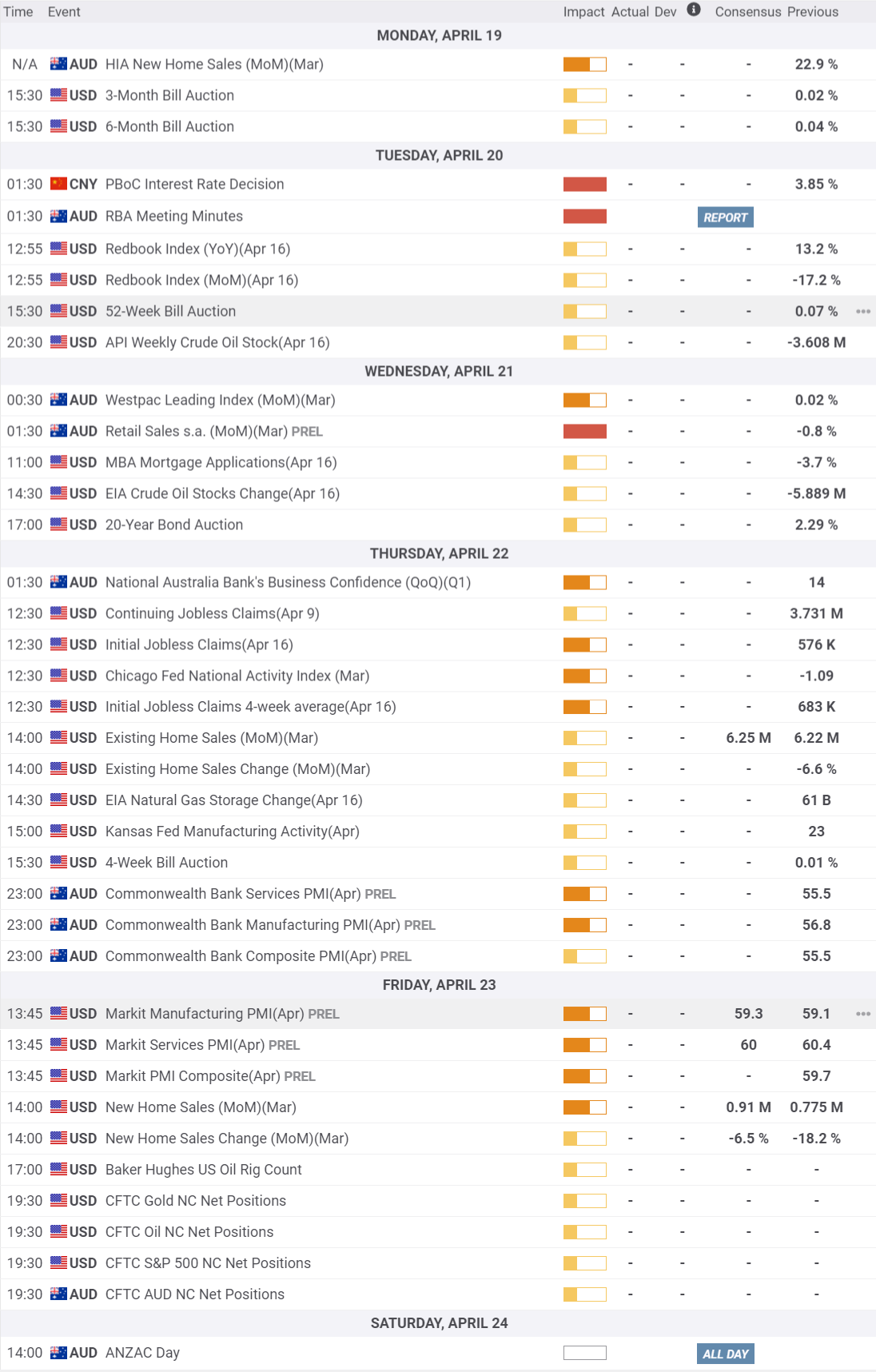
Next week, the Reserve Bank of Australia will publish the Minutes of its latest meeting. The Asian country will publish the March Westpac Leading Index, the preliminary estimate of March Retail Sales, and Q1 NAB’s Business Confidence. By the end of the week, Australia will release the preliminary estimates of the April Commonwealth Bank PMIs.
The US macroeconomic calendar will be quite light, as it won’t offer relevant data until Thursday when the country will publish March Existing Home Sales and weekly unemployment figures. On Friday, Markit will release the preliminary estimates of April PMIs.
AUD/USD technical outlook
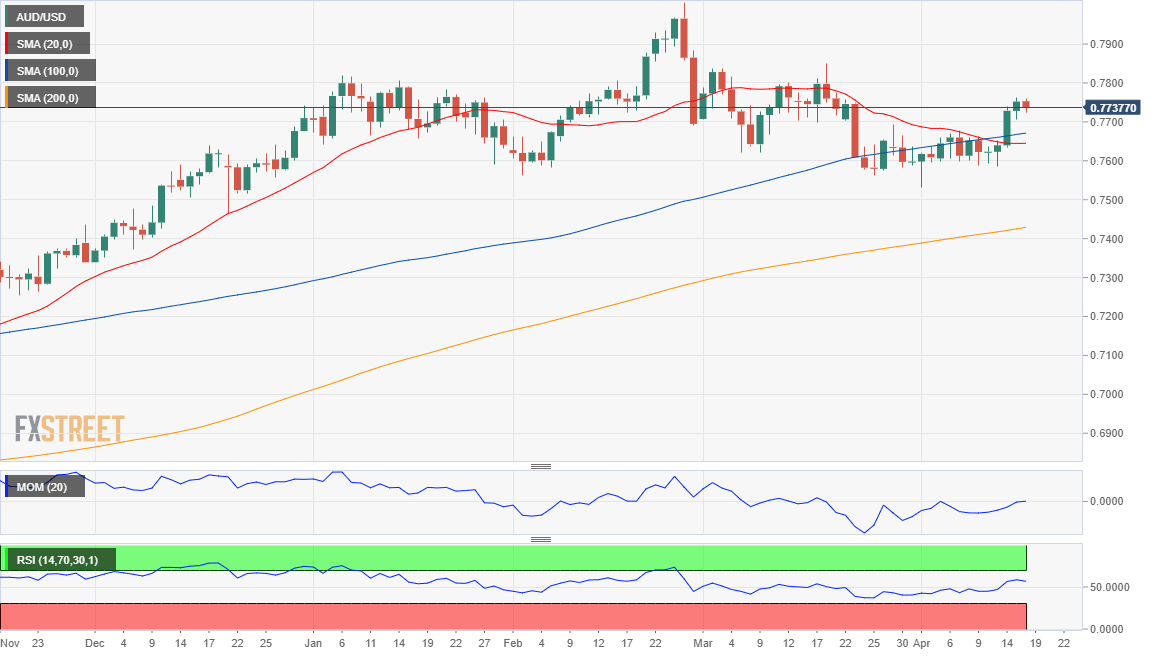
The AUD/USD pair has shrugged off its long-term bearish stance, although it may take some further upside progress before calling a steeper recovery. The weekly chart shows that the pair has managed to recover above a bullish 20 SMA, while the longer ones remain directionless, well below the current level. Technical indicators have gyrated north, with the Momentum holding below its midline and the RSI currently at 60.
On a daily basis, bulls retain the lead. The AUD/USD pair is ending the week well above its 20 and 100 DMAs, although the shorter one maintains its bearish slope just below the 100 SMA, both in the 0.7640/60 region. Technical indicators have advanced within positive levels, losing directional strength but consolidating weekly gains.
The pair is near but just below a critical static resistance level at 0.7770. Once above it, the pair could easily reach the 0.7820 area, while beyond this last, the pair can reach the 0.7900 figure. Bulls will retain the lead as long as the pair holds above 0.7660. Below the level, the next relevant supports are 0.7600 and 0.7531.
AUD/USD sentiment poll
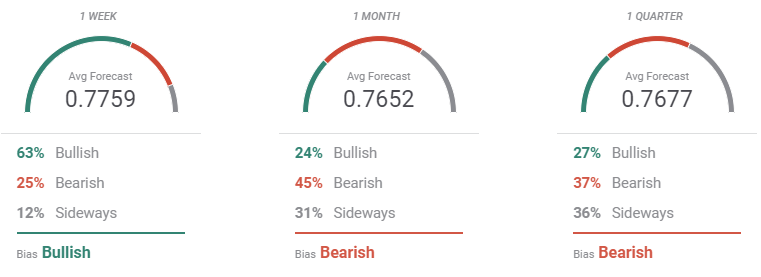
Bulls are in control of AUD/USD according to the FXStreet Forecast Poll, although that scenario is not meant to last. Bulls dominate the weekly perspective with an average target of 0.7759, while bears are a majority in the monthly and quarterly views, but in both cases represent less than 50% of the polled experts.
The Overview chart shows that moving averages are picking up jut modestly, overall maintaining the neutral stance. However, most potential targets accumulate at the higher end of the range, between 0.7600 and 0.8000, somehow indicating that bulls won’t give up easily.
Related Forecasts:
GBP/USD Weekly Forecast: Sterling's recovery hinges on top-tier UK data, further Fed speculation
Author

Valeria Bednarik
FXStreet
Valeria Bednarik was born and lives in Buenos Aires, Argentina. Her passion for math and numbers pushed her into studying economics in her younger years.