AUD/USD Price Forecast: Extra losses likely below 0.6630
- AUD/USD added to Friday’s pullback and broke below 0.6500.
- The US Dollar traded well on the defensive on US political news.
- The 200-day SMA near 0.6630 continues to cap bullish moves.

The US Dollar (USD) made a sharp reversal at the start of the week, giving back a significant portion of last week’s gains after President-elect Donald Trump appointed Wall Street veteran S. Bessent as the next US Treasury Secretary.
Despite this development, the Australian Dollar (AUD) struggled to regain momentum, extending last week’s losses and dipping back below the critical 0.6500 support level.
In contrast to the USD's decline, prices for key Australian exports such as copper and iron ore started the week on a weaker note. This added pressure to the AUD amid lingering scepticism about China’s economic stimulus measures and their potential impact on Australian exports.
Earlier this month, the Reserve Bank of Australia (RBA) kept interest rates steady at 4.35%, reaffirming its commitment to controlling inflation while voicing concerns about slowing economic growth. Governor Michele Bullock emphasised the importance of maintaining tight monetary policy until inflation demonstrates consistent and sustainable improvement.
There were some encouraging signs on the inflation front. The Consumer Price Index (CPI) for September fell to 2.1%, while annual inflation for Q3 eased to 2.8%. However, the RBA has made it clear that one quarter of positive data is not sufficient to justify cutting rates.
Looking ahead, the AUD/USD pair could find support if the Federal Reserve (Fed) pivots toward a rate cut. Nevertheless, uncertainties persist, including potential inflation risks from US policy changes and the USD’s ongoing strength.
China’s economic slowdown continues to pose challenges for the AUD, even as Australia’s labour market shows resilience. October’s unemployment rate remained steady at 4.1%, with 16,000 jobs added, offering some reassurance for the domestic economy.
Regarding the RBA’s policy outlook, markets anticipate a cautious stance. A potential quarter-point rate cut is projected for Q2 2025, contingent on sustained progress in reducing inflation. The RBA has emphasized the need for consistent improvement before altering its current approach.
On the positioning side, the latest CFTC report revealed that non-commercial speculators remained net buyers of the AUD in the week ending November 19, pushing net longs to a six-week high of around 31.5K contracts, alongside an acceptable rise in open interest.
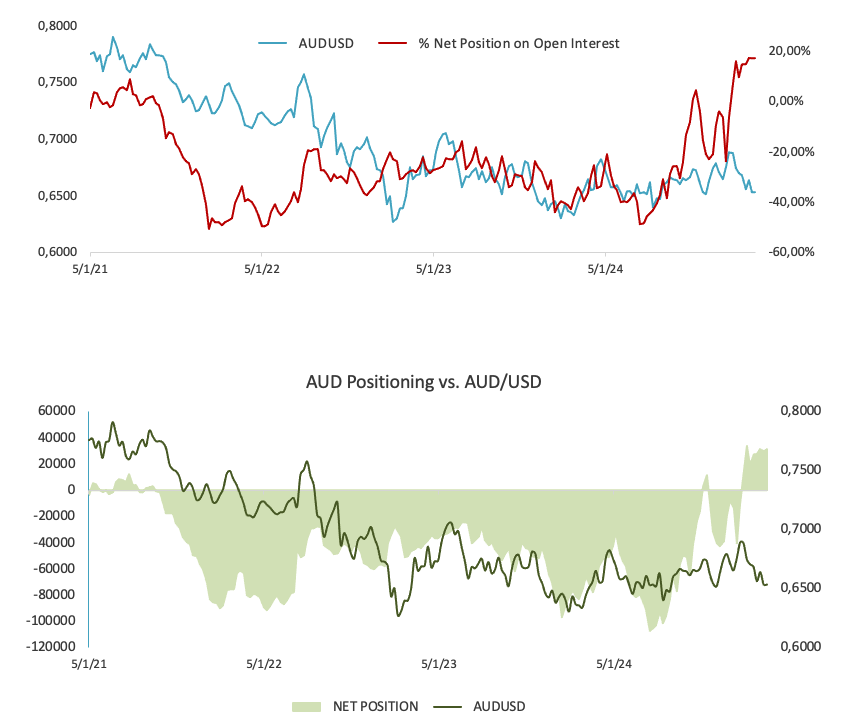
Domestically, the focus turns to key events this week. The RBA’s Monthly CPI Indicator is set for release on November 27, followed by Private Capital Expenditures and a speech by Governor Michele Bullock on November 28.
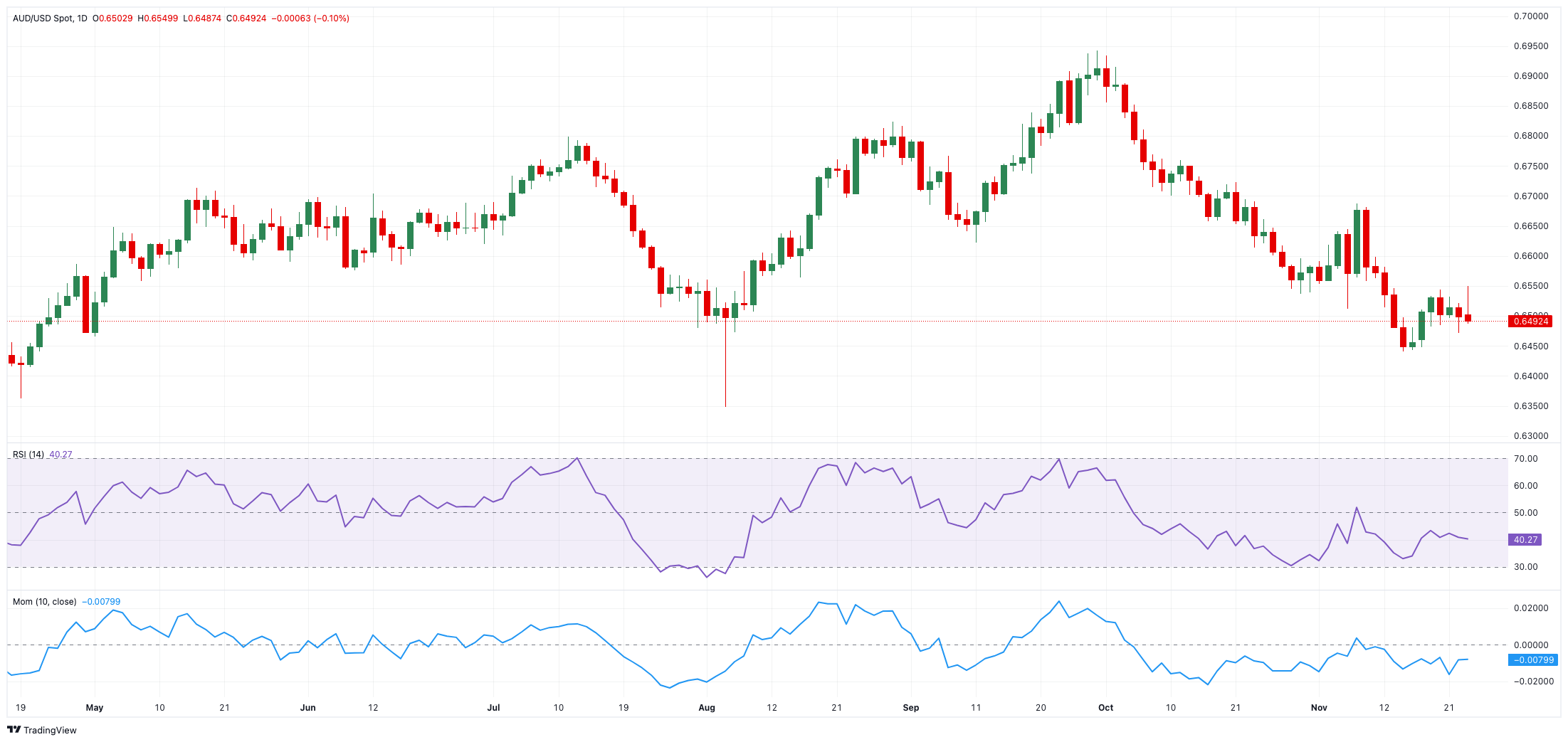
Technical Outlook for AUD/USD
In the medium term, assuming bulls regain control, the next resistance level is the 200-day SMA at 0.6628, then the November high of 0.6687 (November 7), which is still supported by the interim 100-day SMA.
On the other hand, the initial support comes from the November low of 0.6440 (November 14), which precedes the 2024 bottom of 0.6347 (August 5).
The four-hour chart reveals an erratic consolidative phase. The initial support is 0.6484, which comes before 0.6440 and 0.6347. The initial resistance level is projected to be 0.6549, ahead of the 200-SMA at 0.6601. The RSI plummeted to around 45.
Author

Pablo Piovano
FXStreet
Born and bred in Argentina, Pablo has been carrying on with his passion for FX markets and trading since his first college years.