|

AUD/USD Forecast: trapped between USD weakness and nose-diving equities

AUD/USD Current price: 0.7097

  • Australia's Melbourne Institute consumer inflation expectations' gauge remained at 4.0% in October.
  • AUD/USD developing a double bottom at 0.7040, neckline of the figure at 0.7130, the weekly high.
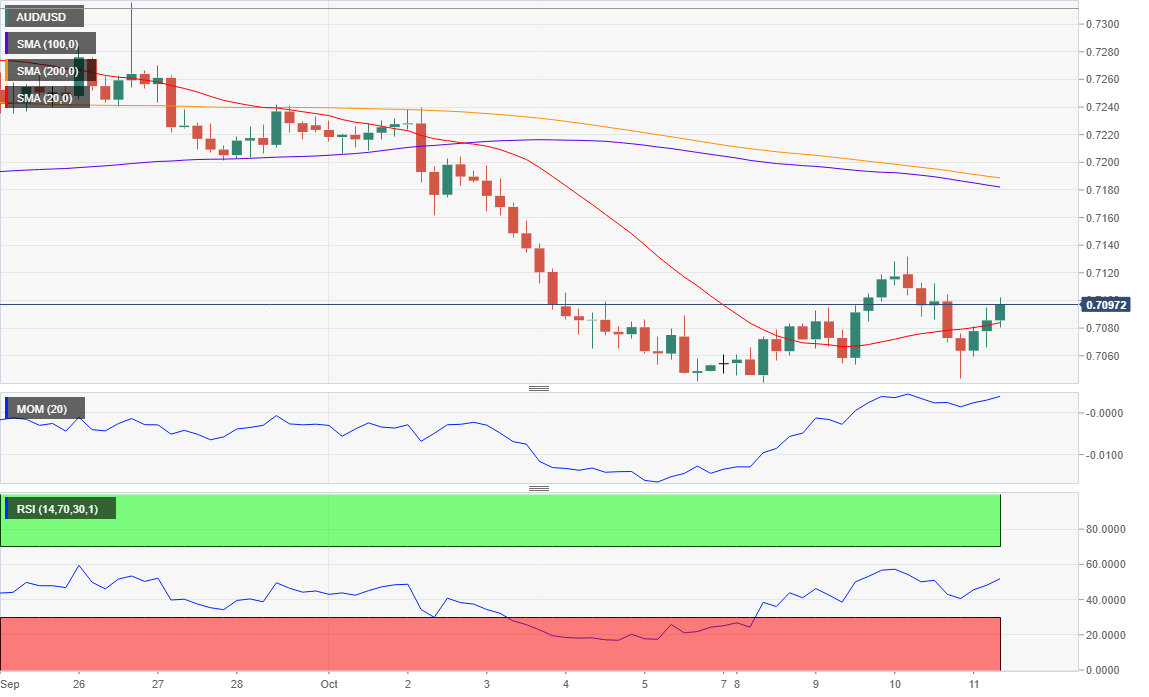
The AUD/USD pair fell to 0.7042 late Thursday amid nose-diving equities, recovering from such low, despite the risk-off mood prevailed through the Asian session and extended into the European opening. The Australian Melbourne Institute consumer inflation expectations' gauge remained at 4.0% in October, according to the overnight release, failing to boost the pair, as the bounce from the mentioned low seems more related to technical causes, given that the 0.7040 level is the yearly low. Despite still trading in the red, European indexes are off their daily lows, while base metals are firmly up amid easing US Treasury yields, all of which helps the pair further up, now nearing the 0.7100 figure.

The greenback remains weak in all fronts ahead of the release of US September inflation data, expected to have advanced within familiar levels, up by 0.2% MoM and by 2.4% YoY. Initial Jobless Claims for the week ended October 5 are expected to come at 206K from the previous 207K. The figures, however, have little chances of affecting prices.

The pair could be developing a double bottom at 0.7040 with the neckline of the figure being this week high of 0.7130. The short-term picture leans the risk toward the upside, as the pair recovered above the 23.6% retracement of its latest decline, now the immediate support at 0.7085, while the Momentum indicator bounced from its 100 level, as the RSI consolidates around 52. Struggling with the 0.7100, a more solid advance could be expected on a break above 0.7140, the 50% retracement of the mentioned decline.

Support levels: 0.7085 0.7040 0.7010  

Resistance levels: 0.7140 0.7175 0.7200

View Live Chart for the AUD/USD

Author

Valeria Bednarik

Valeria Bednarik was born and lives in Buenos Aires, Argentina. Her passion for math and numbers pushed her into studying economics in her younger years.


More from Valeria Bednarik
Share:

Editor's Picks

USD/JPY stays below 160.50 as markets assess BoJ decision

USD/JPY fluctuates in a relatively narrow range above 160.00 on Tuesday as markets assess the Bank of Japan's (BoJ) decision to raise the policy rate by 25 at the June meeting. Meanwhile, investors keep a close eye on news coming out of the Middle East, while preparing for the critical Fed meeting.

AUD/USD trades in tight channel near 0.7050 despite hawkish RBA message

AUD/USD trades modestly lower on the day at around 0.7050 on Tuesday as markets adopt a cautious stance amid a lack of details surrounding the US-Iran peace agreement. The Reserve Bank of Australia (RBA) left the door open for possible policy tightening after leaving the interest rate unchanged, as expected, at the June meeting but failed to boost the Australian Dollar.

Gold trims gains, approaches $4,300

Gold now surrenders part of its initial advance and recedes to the vicinity of the $4,350 mark per troy ounce on Tuesday. The early enthusiasm sparked by the US-Iran peace deal has faded somewhat, prompting investors to adopt a more prudent stance as they await further details of the agreement and key guidance from the Fed.

Why a hawkish RBA is no longer enough to lift the Australian Dollar

The Reserve Bank of Australia delivered more than what markets expected: a hawkish hold that should have supported the Aussie. But markets widely ignored it.

BoJ just hiked and US-Iran deal is on the table: Why Japanese Yen is still around 160.00

The Bank of Japan lifted interest rates from 0.75% to 1.00%, its highest level in more than three decades. The landmark move aims to stabilize a sharply weakening Japanese Yen, but by looking at the immediate market reaction, it doesn’t look like it’s going to work.

Why a hawkish RBA is no longer enough to lift the Australian Dollar

The Reserve Bank of Australia delivered more than what markets expected: a hawkish hold that should have supported the Aussie. But markets widely ignored it, focusing instead on slowing economic growth and proving that central bank messaging alone isn’t always enough to drive currencies.