AUD/USD Forecast: Dollar dynamics continued to drive the price action
- AUD/USD extended the recovery past 0.6500.
- Further USD-selling helped the pair regain momentum.
- The Australian jobs report came in on the soft side.

The Australian dollar moved further up and surpassed the key 0.6500 barrier vs. the US Dollar (USD) on Thursday, gaining nearly a cent since Tuesday’s yearly lows in the 0.6440 region. Further gains in AUD/USD came on the back of the intense sell-off in the Greenback, which prompted the USD Index (DXY) to retest the 104.20 zone.
The rebound in AUD/USD on a daily basis coincided with a negative session for the US Dollar as investors continued to reassess the likelihood of the Federal Reserve initiating an easing cycle in June. This perspective gained further traction following resilient US inflation data in January and appears to have remained unchanged in spite of weak US Retail Sales for the month of January.
Furthermore, the pair managed well to leave behind disheartening prints from the domestic labour market after the jobless rate unexpectedly ticked higher to 4.1% and the Employment Change increased by a meagre 0.5K individuals.
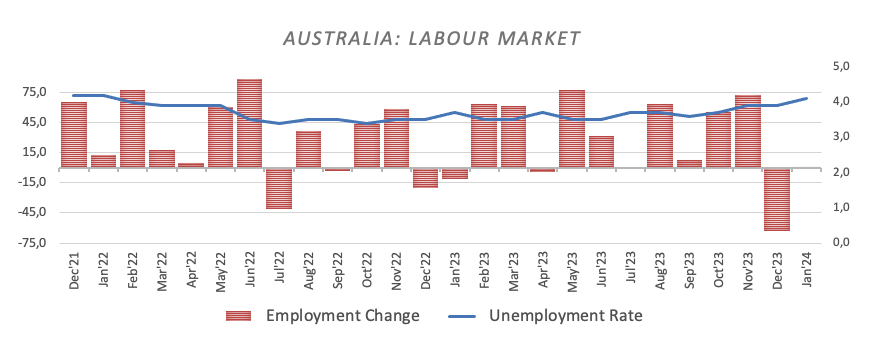
However, the current unemployment rate remains comfortably within the full-employment range estimated by the RBA, which is between 4.0% and 5.75%. This justifies the bank’s decision to not discard the possibility of further interest rate increases. Despite this, the market sentiment suggests that there will be no more interest rate hikes, while there is a 95% probability that the first rate cut will occur in August.
Following the RBA's February meeting, where it maintained a hawkish stance, it appears that the bank's restrictive position could somewhat constrain downside potential in the spot market for the time being, all helped by the still tight labour market in Australia and dwindling inflationary pressures.
Furthermore, it's worth noting that the RBA's Statement on Monetary Policy (SoMP) revised the bank's inflation forecasts downward, projecting both indicators to remain below 3% by the fourth quarter of 2025. Additionally, the RBA adjusted its GDP growth projections lower, reflecting a less optimistic outlook for short-term consumer spending and housing investments.
Despite the pair's ongoing recovery, Tuesday's notable pullback to new yearly lows suggested the potential for further short-term weakness in the AUD. This is influenced by factors such as movements in the US Dollar, weakness in copper and iron ore prices, and persistent uncertainties surrounding the Chinese economy.
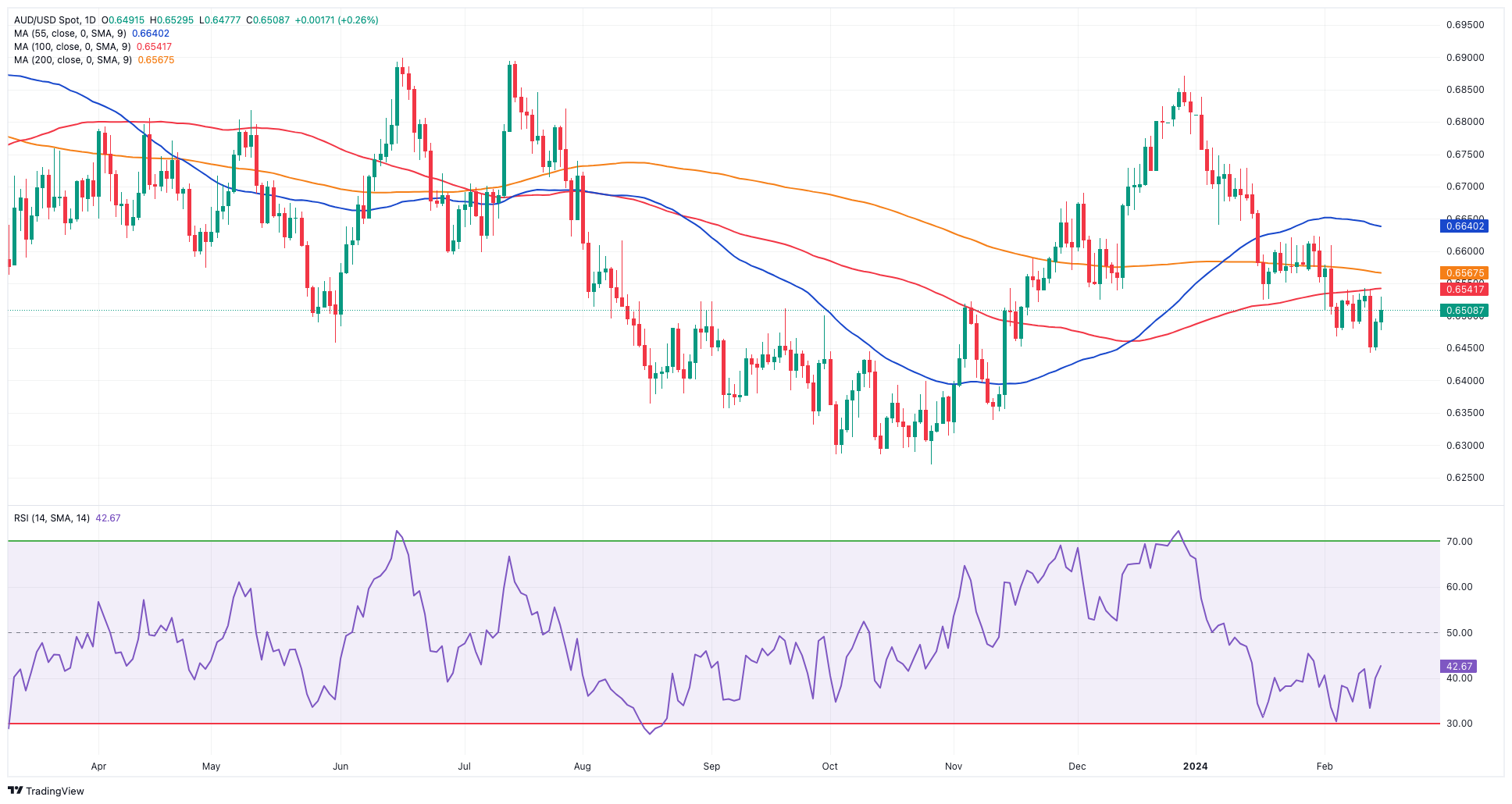
AUD/USD daily chart
AUD/USD short-term technical outlook
The resumption of selling pressure may cause the AUD/USD to initially test its 2024 bottom of 0.6452 (February 13). Breaching this level may result in a retest of the 2023 low of 0.6270 (October 26), seconded by the round level of 0.6200 and the 2022 low of 0.6169 (October 13).
On the upside, the important 200-day Simple Moving Average (SMA) at 0.6565 is the next goal to watch, followed by the temporary 55-day SMA at 0.6633. A break above this range might push the pair to attempt the December 2023 high of 0.6871 (December 28), followed by the July 2023 top of 0.6894 (July 14) and the June 2023 peak of 0.6899 (June 16), all before the critical 0.7000 yardstick.
It's worth noting that for the AUD/USD to experience more short-term gains, it must convincingly surpass the critical 200-day SMA.
The 4-hour chart shows signs of the continuation of the recovery in the near-term horizon. Against that, initial resistance is at 0.6610, which appears reinforced by the 200-SMA (0.6603). Surpassing this zone signals a possible move toward 0.6728. Meanwhile, a breach of 0.6442 might result in a drop to 0.6347 and then 0.6338. The MACD approached the positive zone, while the RSI soared over 61.
Author

Pablo Piovano
FXStreet
Born and bred in Argentina, Pablo has been carrying on with his passion for FX markets and trading since his first college years.