|

AUD/USD Forecast: Declines limited as long as above 0.6865

AUD/USD Current Price: 0.6890

  • Chinese encouraging data and a deal with the US keeping Aussie underpinned.
  • AUD/USD needs to extend gains beyond 0.6930/40 to turn bullish.
The AUD/USD pair has recovered some ground at the beginning of the week but has been unable to recover the 0.6900 threshold, despite encouraging developments in the US-China trade front and prevalent risk-appetite. Australia released the December preliminary Commonwealth Bank Services PMI, which printed at 49.5, better than the 49.1 expected although below the previous one. The Manufacturing PMI, however, missed the market’s expectations as it contracted to 49.4. China released encouraging numbers, as, in November, Industrial Production rose by 6.2% while Retail Sales increased by 8%, both beating the market’s expectations.

Australia will release October Home Loans during the upcoming Asian session, foreseen up by 1.0% following a 1.4% advance in September. The RBA will release the Minutes of its latest meeting.

AUD/USD short-term technical outlook

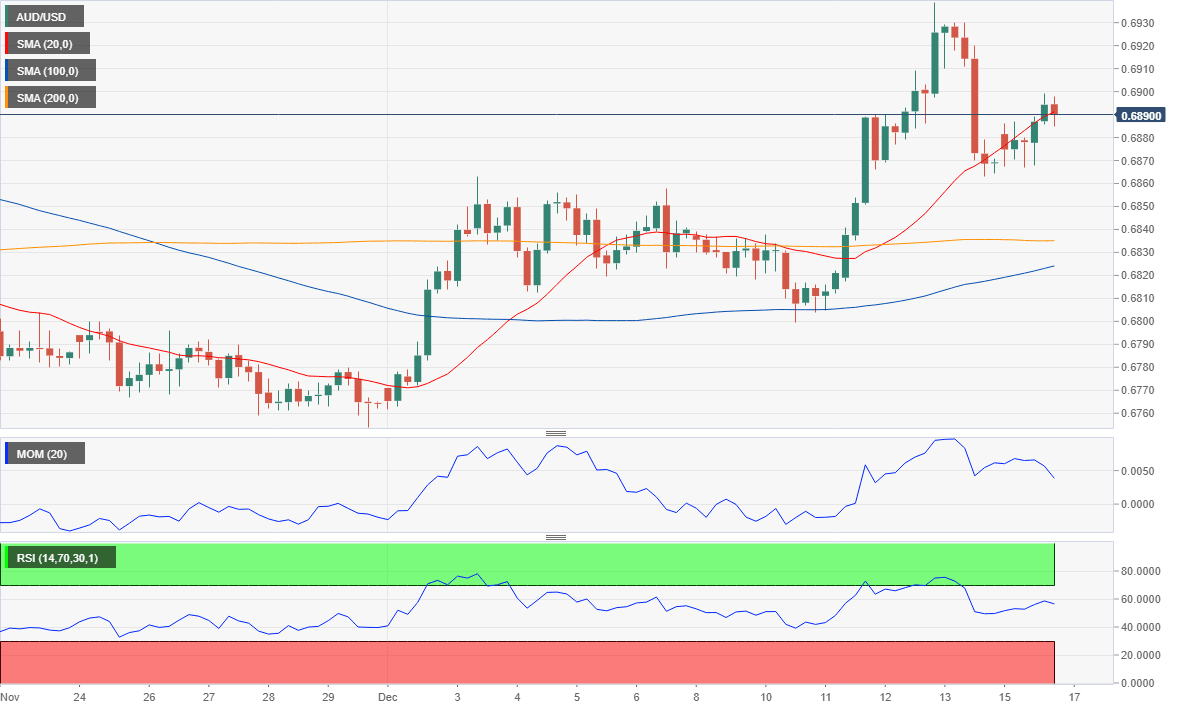
The AUD/USD pair is neutral-to-bullish in the short-term, as, in the 4-hour chart, it held above the 0.6865 support level. In the 4-hour chart, the pair has spent the day struggling to hold above a bullish 20 SMA, which continues advancing above the larger ones. Technical indicators, however, have lost their directional strength, heading nowhere around their midlines. Chances of a bullish extension will increase on a clear advance beyond the 0.6930/40 price zone, where the pair has multiple relevant highs.

Support levels: 0.6865 0.6830 0.6800

Resistance levels: 0.6900 0.6935 0.6970  

View Live Chart for the AUD/USD

Author

Valeria Bednarik

Valeria Bednarik was born and lives in Buenos Aires, Argentina. Her passion for math and numbers pushed her into studying economics in her younger years.


More from Valeria Bednarik
Share:

Editor's Picks

EUR/USD weakens to near 1.1900 as traders eye US data

EUR/USD eases to near 1.1900 in Tuesday's European trading hours, snapping the two-day winning streak. Markets turn cautious, lifting the haven demand for the US Dollar ahead of the release of key US economic data, including Retail Sales and ADP Employment Change 4-week average.

GBP/USD stays in the red below 1.3700 on renewed USD demand

GBP/USD trades on a weaker note below 1.3700 in the European session on Tuesday. The pair faces challenges due to renewed US Dollar demand, UK political risks and rising expectations of a March Bank of England rate cut. The immediate focus is now on the US Retail Sales data. 

Gold sticks to modest losses above $5,000 ahead of US data

Gold sticks to modest intraday losses through the first half of the European session, though it holds comfortably above the $5,000 psychological mark and the daily swing low. The outcome of Japan's snap election on Sunday removes political uncertainty, which along with signs of easing tensions in the Middle East, remains supportive of the upbeat market mood. This turns out to be a key factor exerting downward pressure on the safe-haven precious metal.

Bitcoin Cash trades lower, risks dead-cat bounce amid bearish signals

Bitcoin Cash trades in the red below $522 at the time of writing on Tuesday, after multiple rejections at key resistance. BCH’s derivatives and on-chain indicators point to growing bearish sentiment and raise the risk of a dead-cat bounce toward lower support levels.

Follow the money, what USD/JPY in Tokyo is really telling you

Over the past two Tokyo sessions, this has not been a rate story. Not even close. Interest rate differentials have been spectators, not drivers. What has moved USD/JPY in local hours has been flow and flow alone.

Bitcoin Cash trades lower, risks dead-cat bounce amid bearish signals

Bitcoin Cash (BCH) trades in the red below $522 at the time of writing on Tuesday, after multiple rejections at key resistance. BCH’s derivatives and on-chain indicators point to growing bearish sentiment and raise the risk of a dead-cat bounce toward lower support levels.