AUD/USD Forecast: bulls taking over, corrective recovery could continue
- The RBA and the Federal Reserve will have monetary policy meetings this week.
- AUD/USD bullish potential growing, more gains on a break above 0.7314.

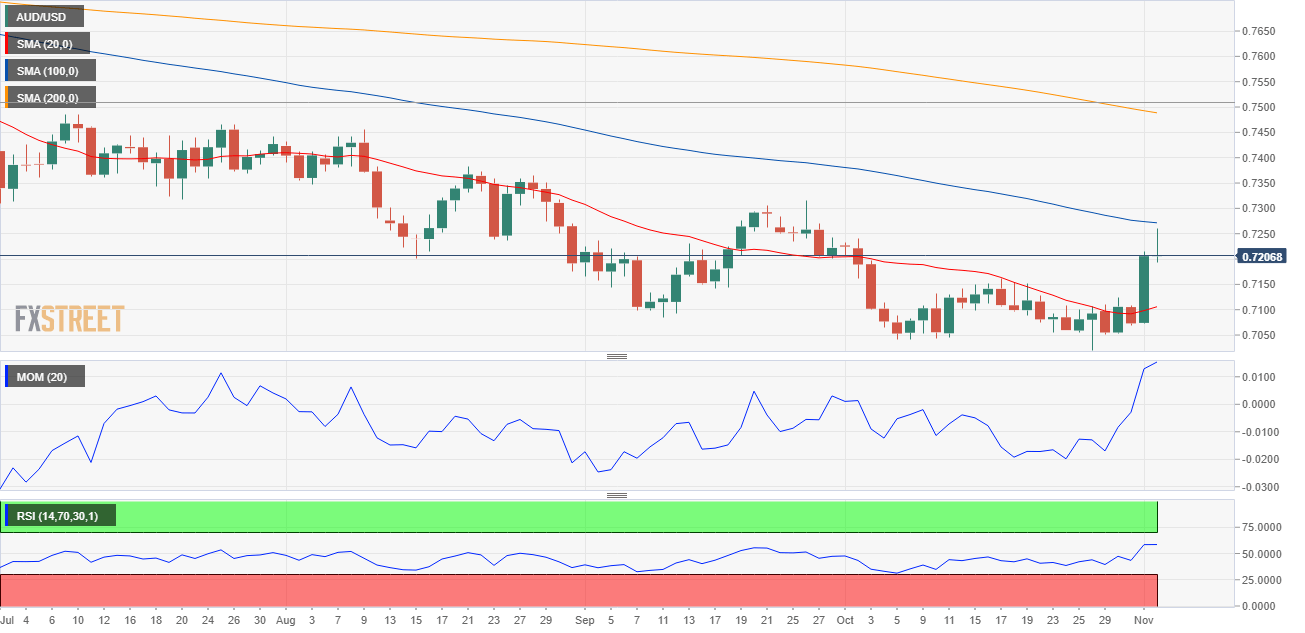
The Australian dollar was among the best performers these last week, surging against the greenback to 0.7258 its highest since late September amid resurgent risk appetite. The pair followed the lead of equities, which, after a soft start to the week, ended up trimming the previous week's losses. Not yet at out of the bloom, and with US mid-term elections next week, stocks could take Aussie down as fast as they take it up.
There were some solid macroeconomic releases that backed the Aussie recovery at the end of the week, although the country's quarterly inflation indicated that the RBA will remain on hold for longer, as the RBA trimmed Q3 CPI resulted at 1.8%, below market's forecast of 1.9%. Australian trade balance surplus for September jumped to $3.017 billion in seasonally adjusted terms, the largest surplus in over a year-and-a-half. August surplus was revised to $2.342B from a previous estimate of $1.604B. Such surplus was a result of a 1.0% increase in exports to the highest on record, while imports fell 1.0%. Also, the Chinese Caixin Manufacturing PMI for October came in at 50.1, surpassing September 50.0 and much better than the contraction reading expected of 49.9.
More relevant, gains were backed by hopes that China and the US could clinch a deal on trade, hopes diluted this Friday on news indicating that there's a long way to go before the US administration considers drafting a possible deal.
The Reserve Bank of Australia and the US Federal Reserve will have monetary policy meetings next week, but none is expected to be a shocker. China will release the final October services PMI and trade data at the end of the week but seems political headlines will continue overshadowing data.
The trade war between China and the US and any headline related to it will lead the way as it did this past week. Equities will also have their saying, particularly with US mid-term elections in the middle. Get ready for big noise then.
AUD/USD technical outlook
The pair is holding above the 0.7200 figure, hovering just above the 61.8% retracement of its September/October decline, somehow leaving doors open for a full retracement up to 0.7314.
The weekly chart for the pair shows that the rally stalled a few pips below a strongly bearish 20 SMA, while technical indicators have turned modestly higher, but hold within negative levels. The RSI is currently at 43, its highest since May, and while is not enough to confirm further gains ahead, for sure is the first warning for bears. In the daily chart, the pair briefly surged above a bearish 100 SMA, but settled well below it, while technical indicators advanced within positive ground, barely losing their bullish momentum near overbought territory in this last trading day of the week.
The bearish case could return if the pair losses quickly the 0.7160 level at the beginning of the week, with the next support then being the 0.7100 level, ahead of the 0.7030/40 price zone. Should the price move beyond the mentioned 0.7314, 0.7370 is tops for next week.
AUD/USD sentiment poll
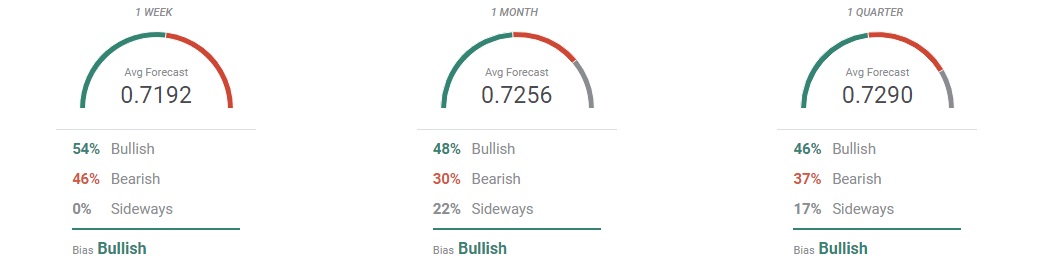
According to the FXStreet Forecast Poll, the AUD/USD pair is bullish in the three time-frame under study, with modest upgrades in the average targets. the conviction is stronger in the shorter term, as both in the 1 week, and - month view, the Overview chart shows that the largest accumulation of targets come above the current level, with the moving averages offering strong upward slopes. For the 3-month perspective, the number of bulls decreased to 46% from 54% but the average target is now at 0.7290 from the previous 0.7189.
Related content:
EUR/USD Forecast: not the time to put all eggs in the same basket
USD/JPY Forecast: When safe-haven demand wanes, the dollar wins, Mid-Terms and the Fed eyed
Author

Valeria Bednarik
FXStreet
Valeria Bednarik was born and lives in Buenos Aires, Argentina. Her passion for math and numbers pushed her into studying economics in her younger years.
















