AUD/USD: below Friday's low but downside limited

AUD/USD Current price: 0.7276
- US-China tensions weighed on the Aussie at the weekly opening.
- Broad US Dollar's weakness and stable equities keeping the pair afloat.
The AUD/USD pair gapped lower at the weekly opening, as the Chinese Yuan appreciated on the back of trade war headlines. The latest batch of mutual tariffs between the US and China came into effect, while China rejected to resume trade talks with the US, spurring some concerns. Nevertheless, US President Trump has already menaced that he will continue with tariffs to cover the total of imported goods from China, and could trigger duties on $627B on Chinese goods, taking off from the equation the surprise factor. Being Australia a close trade partner to China, these kind of news always weigh on the Aussie.
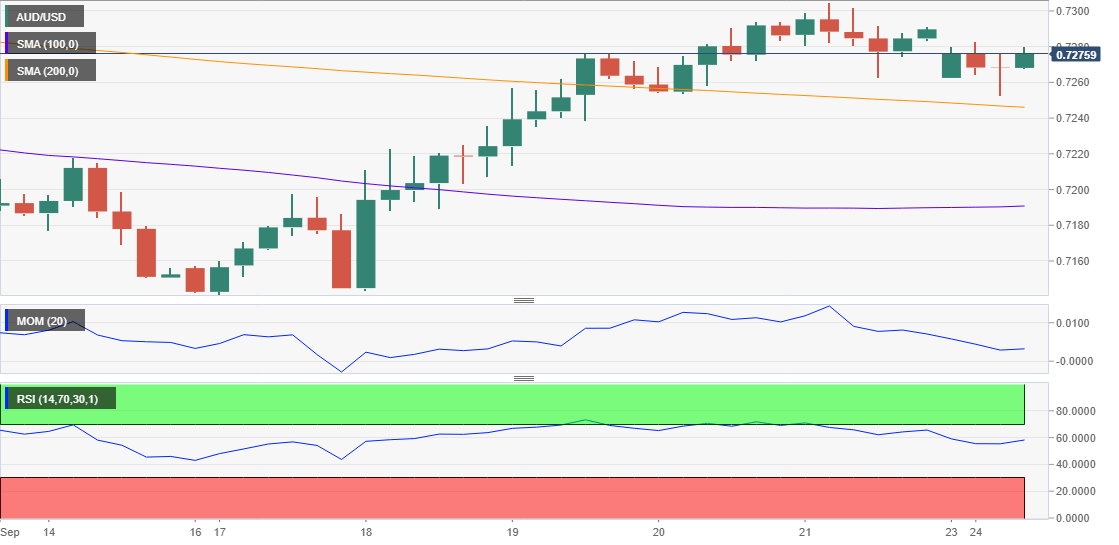
The pair fell to a daily low of 0.7252, meeting buyers at the key static support area, also the 61.8% retracement of the latest daily slump. The pair already filled the opening gap after peaking at 0.7281 during Asian trading hours, now needing to surpass 0.7290 to gain upward traction. Dollar's weakness prevails across the FX board, helping the pair to remain afloat, albeit ranging due to the lack of progress in commodities and equities.
The pair offers a neutral-to-positive stance according to the 4 hours chart, as technical indicators are currently resting above their midlines, trying to regain some upward slopes but without enough strength at the time being. In the same chart, the price is currently battling with a bullish 20 SMA while above the larger ones, also supporting a bullish continuation, more likely on an upward acceleration through the 0.7290 price zone. Given dollar's ongoing weakness a decline seems unlikely unless risk-aversion takes over equities, something that could drag the Aussie lower.
Support levels: 0.7250 0.7220 0.7190
Resistance levels: 0.7290 0.7335 0.7370
Author

Valeria Bednarik
FXStreet
Valeria Bednarik was born and lives in Buenos Aires, Argentina. Her passion for math and numbers pushed her into studying economics in her younger years.