|

AUD/USD analysis: up for a second consecutive day, pressuring 0.7100

AUD/USD Current price: 0.7094

  • Australian data and the 0.7000 psychological barrier help the pair advance.
  • Melbourne Institute Consumer Inflation Expectations for October up next.
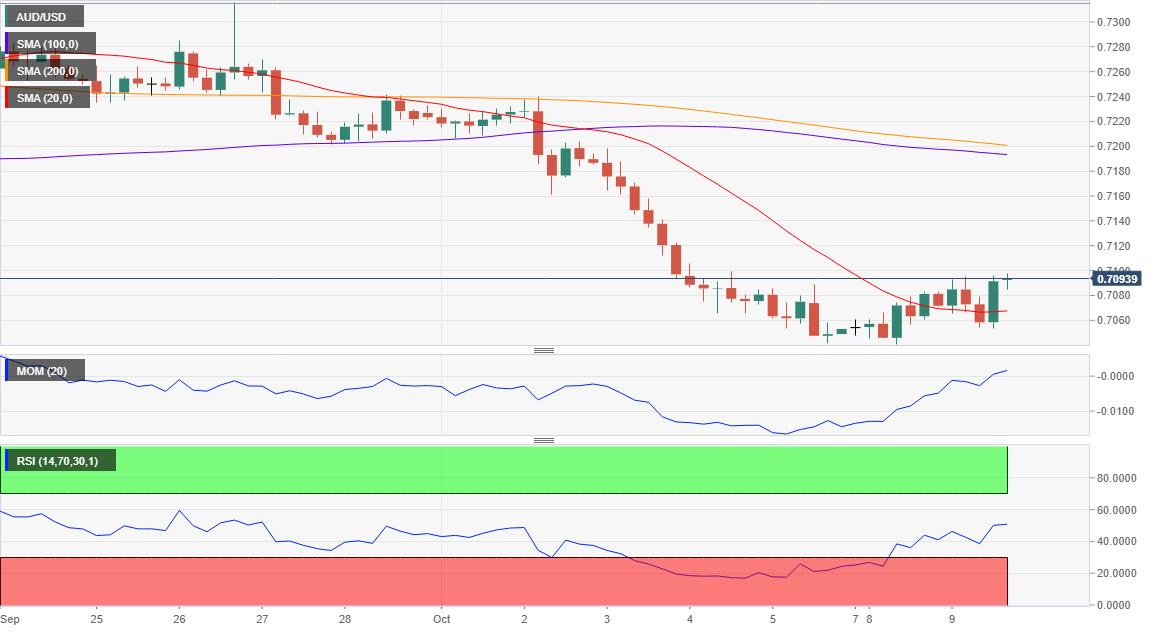
The AUD/USD pair settled near the 0.7100 level, having neared it a couple of times through the day. The Aussie found support at the beginning of the day on improved local data, as the  NAB's survey on Business Confidence for September came in at 6, beating the expected 5. Business Conditions were also upbeat, raising to 15 vs. the 9 forecasted. Up for a second consecutive day, the pair bared quite well with falling European equities and higher US yields, as it seems that speculative interest is unwilling to push the pair through the key 0.7000 threshold, despite prevalent US Dollar demand. Australia will see the release of the Consumer Inflation Expectations from the Melbourne Institute for October this Wednesday, previously at 4.0%.

The pair offers a positive technical stance according to readings in the 4 hours chart, as it's currently advancing above a now flat 20 SMA, while technical indicators advance within positive levels, now at their highest for this month.  Furthermore, the pair is also above the 23.6% retracement of the latest daily slump at around 0.7086, with the 38.2% retracement of the same slide at 0.7115,  with gains beyond this last opening doors for a steeper recovery.

Support levels: 0.7085 0.7040 0.7010  

Resistance levels: 0.7115 0.7150 0.7190

View Live Chart for the AUD/USD

Author

Valeria Bednarik

Valeria Bednarik was born and lives in Buenos Aires, Argentina. Her passion for math and numbers pushed her into studying economics in her younger years.


More from Valeria Bednarik
Share:

Editor's Picks

AUD/USD keeps range near mid-0.7100s as USD bulls await US CPI

AUD/USD steadies near mid-0.7100s in the Asian session on Friday, stalling the previous day's sharp decline to an over one-week low. The August PPI report reaffirmed Fed rate-hike bets and boosted the US Dollar on Thursday, which weighed heavily on the pair. However, hawkish RBA expectations limited losses for the Aussie as USD bulls now await the release of the US consumer inflation figures before placing fresh bets.

USD/JPY holds lower ground toward 154.00; looks to US CPI

USD/JPY holds lower ground toward 154.00 in the Asian session on Friday after hot Japanese PPI data bolster a more hawkish BoJ repricing and provide fresh impetus to the Japanese Yen. However, the downside appears capped as the US Dollar preserves overnight gains ahead of the latest US consumer inflation data.

Gold moves away from one-week low, climbs above $4,450 as USD edges lower ahead of CPI

Gold builds on its modest intraday recovery from the $4,300 neighborhood, or a one-and-a-half-week low, touched earlier this Friday, and climbs above $4,350 heading into the European session. The upside potential, however, seems limited as traders opt to wait for the release of US consumer inflation figures before placing directional bets.

Cardano approaches critical support as correction risks grow
Cardano (ADA) recovers slightly, trading at $0.206 at the time of writing on Friday, inches above the critical support zone after losing more than 6% so far this week. Weakening derivatives data and fading bullish momentum suggest a bearish near-term outlook, with a decisive close below the support zone potentially triggering a deeper correction for ADA.
US core CPI data set to ease in August as markets reprice Fed September rate decision

The US Bureau of Labor Statistics will publish the August Consumer Price Index data on Friday. The report is expected to show a small decline in annual core inflation. Any divergence from analysts’ estimates could influence the Federal Reserve’s policy outlook and impact the US Dollar’s valuation.

Venezuela’s 65-billion-barrel Oil deal could reshape America’s inflation fight
The United States (US) has secured unprecedented access to part of Venezuela’s vast Oil reserves. The timing is particularly significant as the war with Iran is disrupting Middle Eastern supplies, keeping energy prices elevated and reviving concerns about inflation.