|

AUD/USD analysis: base metals weighed the AUD

AUD/USD Current price: 0.7217

  • Australian macroeconomic calendar has little to offer that can affect the pair.
  • Aussie ignored the positive momentum of US equities, fell alongside with gold.
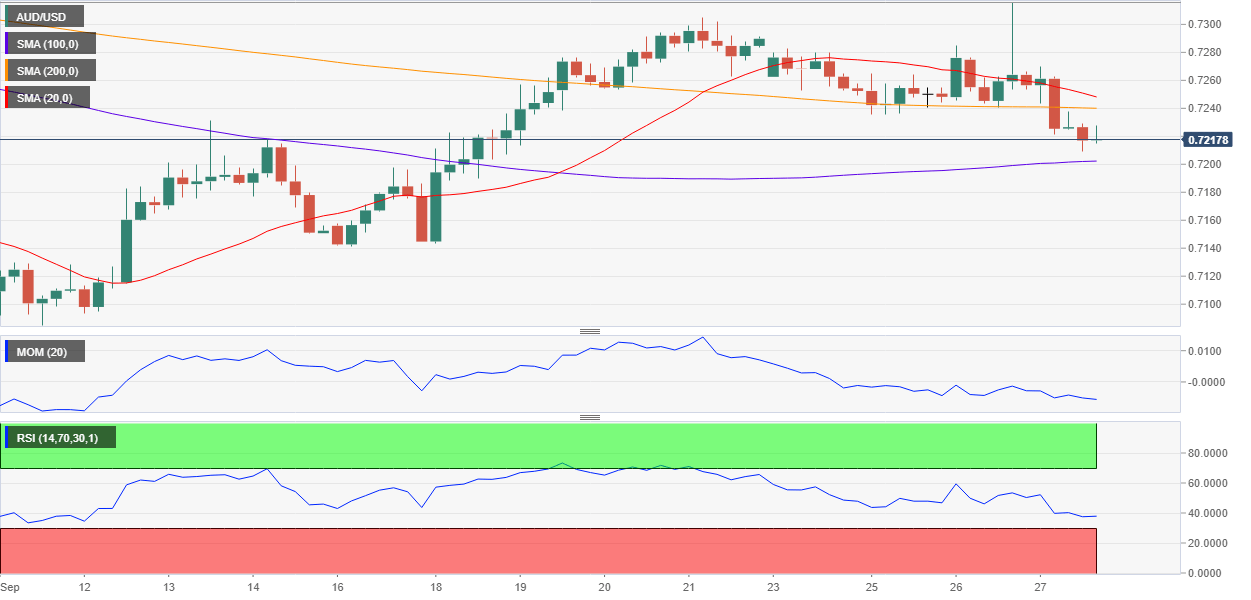
The AUD/USD pair fell sharply after failing once again to sustain gains beyond the 0.7300 figure, also dragged south by a sharp decline in metals' prices. Broad dollar's strength, triggered by the US Federal Reserve confirming the gradual pace of tightening into 2019 sent gold prices to over one-month lows. The Aussie, lately led by sentiment through equities' behavior, ignored the positive tone that prevailed through the US afternoon. The week will end as it started, with Australia not offering relevant macroeconomic data. For this Friday, the country has scheduled Private Sector Credit figures for August, hardly a game changer.

Meanwhile, the pair broke below the 50% retracement of its latest downward move at 0.7225, now the immediate resistance, and the ongoing downward extension sub 0.7250 also leans the scale toward the downside for the upcoming sessions. The 38.2% retracement of the mentioned slide comes at 0.7190, with a break below it further discouraging bulls. In the 4 hours chart, the 20 SMA is currently gaining downward traction above the 200 SMA, both above the current level, while the 100 SMA is directionless a handful of pips below the current level. The Momentum indicator in the mentioned chart remains directionless within negative levels, while the RSI maintains its downward slope around 36, also skewing the risk to the downside.

Support levels: 0.7190 0.7155  0.7120

Resistance levels: 0.7225 0.7255 0.7300    

View Live Chart for the AUD/USD


Author

Valeria Bednarik

Valeria Bednarik was born and lives in Buenos Aires, Argentina. Her passion for math and numbers pushed her into studying economics in her younger years.


More from Valeria Bednarik
Share:

Editor's Picks

AUD/USD meets support near 0.7150

AUD/USD comes under renewed and quite strong selling pressure ahead of the Asia opening bell on Friday, drifting back toward multi-day troughs near 0.7150, where it seems to have met some decent contention for now. The Aussie’s decline follows the inflation-reignited uptick in the Greenback in response to robust US factory-gate prices in August.


USD/JPY consolidates around 153.50 as bears turn cautious ahead of US inflation

USD/JPY stabilizes above 153.50 during the Asian session on Thursday, but remains near a seven-month low set earlier this week as hawkish BoJ repricing continues to underpin the Japanese Yen. Meanwhile, rising September Fed rate-hike bets and escalating US-Iran tensions help ease US Dollar selling pressure, offering some support to the currency pair ahead of US inflation figures.

Gold remains weak, retargets $4,350

Gold keeps the choppy price action on Thursday, now slipping back toward the $4,350 region per troy ounce amid the robust bounce in the US Dollar as well as rising US Treasury yields across the curve, particularly following US Producer Prices and ahead of Friday’s more relevant US CPI data.

Bitcoin and Gold Outlook: BTC and XAU drop as US PPI broadens rate-hike bets
Cryptocurrency prices are broadly correcting, led by Bitcoin (BTC), which is trading around $77,000 on Thursday, marking four consecutive days of declines. Meanwhile, Gold (XAU) remains sideways, hovering around $4,365, with upside capped below $4,400.
ECB recap: A hawkish hike despite downside growth risks
The European Central Bank (ECB) increased the Deposit Facility Rate to 2.50%, the Refinancing Rate to 2.65% and the Marginal Lending Facility to 2.90%, effective from September 16. The decision was accompanied by a clear warning that the outlook remains highly uncertain, with risks tilted to the upside for inflation and to the downside for growth.
Venezuela’s 65-billion-barrel Oil deal could reshape America’s inflation fight
The United States (US) has secured unprecedented access to part of Venezuela’s vast Oil reserves. The timing is particularly significant as the war with Iran is disrupting Middle Eastern supplies, keeping energy prices elevated and reviving concerns about inflation.