ADP Employment Preview: The turn of the tide?
- Private sector job creation expected to recover to the three month moving average
- Two weak months in the last three for ADP payrolls have markets attention
- NFP has also faltered with two of the last four months well below average

Automatic Data Processing the private payroll company will issue its National Employment Report on Wednesday July 3rd at 8:15 am EDT, 12:15 pm GMT.
Forecast
The US business clients of ADP are predicted to add 140, 000 new employees to their payrolls in June after 27,000 were hired in May.
ADP and NFP
The ADP report is the precursor for the important Bureau of Labor Statistics (BLS) Employment Situation Summary commonly called NFP or simply payrolls for its most widely quoted statistic.
The BLS report for May will be released this Friday July 5th at 8:30 am EDT, 12:30 pm GMT.
The NFP report is the best known, most complete and timely accounting for the state of the US labor market. It includes non-farm payrolls, the government’s estimate of jobs created each month. This statistic is and has been for a decade and more the most followed and traded US economic statistic.
The report compiles various unemployment rates, changes in wage compensation, data on labor force participation, average work week, hours worked and many other topics. It organizes the employment statistics into numerous categories--private and government payrolls, type of employment, age, racial and gender differentiated unemployment rates and many others. In all the BLS report contains 25 different tables of employment statistics.
ADP and NFP: Part and Whole
The ADP payroll report is viewed as a reliable indicator to the government job report issued two days later.
There are two important differences between the reports. The ADP information covers only the payrolls of its own clients, the 411,000 US firms that employ its processing and accounting services. The BLS report covers the entire economy including government employment at local, state and federal levels.
The second difference is that ADP comprises actual employees whose paychecks are produced by the company. The NFP figures from the BLS include a monthly estimate for the number of jobs created by newly formed companies that have not yet been reported to the government. This estimated number is later revised to the actual tax rolls and the NFP figures are adjusted each year to correct for the variation.
NFP and ADP Trends: ADP
The robust positive averages of both payrolls reports in 2018 have withered in the second quarter.
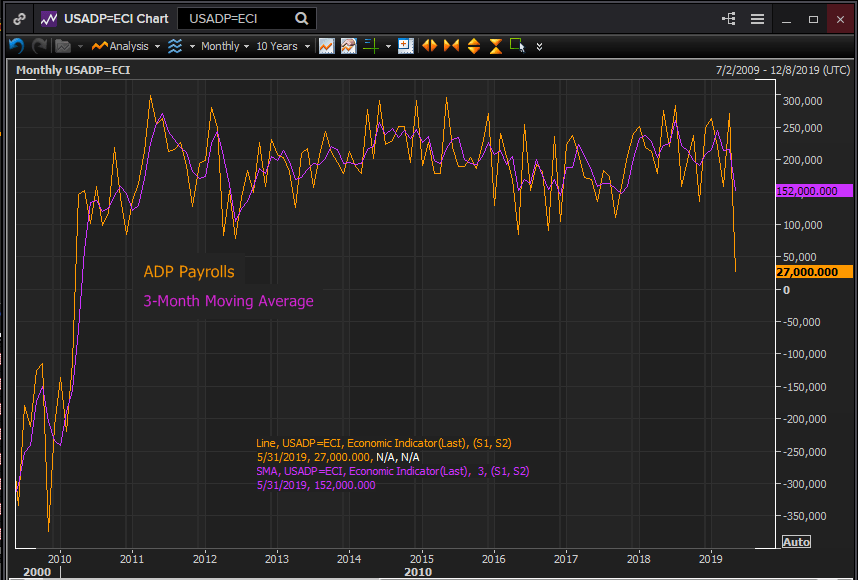
The 3-month moving average for ADP has fallen from 244, 000 in February to 152,000 in May dragged down by 158,000 in March and 27,000 in May. If the June figure is as expected at 140,000 it will have confirmed the steep slide in the last four months.
Reuters
Sharp retreats in private sector employment have occurred within healthy markets and do not necessarily presage a longer term decline in hiring. From March 2017 to October the 3–month moving average dropped from 223,000 to 148, 000, only to reverse back to 237,000 by February 2018 and to remain above 200,000 for 10 of the next 12 months.
The seven month slope from March to October 2017 above was gradual, characterized by a drop of four months to between 170,000 and 180,000, with a low in September 2018 of 111,000.
The descent this year has been much more rapid, three months as opposed to seven. The magnitude was largely due to the single month collapse in May to 27,000. If that month had been on par with March at 158,000 the May 3-month average would have been 196,000 rather than 152,000.
The questions for June are how much of an anomaly was the May drop and will the expected result for June be an affirmation of a sharply lower average?
NFP and ADP Trends: NFP
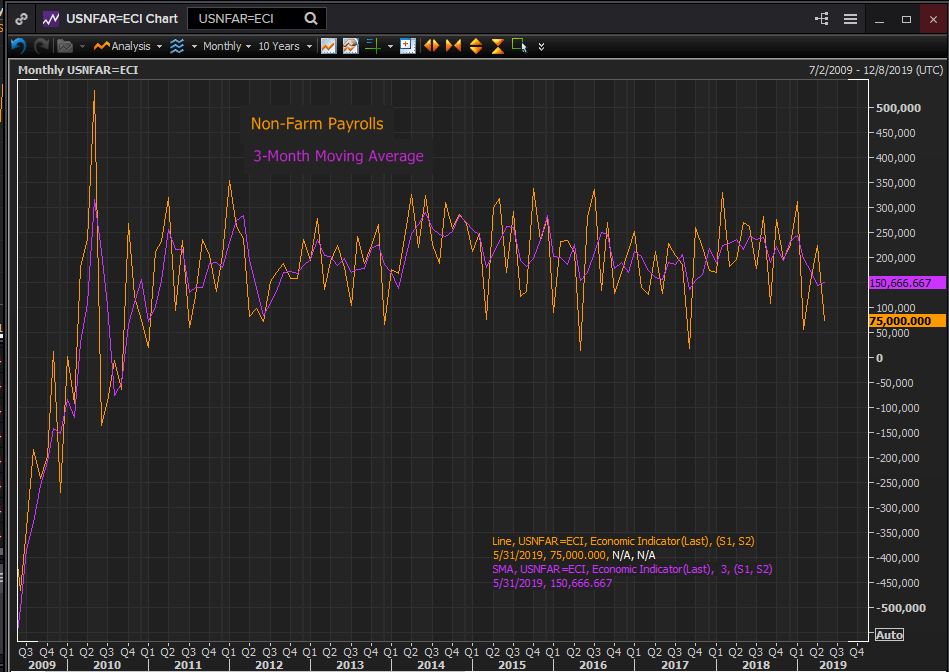
Not surprisingly non-farm payrolls have seen similar movements this year. From a high in the 3-month moving average of 245,000 in January NFP lost 101,000 in three months to 144,000 in April. The plunge was based on two months far below average, 56,000 in February and 75,000 in May.
Reuters
Here too sharp movements in the averages and variation in month to month figures are not unusual. From August to September 217 the 3-month average dropped from 207,000 to 136,000, the result of September’s wholly eccentric 18,000. The three subsequent months averaged 218,000.
The Labor Market and the US Economy
American economic growth has slowed from its 3.1% annualized pace the first quarter. The Atlanta Fed GDPNow running estimate for the second quarter was 1.5% on July 1st.
Other labor indicators suggest a moderate expansion remains intact.
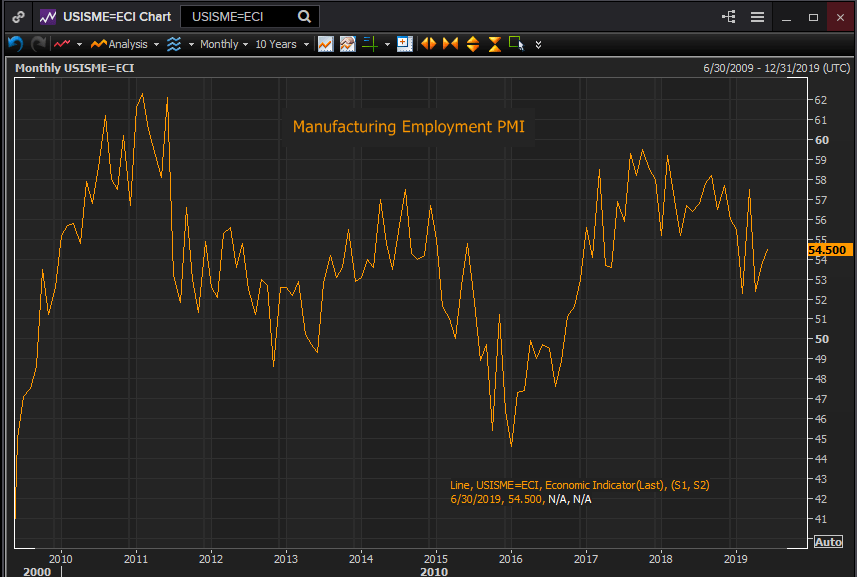
The employment purchasing managers’ index for manufacturing was stronger than predicted in June at 54.5, up from 53.7 in May and well above the 52.8 forecast. Hiring sentiment has bounced even though the overall manufacturing PMI dropped to 51.7 in June its lowest level since October 2016 and far from the optimism of 2017 and 2018.
Reuters
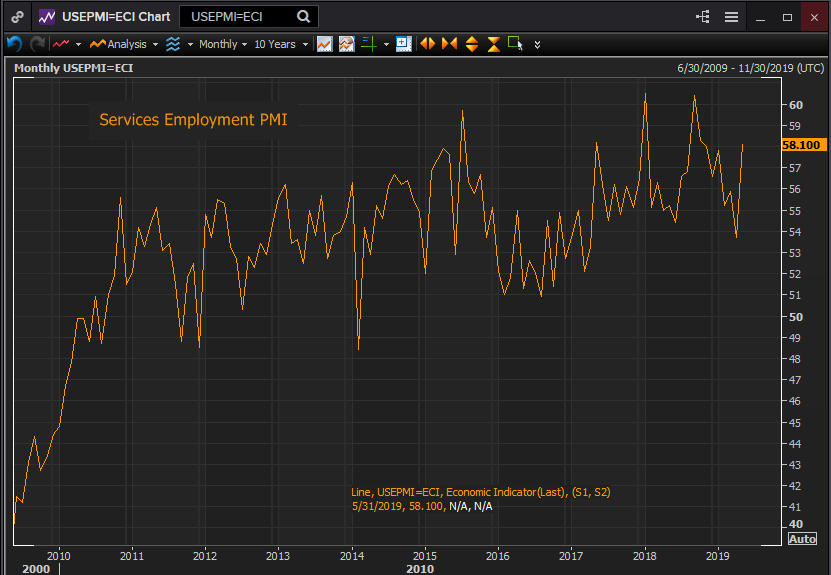
The service sector PMI figures will be reported on Wednesday July 3th. The overall index is expected to drop to 55.9 in June from 56.9 in May. The May employment index had posted 58.1, it’s best reading since October 2018 and a sharp improvement from April’s 53.7 that had been the weakest score since early 2017.
Reuters
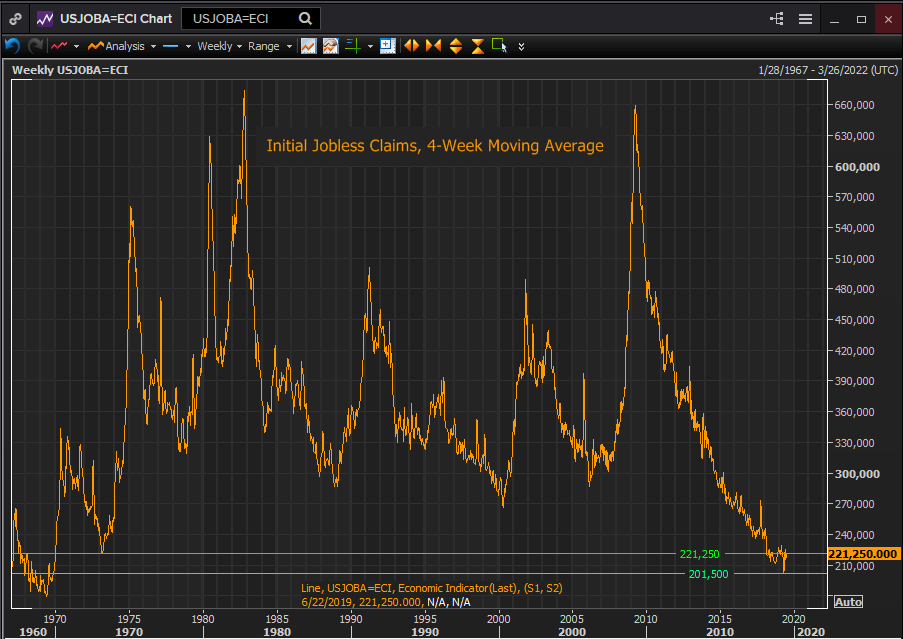
The 4-week moving averge for initial jobless claims was 221,250 in the third week of June. While the averge has risen 20,000 since the middle of April that score of 201,500 was a five decade low and the latest week is a 46 year record. It is hard to read labor market weakness into those averages.
Reuters
Conclusion
The averages in ADP and NFP have fallen substantially from their January and February highs. The declines have been the result of several months, one in the ADP and two in NFP that were far outside the range of the past two years. There has not been a general trend lower but sharp drops in individual months.
Monthly variation in both statistics is not uncommon. When the recent payroll volatility is combined with lower second quarter GDP, decreases in the PMI indexes and the business sentiment killing duration of the US-China trade dispute the potential for a surprise is unusually high.
Author

Joseph Trevisani
FXStreet
Joseph Trevisani began his thirty-year career in the financial markets at Credit Suisse in New York and Singapore where he worked for 12 years as an interbank currency trader and trading desk manager.
















