|

Xiaomi Corp (1810.HK) pulling back in wave (IV)

Xiaomi Corporation (1810.HK), founded in 2010 and headquartered in Beijing, China, is a leading global technology company known for its innovative smartphones, IoT devices, and lifestyle products. Listed on the Hong Kong Stock Exchange since July 2018, it operates through four main segments: Smartphones, IoT and Lifestyle Products, Internet Services, and Others, offering a wide range of products from smart TVs and laptops to electric vehicles. With a strong focus on affordable, high-quality tech and a growing presence in markets like Southeast Asia and India, Xiaomi has become the world’s third-largest smartphone vendor, boasting a market cap of approximately HKD 1.365 trillion as of early 2025. Below we will look at the Elliott Wave technical outlook of the company.

Xiaomi monthly Elliott Wave chart
Chart

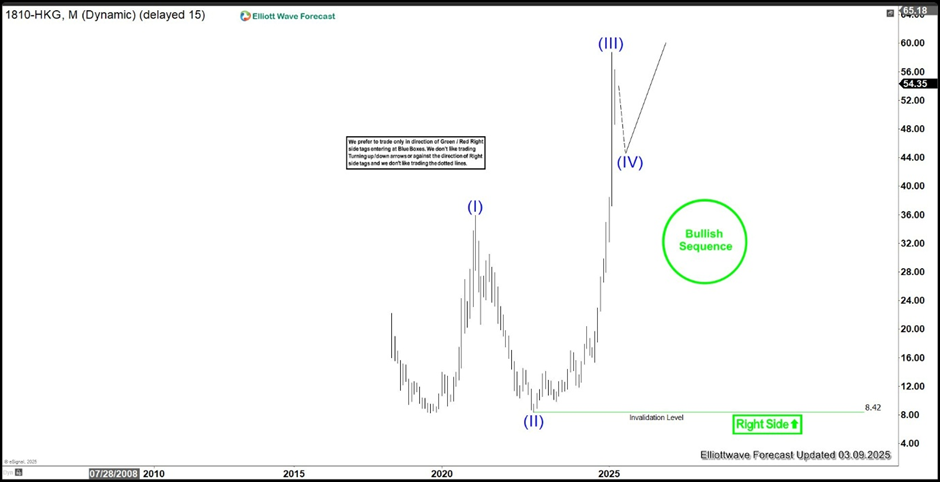
Monthly Elliott Wave Chart of Xiaomi above shows that rally from all-time low is unfolding as a 5 waves impulse. Wave (I) ended at 33.8 and pullback in wave (II) ended at 8.31. The stock rallied higher in wave (III) towards 58.7. Expect pullback in wave (IV) to correct cycle from 10.12.2022 low in 3, 7, or 11 swing before it resumes higher.

Xiaomi daily Elliott Wave chart
Chart

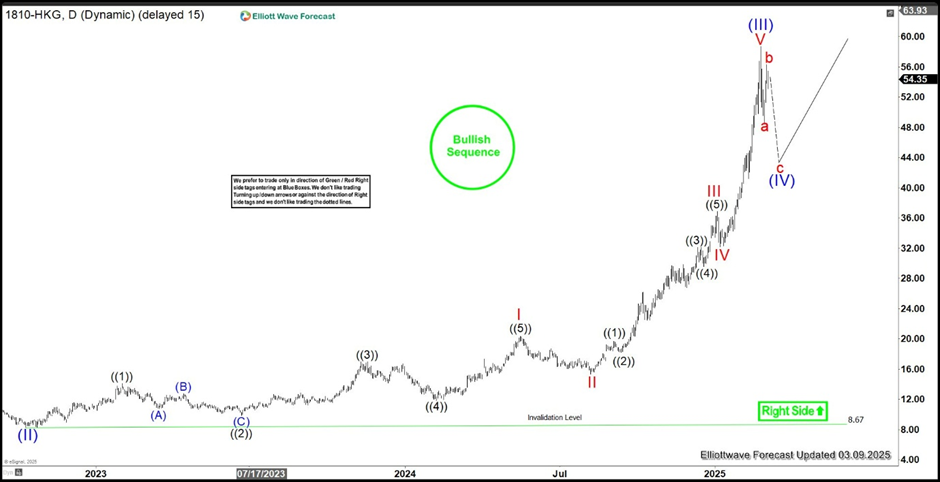
Daily Elliott Wave Chart of Xiaomi above shows that wave (II) ended at 8.67. The stock then nested higher from there. Wave I ended at 20.35 and wave II dips ended at 15.36. Stock then rallied higher in wave III towards 36.85 and pullback in wave IV ended at 32.2. Wave V ended at 58.7 which completed wave (III) in higher degree. Expect pullback in wave (IV) to correct cycle from 10.12.2022 low before it resumes higher again. While pivot at 8.67 low remains intact, expect pullback to find support in 3, 7, or 11 swing for further upside.

Author

Elliott Wave Forecast Team

Elliott Wave Forecast Team

ElliottWave-Forecast.com

More from Elliott Wave Forecast Team
Share:

Editor's Picks

EUR/USD stays weak near 1.1650 ahead of critical US events

EUR/USD stays in the red near 1.1650 in the European trading hours on Friday. The pair remains undermined by broad US Dollar strength and a cautious market mood. Traders keenly await the US Nonfarm Payrolls data and Supreme Court's ruling on Trump's tariff powers for further direction. 

GBP/USD holds lower ground below 1.3450, with eyes on US data

GBP/USD remains subdued for the fourth consecutive day, while trading below 1.3450 in the European session on Friday. Markets remain in a wait-and-see mode before the key US event risks and prefer to hold the US Dollar, which weighs negatively on the pair. The US monthly jobs data and the Supreme Court decision on tariffs are awaited. 

Gold flat lines around $4,475; looks to US NFP report for fresh impetus

Gold reverses a modest intraday dip to the $4,453 area, and trades near the top end of its daily range heading into the European session. The upside, however, seems limited as traders might opt to wait for the US Nonfarm Payrolls report later today. The crucial employment details will be looked upon for more cues about the Federal Reserve's rate-cut path.

Nonfarm Payrolls expected to show US labor market remained weak in December

The United States Bureau of Labor Statistics will release the Nonfarm Payrolls data for December on Friday at 13:30 GMT. Economists expect Nonfarm Payrolls to rise by 60,000 in December following the 64,000 increase recorded in November.

2026 economic outlook: Clear skies but don’t unfasten your seatbelts yet

Most years fade into the background as soon as a new one starts. Not 2025: a year of epochal shifts, in which the macroeconomy was the dog that did not bark. What to expect in 2026? The shocks of 2025 will not be undone, but neither will they be repeated.

Pepe Price Forecast: PEPE risks 100-day EMA fallout as bullish interest fades

Pepe is under extreme selling pressure, trading in the red for the fifth consecutive day, down 1% at press time on Friday. Pepe’s decline following a 72% hike last week suggests a likely profit-booking phase, while on-chain data indicates declining network activity.