WTI Price Forecast: Recovery halts at $63.00 amid fears of an Oil glut
- U.S. Gasoline stocks increased beyond expectations last week.
- Saudi Arabia is pushing OPEC+ countries to hike output again in August.
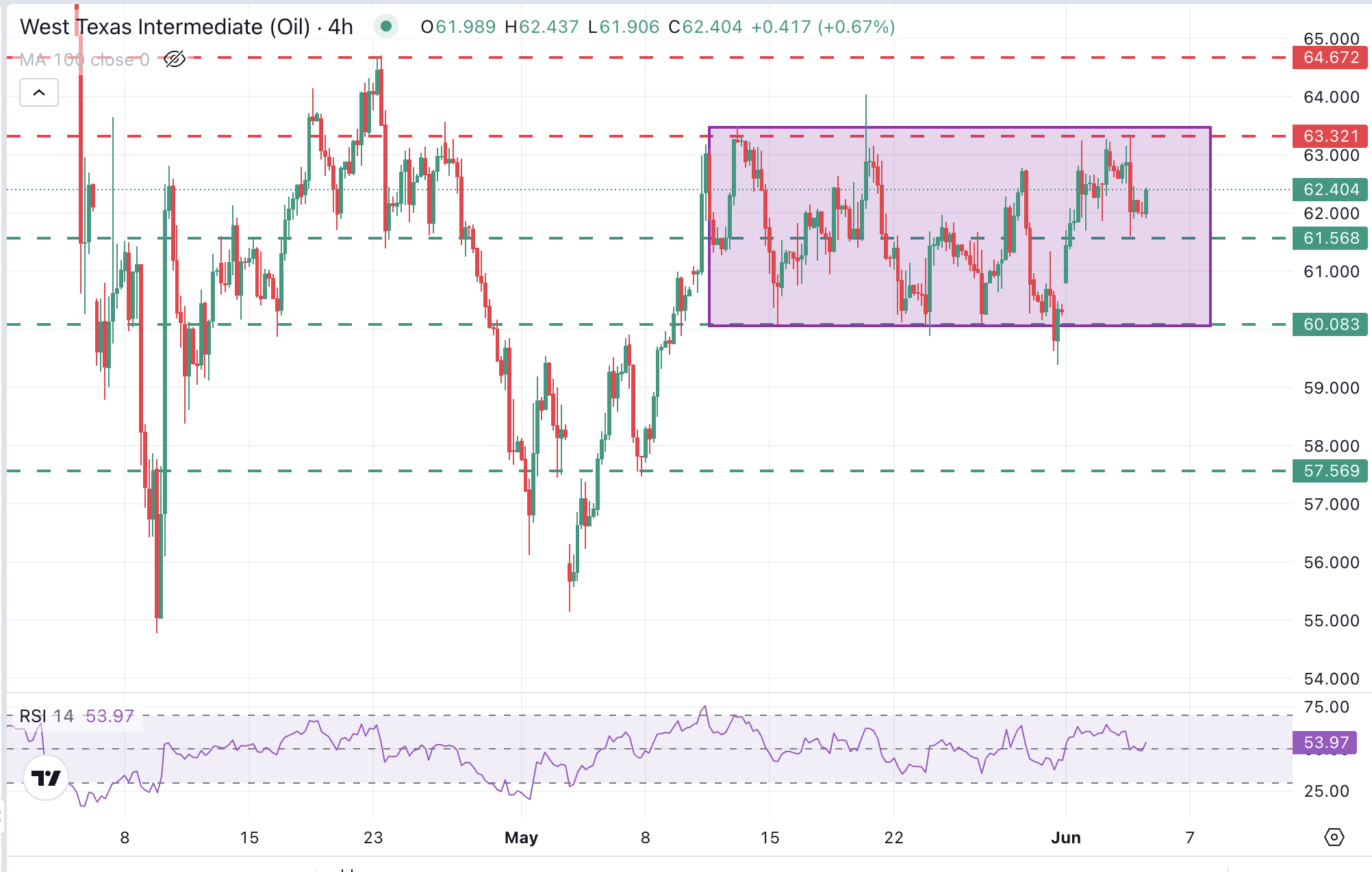
- WTI Oil prices remain contained within a $60.00 to $63.00 range.

Crude prices have been capped again at the $63.00 area, before dropping to levels right above $62.00 at the time of writing. A larger-than-expected increase in US gasoline supplies, ongoing global trade uncertainty, and news that OPEC is considering another supply hike have revived fears about an oversupply.
The recovery from the psychological $60.00 level was hit on Wednesday after the US Energy Information Administration reported that gasoline stocks surged by 5.2 million barrels in the last week of May, against market expectations of a 600,00 rise.
OPEC+ countries plan another supply hike
Beyond that, Saudi Arabia revealed that they are pressuring the OPEC+ group to hike output further in the coming months, attempting to gain market share. The Saudis are pursuing another 411,000 bpd increase in August, following an identical hike in July.
This news, coupled with the ongoing global trade uncertainty. which is expected to weigh on future demand for crude, has revived fears of an oil glut, and is keeping crude prices on their back foot on Thursday.ç
Technical analysis: Sideways movement between $60.00 and $63.00
The technical picture shows choppy and volatile trading between the $60.00 level and $63.30 on the upside.
From a wider perspective, a potential double bottom at the 55.00 area suggests the possibility of a deeper recovery, but prices should break the $64.65 neckline to confirm that scenario.
On the downside, supports are at the $61.55 intra-day low and the mentioned $60.00 area.
WTI OIL 4-Hour Chart
WTI Oil FAQs
WTI Oil is a type of Crude Oil sold on international markets. The WTI stands for West Texas Intermediate, one of three major types including Brent and Dubai Crude. WTI is also referred to as “light” and “sweet” because of its relatively low gravity and sulfur content respectively. It is considered a high quality Oil that is easily refined. It is sourced in the United States and distributed via the Cushing hub, which is considered “The Pipeline Crossroads of the World”. It is a benchmark for the Oil market and WTI price is frequently quoted in the media.
Like all assets, supply and demand are the key drivers of WTI Oil price. As such, global growth can be a driver of increased demand and vice versa for weak global growth. Political instability, wars, and sanctions can disrupt supply and impact prices. The decisions of OPEC, a group of major Oil-producing countries, is another key driver of price. The value of the US Dollar influences the price of WTI Crude Oil, since Oil is predominantly traded in US Dollars, thus a weaker US Dollar can make Oil more affordable and vice versa.
The weekly Oil inventory reports published by the American Petroleum Institute (API) and the Energy Information Agency (EIA) impact the price of WTI Oil. Changes in inventories reflect fluctuating supply and demand. If the data shows a drop in inventories it can indicate increased demand, pushing up Oil price. Higher inventories can reflect increased supply, pushing down prices. API’s report is published every Tuesday and EIA’s the day after. Their results are usually similar, falling within 1% of each other 75% of the time. The EIA data is considered more reliable, since it is a government agency.
OPEC (Organization of the Petroleum Exporting Countries) is a group of 12 Oil-producing nations who collectively decide production quotas for member countries at twice-yearly meetings. Their decisions often impact WTI Oil prices. When OPEC decides to lower quotas, it can tighten supply, pushing up Oil prices. When OPEC increases production, it has the opposite effect. OPEC+ refers to an expanded group that includes ten extra non-OPEC members, the most notable of which is Russia.
Author

Guillermo Alcala
FXStreet
Graduated in Communication Sciences at the Universidad del Pais Vasco and Universiteit van Amsterdam, Guillermo has been working as financial news editor and copywriter in diverse Forex-related firms, like FXStreet and Kantox.