|

WTI Price Analysis: Prints three-day uptrend on the way to $71.00

  • WTI stays firmer around six-week high, picks up bids of late.
  • Bullish MACD, sustained rebound from 100-day EMA, upside break of multi-day-old resistance line favor buyers.
  • 61.8% Fibonacci retracement of July-August fall guards immediate upside.

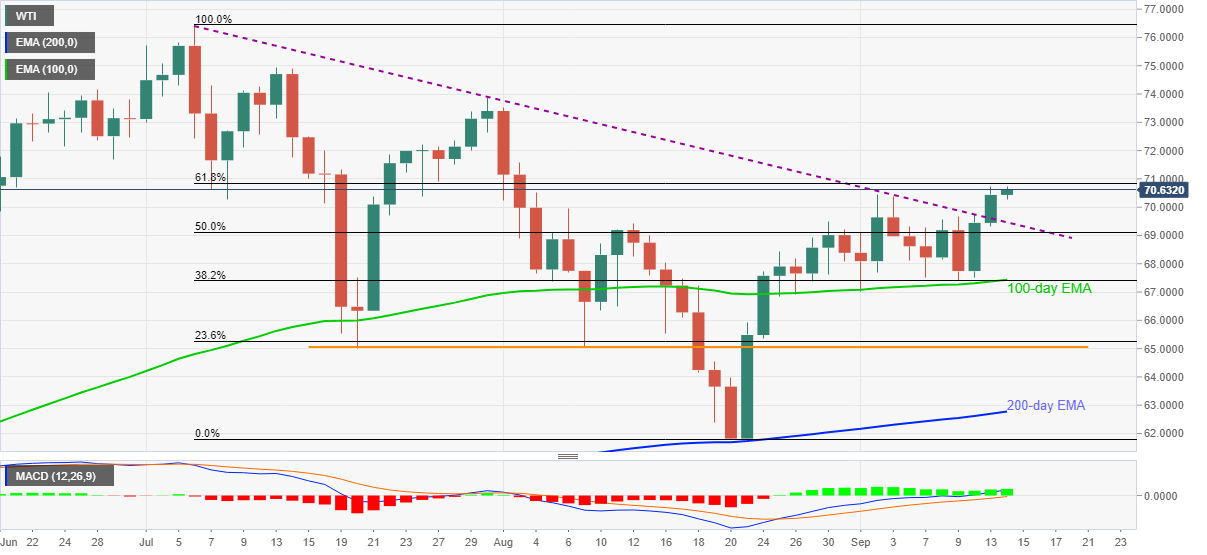
WTI takes the bids around $70.65, up 0.30% intraday during early Tuesday. In doing so, the black gold rises for the third consecutive day after refreshing the highest levels since early August the previous day.

Given the bullish MACD signals and the quote’s ability to keep recovery moves from 100-day EMA, not to forget breaking a downward sloping resistance line from July 03, WTI stays directed towards the 61.8% Fibonacci retracement (Fibo) level surrounding $70.85.

Following that, the $71.00 threshold will act as a validation point before fueling the energy prices towards the late July tops near $73.90.

Meanwhile, the resistance-turned-support near $69.45 acts as an immediate catalyst to trigger the profit-booking moves if broken.

Even so, WTI bears will remain skeptical unless witnessing a clear downside break of $67.40 comprising 100-day EMA and 38.2% Fibo.

In a case where the commodity prices remain pressured towards the south following the $67.40 breakdown, a two-month-old horizontal area around $65.00 will be in focus.

WTI: Daily chart
Trend: Further upside expected

Additional important levels

Overview
Today last price70.67
Today Daily Change0.24
Today Daily Change %0.34%
Today daily open70.43
 
Trends
Daily SMA2067.55
Daily SMA5069.36
Daily SMA10068.82
Daily SMA20062.64
 
Levels
Previous Daily High70.72
Previous Daily Low69.3
Previous Weekly High69.75
Previous Weekly Low67.41
Previous Monthly High73.54
Previous Monthly Low61.73
Daily Fibonacci 38.2%70.18
Daily Fibonacci 61.8%69.85
Daily Pivot Point S169.58
Daily Pivot Point S268.73
Daily Pivot Point S368.16
Daily Pivot Point R171
Daily Pivot Point R271.58
Daily Pivot Point R372.43

Author

Anil Panchal

Anil Panchal

FXStreet

Anil Panchal has nearly 15 years of experience in tracking financial markets. With a keen interest in macroeconomics, Anil aptly tracks global news/updates and stays well-informed about the global financial moves and their implications.


More from Anil Panchal
Share:

Editor's Picks

GBP/USD stays offered near 1.3370

GBP/USD remains on the back foot, slipping back toward the 1.3370 zone on Tuesday. Cable has come under pressure soon after testing the 1.3400 neighbourhood as investors turned more cautious in response to renewed effervescence on the geopolitical front.

EUR/USD stays offered below 1.1450

EUR/USD remains on the back foot ahead of the opening bell in Asia, returning to the low-1.1400s on the back of the resurgence of the demand for the US Dollar. Indeed, renewed jitters in the Middle East support the safe haven universe and weigh on the sentiment surrounding the risk complex. Moving forward, investors’ attention should shift to Wednesday’s FOMC Minutes.

Gold weakens toward $4,100

Gold adds to Monday’s decent pullback and trades close to the $4,100 mark per troy ounce on Tuesday. In the meantime, fresh geopolitical effervescence appear to have reignited inflation concerns, which in turn, limit any recovery attempt from the precious metal.

RBNZ set to increase interest rate after three pauses amid deeply divided committee

The Reserve Bank of New Zealand is widely expected to raise the Official Cash Rate by 25 basis points from 2.25% to 2.50% on Wednesday, snapping a three-consecutive-meeting pause.

Bye, forward guidance: How to trade when central banks choose silence
Central banks have spent years telling markets what might come next. Now, traders face the possibility that they say a lot less. From the Federal Reserve to the European Central Bank and the Bank of England, policymakers are pushing back against forward guidance, arguing that the current world demands more flexibility.
Bye, forward guidance: How to trade when central banks choose silence

Central banks have spent years telling markets what might come next. Now, traders face the possibility that they say a lot less. From the Federal Reserve to the European Central Bank and the Bank of England, policymakers are pushing back against forward guidance.