|

WTI Price Analysis: Bulls attack weekly resistance below $68.00

  • WTI refreshes intraday high to consolidate losses marked during the last five weeks.
  • Bearish MACD also challenges the buyers, 10-DMA, 200-DMA act as additional upside filters.
  • Sellers remain away beyond an ascending support line from late March.

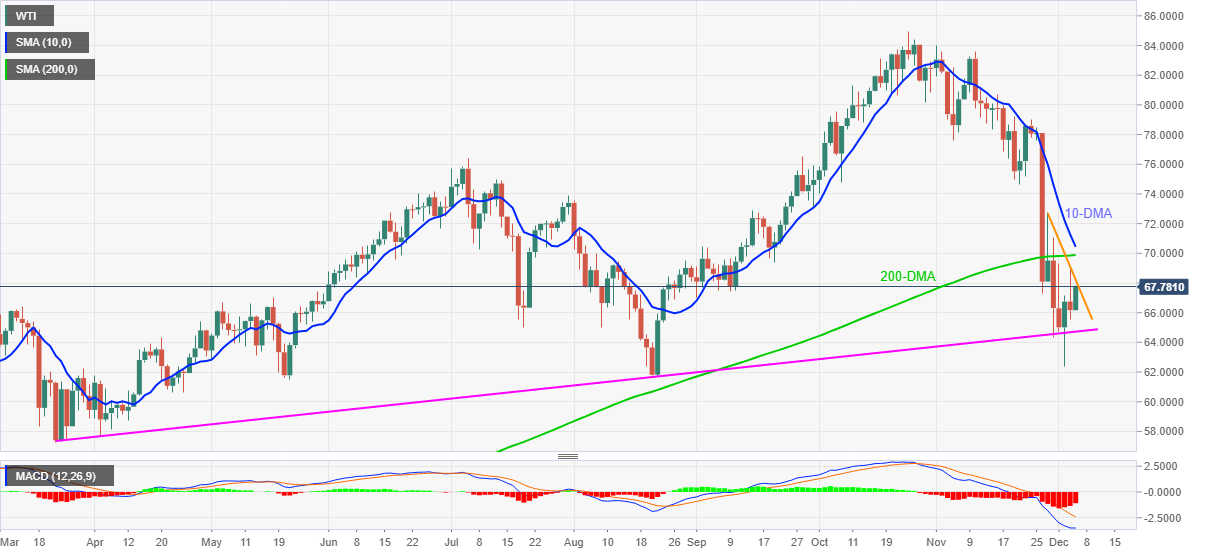
WTI takes the bids around $67.80, up 2.45% intraday during Monday’s Asian session. In doing so, the US oil benchmark reverses the previous day’s losses while keeping the bounce off an upward sloping support line from March 23.

However, bearish MACD signals and a weekly descending trend line near $68.25 challenge the energy bulls.

Even if the quote rises past $68.25, the 200-DMA and the 10-DMA, respectively around $69.90 and $70.45, will challenge the WTI buyers.

In a case where the oil prices rally beyond $70.45, the late November’s swing low near $74.65 will be in focus.

Alternatively, the stated support line from March, around $64.70, becomes the key level to watch for WTI bear’s entry.

Following that, the recent trough of $62.34 and August month’s low near $61.80 can probe the downside targeting March’s low near $57.25.

WTI: Daily chart
Trend: Pullback expected

Additional important levles

Overview
Today last price67.64
Today Daily Change1.47
Today Daily Change %2.22%
Today daily open66.17
 
Trends
Daily SMA2075.42
Daily SMA5078.15
Daily SMA10073.68
Daily SMA20069.85
 
Levels
Previous Daily High69.06
Previous Daily Low65.52
Previous Weekly High72.75
Previous Weekly Low62.34
Previous Monthly High83.97
Previous Monthly Low64.32
Daily Fibonacci 38.2%66.87
Daily Fibonacci 61.8%67.71
Daily Pivot Point S164.77
Daily Pivot Point S263.37
Daily Pivot Point S361.22
Daily Pivot Point R168.31
Daily Pivot Point R270.46
Daily Pivot Point R371.86

Author

Anil Panchal

Anil Panchal

FXStreet

Anil Panchal has nearly 15 years of experience in tracking financial markets. With a keen interest in macroeconomics, Anil aptly tracks global news/updates and stays well-informed about the global financial moves and their implications.


More from Anil Panchal
Share:

Editor's Picks

GBP/USD hovers around 1.3300 as US Dollar struggles ahead of Fed

GBP/USD defends minor bids around 1.3300 in the European trading hours on Wednesday. The pair stays supported as the US Dollar struggles ahead of the Federal Reserve’s upcoming policy decision. However, the upside appears capped by renewed escalation in the Middle East and surging Oil prices.


EUR/USD keeps range around 1.1400 ahead of Fed policy decision

EUR/USD oscillates in a narrow range around 1.1400 in European trading on Wednesday. The pair treads water as the US Dollar struggles, despite risk aversion. Investors keenly await the Federal Reserve’s upcoming policy decision for fresh directional impetus.

Gold extends recovery to $4,050, with eyes on FOMC

Gold builds on its steady intraday recovery from an over one-week low and climbs closer to the $4,050 level in the European session on Wednesday. A modest US Dollar downtick supports the commodity, though the upside potential seems limited ahead of the FOMC policy announcements.


Bitcoin slips below support, Ethereum and XRP flash bearish signals

Bitcoin, Ethereum and Ripple remain under pressure on Wednesday after a mild correction earlier this week. BTC slips below a key support zone, and ETH is testing a key resistance zone. Meanwhile, XRP is drifting toward the psychologically important $1.00 support level.

South Korean Won nears four-month highs despite the KOSPI index selloff
The South Korean Won (KRW) extends gains for the second consecutive day against the US Dollar (USD), and is set for a 6.5% monthly rally. Strong South Korean macroeconomic data and market expectations of monetary tightening by the Bank of Korea have offset the KOSPI Index’s sell-off.
US Dollar mid-year outlook: Exceptional currency, exceptional risks?
The US Dollar enters the second half of 2026 in a markedly different position from a year ago. The King currency has recovered, reflecting persistent US inflation, changing expectations for Fed policy, geopolitical tensions and renewed demand for defensive assets.














