|

WTI drops and pops in the open on OPEC news

  • WTI starts the day off indecisive in thin trade following weekend news. 
  • OPEC+ agreed to gradually add more oil supplies to the market.

Oil prices start out volatile with West Texas Intermediate (WTI) dropping and popping in the open following weekend news. 

WTI is currently trading flat again at $71.40, but it fell in the open to a low of $70.99 and printed a high of $71.55.

Oil is suffering on the back of expectations of growing supplies and a rise in coronavirus cases that could lead to lockdown restrictions and depressed demand.

The weekend news

''OPEC and its allies agreed to gradually add more oil supplies to the market from August (400,000 b/d monthly hikes until Sep 2022) after Saudi Arabia and the United Arab Emirates resolved a dispute that was blocking the deal.''

On Thursday, the group announced that global demand for oil is expected to increase next year to around levels seen before the pandemic, about 100 million bpd, led by demand growth in the United States, China and India. 

Additionally, from Friday, the US oil rig count continued its slow increase, gaining two rigs this week to 380 active units, their highest since April 2020, according to energy services firm Baker Hughes. US crude production has also increased by 300,000 barrels per day (bpd) over the last two weeks, rising to 11.4 million bpd in the week ended July 9, the highest since May 2020, according to federal data. 

WTI technical analysis

Technically, the price is meeting a daily support at the lows and considering the M-formation, the price could be on the verge of an upward correction of 50% of the bearish impulse to test the prior lows of 73.20.

If the price fails to break the resistance, then it would be expected to lead to an onward downside continuation in the coming week:
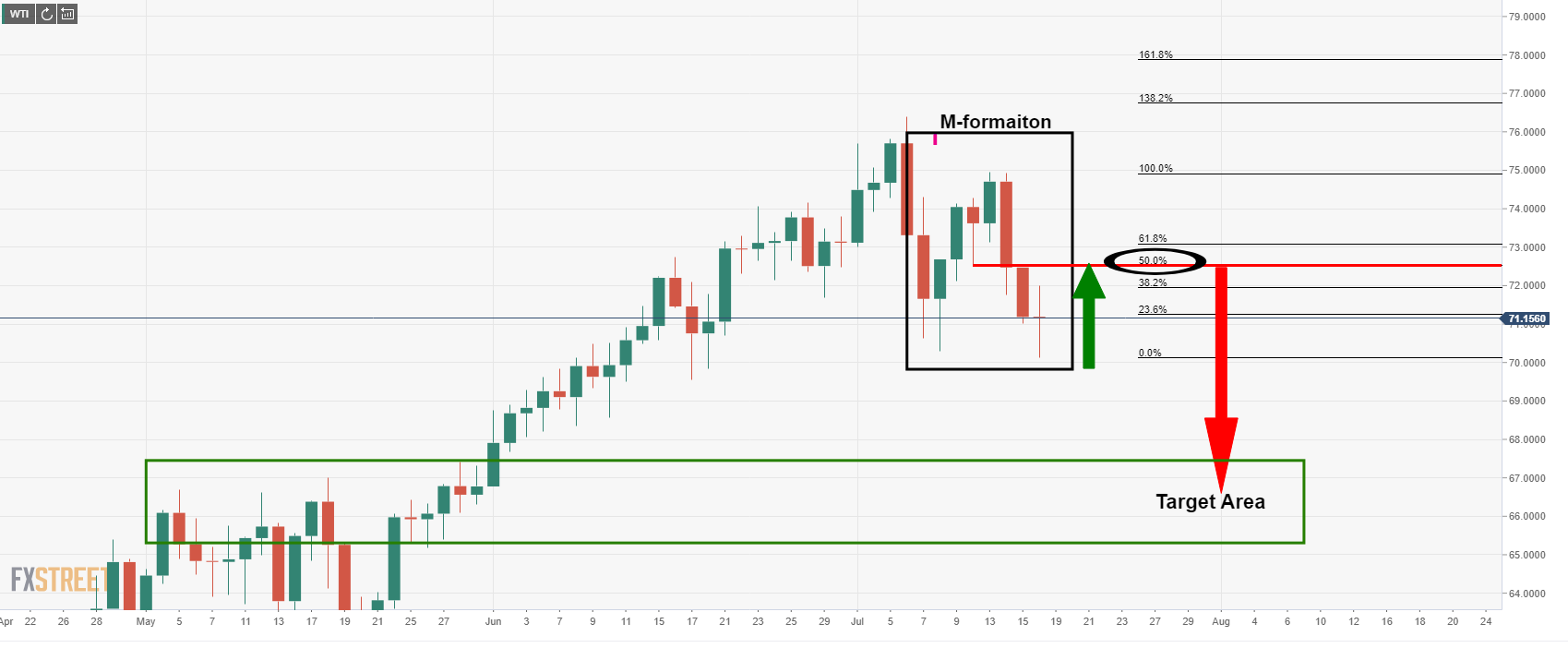
The targetted area is between the 67.50s and 65.30s. 

Author

Ross J Burland

Ross J Burland, born in England, UK, is a sportsman at heart. He played Rugby and Judo for his county, Kent and the South East of England Rugby team.


More from Ross J Burland
Share:

Editor's Picks

AUD/USD edges higher as hot CPI inflation and hawkish RBA lift rate hike bets

The AUD/USD pair gathers strength to near 0.7035 during the Asian trading hours on Friday. The Australian Dollar edges higher against the US Dollar as hotter Australian CPI inflation data has bolstered expectations of Reserve Bank of Australia rate hikes.

USD/JPY meets support near 157.00

USD/JPY retreats for the third consecutive day on Friday, revisiting the 157.00 region before attempting some recovery as investors continue to assess the latest BoJ meeting, where the central bank left rates unchanged, as widely anticipated.

Gold sinks to fresh yearly lows despite risk-off mood as Fed rate hike bets weigh

Gold slips to fresh year-to-date lows on Friday. The metal struggles despite a risk-off mood across markets, as expectations of further Federal Reserve (Fed) interest rate hikes continue to dominate price action, leaving Gold on track to end the month in negative territory.


Ripple Price Forecast: XRP bulls defend $1.20 as sell-side pressure triggers liquidations
Ripple (XRP) trades around $1.25 on Friday, rising from a short-term support level established at $1.20. This minor upward correction follows a sharp sell-off, triggered amid reports of a hack attack on the Binance exchange that impacted approximately $6.3 billion. The attack drove the broader crypto market on edge, as Binance suspended both deposits and withdrawals to contain the situation.
BoJ recap: A pause for now... but Japan has entered a new inflation phase
The Bank of Japan left its short-term policy rate unchanged at 1.25% but delivered a distinctly hawkish message on the risk of an inflation overshoot. The decision passed by 8-1, with board member Takata dissenting in favour of an increase to 1.5%, while Governor Kazuo Ueda stressed that the Bank would continue adjusting policy as needed.
The 2% inflation target came from a throwaway remark. It now moves trillions
The Federal Reserve's 2% inflation goal grew out of an off-the-cuff remark by a New Zealand politician in 1988. Bond investors still price long-term US debt as if 2% holds, so a change in how the Fed measures inflation would move markets.















