|

WTI declines after disappointing US data, Middle East tension easing

  • The WTI barrel price declined by more than 2% to $80.70.
  • The US reported soft labor market figures.
  • Tensions in the Middle East are easing, favouring the price to decline.

At the end of the week, the West Texas Intermediate (WTI) barrel is seeing sharp losses, mainly due to worries on the US economy, the largest Oil consumer, after the release of weak labor and economic activity data. In addition, as the Middle East tensions ease, markets are confident that there won't be any supply or demand disruptions also contributing to the downward movements. 

The US Bureau of Labor Statistics revealed disappointing numbers, as job additions for October from the US economy fell short of expectations at 150,000 vs the 180,000 expected and decelerated from its revised previous figure of 297,000. In addition, the Unemployment Rate rose to 3.9%, above the expected 3.8% while the Average Hourly Earnings increased by 0.2% MoM, lower than the projections and tallied a 4.1% YoY increase. In line with that, if the US continues to reveal that its economy is weakening and that the cumulative effects of the monetary policy are kicking in just now, Oil prices could face further downside as lower energy would be demanded from the largest consumer in the world.

On the positive side, as the Federal Reserve (Fed) approaches the end of its tightening cycle, it would be beneficial for the WTI price as higher rates tend to be negatively correlated with energy demand. In that sense, the market focus shifts to the next reports ahead of the next Fed meeting in December, including two additional inflation readings and a job report.

 WTI Levels to watch 

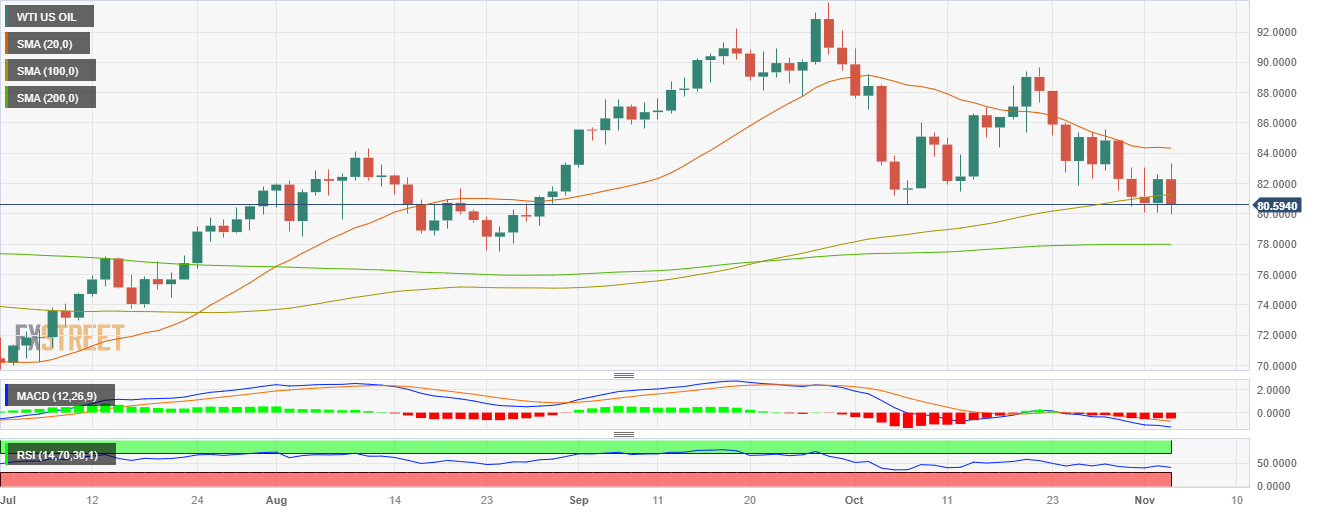
Upon evaluating the daily chart, a neutral to bearish outlook is seen for the WTI, with the balance starting to lean in favour of the bears, although they still have some work to do.The Relative Strength Index (RSI) has a negative slope below its midline, while the Moving Average Convergence (MACD) displays neutral red bars. In addition, the price has fallen below the 20 and 100-day Simple Moving Averages (SMA), which seem to be converging towards the $83.00 area to perform a bearish cross, which would likely trigger further downside for the WTI in the short term. 

 Support levels: $80.50, $80.30, $80.00. 

 Resistance levels: $81.60 (100-day SMA), $82.80, $83.50

WTI Daily Chart
WTI US OIL

Overview
Today last price80.59
Today Daily Change-1.71
Today Daily Change %-2.08
Today daily open82.3
 
Trends
Daily SMA2084.4
Daily SMA5085.98
Daily SMA10081.2
Daily SMA20078
 
Levels
Previous Daily High82.6
Previous Daily Low80.11
Previous Weekly High88.12
Previous Weekly Low81.91
Previous Monthly High90.88
Previous Monthly Low80.52
Daily Fibonacci 38.2%81.65
Daily Fibonacci 61.8%81.06
Daily Pivot Point S180.73
Daily Pivot Point S279.17
Daily Pivot Point S378.24
Daily Pivot Point R183.23
Daily Pivot Point R284.17
Daily Pivot Point R385.73


Author

Patricio Martín

Patricio is an economist from Argentina passionate about global finance and understanding the daily movements of the markets.


More from Patricio Martín
Share:

Editor's Picks

AUD/USD keeps range near 0.6950 after Australian trade data

AUD/USD consolidates near a two-month low, trading around mid-0.6900s in the Asian session on Thursday amid a bullish US Dollar. The US PCE data tempered October Fed hike bets, though oil-driven inflation fears remain supportive of elevated US bond yields. Meanwhile, Australia's trade surplus shrank sharply in August to AUD495M, having limited impact on the Aussie Dollar and the pair.


USD/JPY sits at weekly top above 158.00 as bullish USD counters intervention risks

USD/JPY is sitting at the top end of its weekly range above 158.00 in the Asian session on Thursday. Despite the softer US PCE data, oil-driven inflation risks keep US bond yields elevated near multi-year highs. Moreover, the US-Iran standoff benefits the safe-haven US Dollar and supports the pair. Broad US Dollar strength counters hawkish BoJ expectations and Japanese intervention risks.

Gold struggles as rising US Treasury yields outweigh dovish Fed repricing

Gold treads water on Thursday as a stronger US Dollar and soaring US Treasury yields limit the upside. At the time of writing, XAU/USD trades around $4,167, up 0.26% on the day, as the precious metal struggles to build on its early recovery.

Hyperliquid pares gains as ETF outflows cap tentative bullish recovery

Hyperliquid (HYPE) is down 2% at press time on Thursday, trimming its 5% gains from the previous day. Institutional demand is easing, with $5 million in outflows on Wednesday, weighing on near-term investors' sentiment. The technical outlook for HYPE indicates a near-term mixed tone as the price remains capped below $90.

The Euro is near a one-year low: Inflation could trigger its rebound, not its fall

EUR/USD has fallen to its lowest level since May 2025, but a fresh inflation shock in the Eurozone could give the Euro an unexpected lifeline. The pair hit 1.1312 on Wednesday and trades well below the January peak of 1.2082. The decline reflects a powerful combination of US Dollar strength, geopolitical uncertainty and renewed concerns about Europe's exposure to higher energy prices.

The Euro is near a one-year low: Inflation could trigger its rebound, not its fall

EUR/USD has fallen to its lowest level since May 2025, but a fresh inflation shock in the Eurozone could give the Euro (EUR) an unexpected lifeline. The pair hit 1.1312 on Wednesday and trades well below the January peak of 1.2082.