WTI Crude Oil rises as Red Sea attacks overshadow EIA inventory build
- WTI remains supported as Houthi rebel attacks in the Red Sea escalate.
- The EIA report reveals a surprise build in US stockpiles, but geopolitical risks offset increased supply.
- WTI Crude Oil remains supported by $65.00 support as resistance holds at the 200-day moving average above $68.00.

WTI Crude Oil is trading higher on Wednesday as attacks in the Red Sea overshadow reports of rising supply.
The US Energy Information Administration (EIA)released its weekly inventory report, which revealed that stockpiles increased by 7.07 million barrels over the past week. Expectations had been for the latest report to show a drawdown of 2 million barrels.
The unexpected surge in inventories led to a slight pullback in West Texas Intermediate (WTI) Crude Oil, before it recovered to trade above $67.00 at the time of writing.
Over the weekend, the Organisation of the Petroleum Exporting Countries (OPEC) and its allies (OPEC+) announced that they would increase production by 548,000 barrels per day (bpd) in August.
Between April and July, production from members of OPEC+ has already increased by 1.37 million barrels per day. However, despite the additional supply, geopolitical risks, especially in the Middle East, have limited the downside move.
Red Sea attacks and rising risk premiums support higher Oil prices
Houthi rebels launched a coordinated assault on the Greek-owned bulk carrier Magic Seas on Sunday, forcing the crew to abandon the ship before the vessel sank. The attacks intensified on Monday as drones and speedboats targeted a Liberian-flagged, Greek-operated ship, the Eternity C. Several crew members were killed or went missing, and the ship sank in the early hours of Wednesday.
As a result, risk premiums on Oil have increased, underpinning higher prices.
WTI Crude Oil heads toward the 200-day SMA, providing resistance above $68.00
West Texas Intermediate (WTI) crude is trading around $67.54, holding just above the 50% Fibonacci retracement level of the January-April decline at $67.08, which is acting as immediate support.
The price is facing resistance near the 200-day Simple Moving Average (SMA) at $68.16, with a break above this level potentially paving the way for a move toward the 61.8% Fibonacci level at $69.98.
On the downside, support is reinforced by the 100-day SMA at $65.02 and the 50-day SMA at $64.07, which aligns with the 38.2% retracement at $64.18, creating a strong technical floor.
WTI Crude Oil daily chart
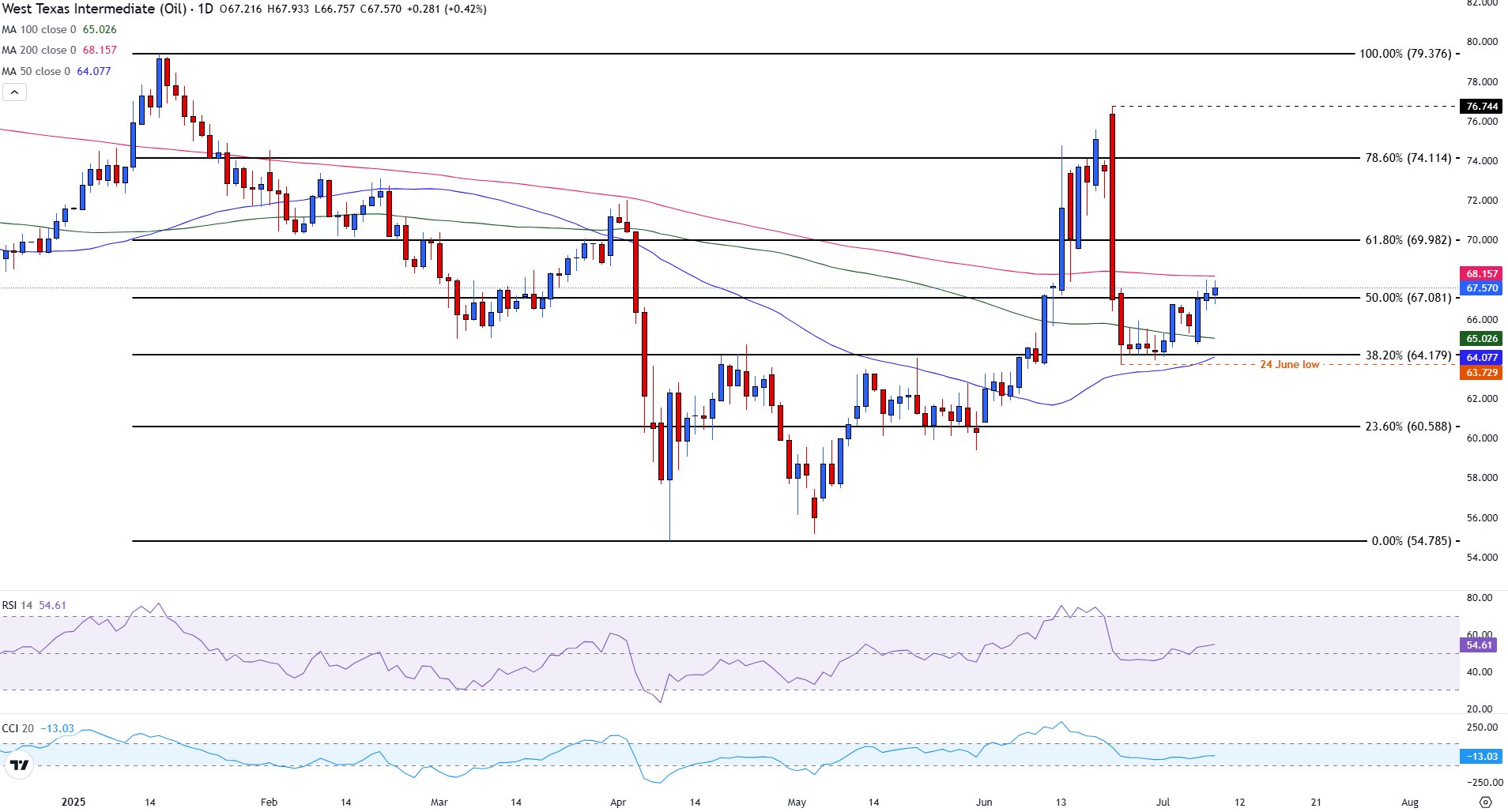
Momentum indicators are mixed. The Relative Strength Index (RSI) is reading slightly above the neutral level at 54, while the Commodity Channel Index (CCI) is slightly negative, reflecting caution among bulls. Despite bearish pressure from rising inventories and increased OPEC+ supply, geopolitical risks in the Middle East are helping to keep prices supported near key technical levels.
WTI Oil FAQs
WTI Oil is a type of Crude Oil sold on international markets. The WTI stands for West Texas Intermediate, one of three major types including Brent and Dubai Crude. WTI is also referred to as “light” and “sweet” because of its relatively low gravity and sulfur content respectively. It is considered a high quality Oil that is easily refined. It is sourced in the United States and distributed via the Cushing hub, which is considered “The Pipeline Crossroads of the World”. It is a benchmark for the Oil market and WTI price is frequently quoted in the media.
Like all assets, supply and demand are the key drivers of WTI Oil price. As such, global growth can be a driver of increased demand and vice versa for weak global growth. Political instability, wars, and sanctions can disrupt supply and impact prices. The decisions of OPEC, a group of major Oil-producing countries, is another key driver of price. The value of the US Dollar influences the price of WTI Crude Oil, since Oil is predominantly traded in US Dollars, thus a weaker US Dollar can make Oil more affordable and vice versa.
The weekly Oil inventory reports published by the American Petroleum Institute (API) and the Energy Information Agency (EIA) impact the price of WTI Oil. Changes in inventories reflect fluctuating supply and demand. If the data shows a drop in inventories it can indicate increased demand, pushing up Oil price. Higher inventories can reflect increased supply, pushing down prices. API’s report is published every Tuesday and EIA’s the day after. Their results are usually similar, falling within 1% of each other 75% of the time. The EIA data is considered more reliable, since it is a government agency.
OPEC (Organization of the Petroleum Exporting Countries) is a group of 12 Oil-producing nations who collectively decide production quotas for member countries at twice-yearly meetings. Their decisions often impact WTI Oil prices. When OPEC decides to lower quotas, it can tighten supply, pushing up Oil prices. When OPEC increases production, it has the opposite effect. OPEC+ refers to an expanded group that includes ten extra non-OPEC members, the most notable of which is Russia.
Author

Tammy Da Costa, CFTe®
FXStreet
Tammy is an economist and market analyst with a deep passion for financial markets, particularly commodities and geopolitics.