WTI Crude Oil prices lurch higher again as Trump barrels into Israel-Iran conflict
- US Crude Oil bids surged on Tuesday, pairing recent declines as geopolitical tensions rise.
- Energy markets are roiling as the Israel-Iran conflict stretches on.
- President Trump is racing toward getting involved directly in the conflict, unplugging market hopes for a quick resolution.


West Texas Intermediate (WTI) US Crude Oil prices rose back into near-term highs on Tuesday, pushed higher by continued escalations in the Israel-Iran conflict. US President Donald Trump is using his favorite policy announcement tool, social media posts, to declare his desire for an “UNCONDITIONAL SURRENDER” from Iranian supreme leader Ali Khamenei, stamping out investor hopes for a quick and peaceful resolution to the tit-for-tat missile strikes between Israel and Iran that have stretched into their fifth straight day.
Market rumors are swirling that Iran is looking to step up its pace of rocket strikes against Israel on Tuesday or Wednesday, sparking fresh investor fears that the Middle East region may not be poised for as quick a peaceful resolution as many traders had hoped heading into the week. US President Donald Trump took to social media to convey direct threats against Iran’s Ayatollah Khamenei, declaring that the US knows exactly where he is, but has no intention of directly striking him down (yet). The escalatory rhetoric from the leader of the US bodes poorly for market hopes of a quick resolution.
WTI Crude Oil price forecast
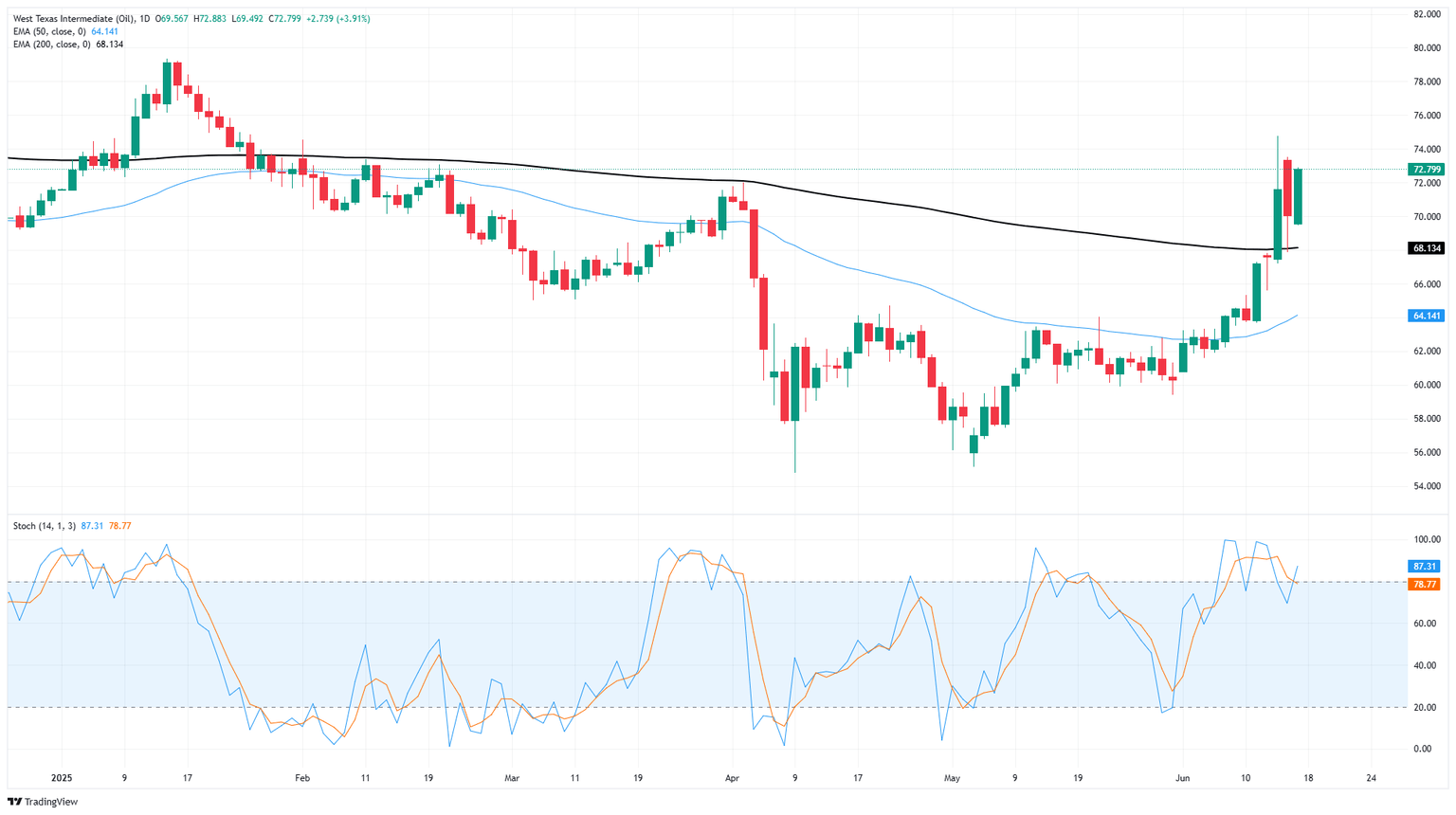
Geopolitical factors have dragged Crude Oil prices firmly higher, pushing WTI bids above the 200-day Exponential Moving Average (EMA) near $68.00 per barrel for the first time since early this year. Bids are roiling on headlines between $72.00 and $74.00, with near-term momentum expected to remain choppy.
WTI daily chart
WTI Oil FAQs
WTI Oil is a type of Crude Oil sold on international markets. The WTI stands for West Texas Intermediate, one of three major types including Brent and Dubai Crude. WTI is also referred to as “light” and “sweet” because of its relatively low gravity and sulfur content respectively. It is considered a high quality Oil that is easily refined. It is sourced in the United States and distributed via the Cushing hub, which is considered “The Pipeline Crossroads of the World”. It is a benchmark for the Oil market and WTI price is frequently quoted in the media.
Like all assets, supply and demand are the key drivers of WTI Oil price. As such, global growth can be a driver of increased demand and vice versa for weak global growth. Political instability, wars, and sanctions can disrupt supply and impact prices. The decisions of OPEC, a group of major Oil-producing countries, is another key driver of price. The value of the US Dollar influences the price of WTI Crude Oil, since Oil is predominantly traded in US Dollars, thus a weaker US Dollar can make Oil more affordable and vice versa.
The weekly Oil inventory reports published by the American Petroleum Institute (API) and the Energy Information Agency (EIA) impact the price of WTI Oil. Changes in inventories reflect fluctuating supply and demand. If the data shows a drop in inventories it can indicate increased demand, pushing up Oil price. Higher inventories can reflect increased supply, pushing down prices. API’s report is published every Tuesday and EIA’s the day after. Their results are usually similar, falling within 1% of each other 75% of the time. The EIA data is considered more reliable, since it is a government agency.
OPEC (Organization of the Petroleum Exporting Countries) is a group of 12 Oil-producing nations who collectively decide production quotas for member countries at twice-yearly meetings. Their decisions often impact WTI Oil prices. When OPEC decides to lower quotas, it can tighten supply, pushing up Oil prices. When OPEC increases production, it has the opposite effect. OPEC+ refers to an expanded group that includes ten extra non-OPEC members, the most notable of which is Russia.
Author
Joshua Gibson
FXStreet
Joshua joins the FXStreet team as an Economics and Finance double major from Vancouver Island University with twelve years' experience as an independent trader focusing on technical analysis.