WTI Crude Oil edges lower amid robust supply and diminishing demand expectations
- WTI Crude Oil edges lower as reports confirm robust supply.
- Red Sea attacks and rising geopolitical risks could continue to influence prices if concerns rise.
- Trump's tariff threats weigh on sentiment, dampening demand expectations for Oil.


West Texas Intermediate (WTI) Crude Oil is trading lower on Thursday, falling back below the $67.00 mark as markets react to renewed supply concerns and softening demand expectations.
At the time of writing, WTI is trading around $66.80 per barrel with losses nearing intraday losses of 2%.
Losses have accelerated after US President Donald Trump confirmed a 50% tariff on Copper imports, effective August 1. He has also threatened 50% tariffs on all goods imported to the US from Brazil.
The renewed trade rhetoric has reignited concerns over global growth and commodity demand, further weighing on risk sentiment.
Adding to the market's unease, the latest report from the US Energy Information Administration (EIA), released on Wednesday, delivered an unexpected blow. Instead of the anticipated 2-million-barrel draw, US crude inventories surged by 7.07 million barrels last week, reinforcing concerns about weakening short-term consumption.
Geopolitical tensions remain elevated following a series of Red Sea attacks claimed by Yemen’s Houthi rebels. These attacks have raised concerns about the safety of shipping lanes in the region, potentially disrupting the flow of Crude Oil. On Sunday, the Magic Seas, a Greek-owned bulk carrier, was struck and sank after the crew evacuated.
Violence escalated Monday when the Eternity C, a Liberian-flagged, Greek-operated vessel, was attacked by Houthi drones and speedboats. Several crew members were reported killed or missing, and the ship sank by early Wednesday. These incidents could lead to increased insurance costs for shipping in the region, potentially impacting Crude Oil prices.
While global supply remains robust, particularly with OPEC+ confirming a 548,000 barrel-per-day output increase for August, the ongoing disruptions to shipping lanes and the significant rise in freight insurance costs in the Red Sea could offer limited support to prices in the near term.
WTI technical analysis: US Crude Oil daily chart
WTI Crude is facing renewed selling pressure near the $67.00 level, struggling to break higher following recent gains.
Support rests at the 100-day Simple Moving Average (SMA) at $64.97, with further downside risk toward the 50-day SMA at $64.23 and the 38.2% Fibonacci retracement of the January-April decline at $64.18.
The low on 24 June at $63.73 marks an additional near-term pivot for downside scenarios.
Price action on the daily chart shows WTI pulling back after testing the 50.0% retracement level, located at $67.08.
Immediate resistance is at this level. A sustained close above this threshold could open the door toward the 200-day SMA at $68.14, followed by the 61.8% retracement at $69.98.
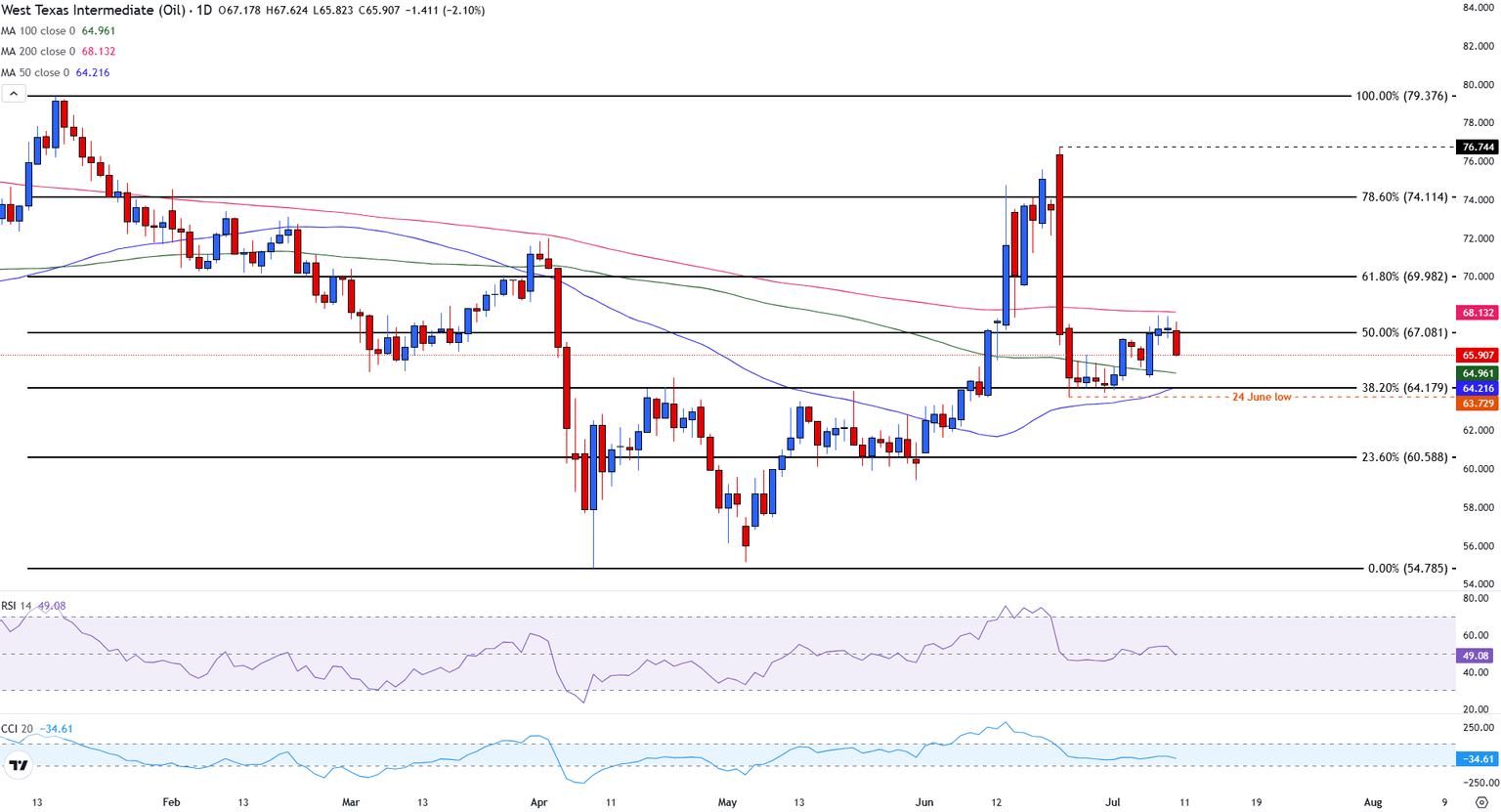
The Relative Strength Index (RSI) is around 49, indicating neutral momentum and limited directional conviction at this stage.
The Commodity Channel Index (CCI) sits at -35, suggesting mildly bearish short-term sentiment but that WTI is not yet in oversold territory.
WTI Oil FAQs
WTI Oil is a type of Crude Oil sold on international markets. The WTI stands for West Texas Intermediate, one of three major types including Brent and Dubai Crude. WTI is also referred to as “light” and “sweet” because of its relatively low gravity and sulfur content respectively. It is considered a high quality Oil that is easily refined. It is sourced in the United States and distributed via the Cushing hub, which is considered “The Pipeline Crossroads of the World”. It is a benchmark for the Oil market and WTI price is frequently quoted in the media.
Like all assets, supply and demand are the key drivers of WTI Oil price. As such, global growth can be a driver of increased demand and vice versa for weak global growth. Political instability, wars, and sanctions can disrupt supply and impact prices. The decisions of OPEC, a group of major Oil-producing countries, is another key driver of price. The value of the US Dollar influences the price of WTI Crude Oil, since Oil is predominantly traded in US Dollars, thus a weaker US Dollar can make Oil more affordable and vice versa.
The weekly Oil inventory reports published by the American Petroleum Institute (API) and the Energy Information Agency (EIA) impact the price of WTI Oil. Changes in inventories reflect fluctuating supply and demand. If the data shows a drop in inventories it can indicate increased demand, pushing up Oil price. Higher inventories can reflect increased supply, pushing down prices. API’s report is published every Tuesday and EIA’s the day after. Their results are usually similar, falling within 1% of each other 75% of the time. The EIA data is considered more reliable, since it is a government agency.
OPEC (Organization of the Petroleum Exporting Countries) is a group of 12 Oil-producing nations who collectively decide production quotas for member countries at twice-yearly meetings. Their decisions often impact WTI Oil prices. When OPEC decides to lower quotas, it can tighten supply, pushing up Oil prices. When OPEC increases production, it has the opposite effect. OPEC+ refers to an expanded group that includes ten extra non-OPEC members, the most notable of which is Russia.
Author
Tammy Da Costa, CFTe®
FXStreet
Tammy is an economist and market analyst with a deep passion for financial markets, particularly commodities and geopolitics.