Why the Cac could be vulnerable to French political risk


The Cac 40 index is a major underperformer in the European equity space on Monday, as investors and traders react to news that another French Prime Minister has been forced to resign, leaving the Eurozone’s second largest economy politically rudderless once again.
The French index is down more than 1% today, it has picked up from its lows, but it remains under pressure compared to its peers. It is also a major laggard so far this year. The Cac is higher by 8% so far this year, compared to a 34% gain for Spain’s Ibex, a 22% gain for the Dax and a 16% gain for the FTSE 100. The question now is, will French stock market underperformance continue?
Usually stock markets can absorb political risks well, for example, US stocks hit record highs last week even though the US Federal Government shut down, the UK index has also hit a record recently even though the UK is on the cusp of a political and fiscal crisis not dissimilar to France.
So, why is the Cac underperforming, and will it continue? We think that the answer is yes, due to these two reasons:
The investor mix
The Cac 40 is 45% owned by international investors, and they are the top holders of the French index, largely due to the index’s raft of international healthcare, defense and luxury companies. In contrast, the top holders of Germany’s Dax includes the US, but also domestic investors, who constitute the second largest group of shareholders in the index. Other European investors also favour the Dax over the Cac 40.
Having a larger share of international investors could make the Cac more vulnerable to a sell off, especially as political risks build. This is because international investors may have less loyalty than domestic investors and less patience when it comes to domestic political troubles.
The earnings outlook
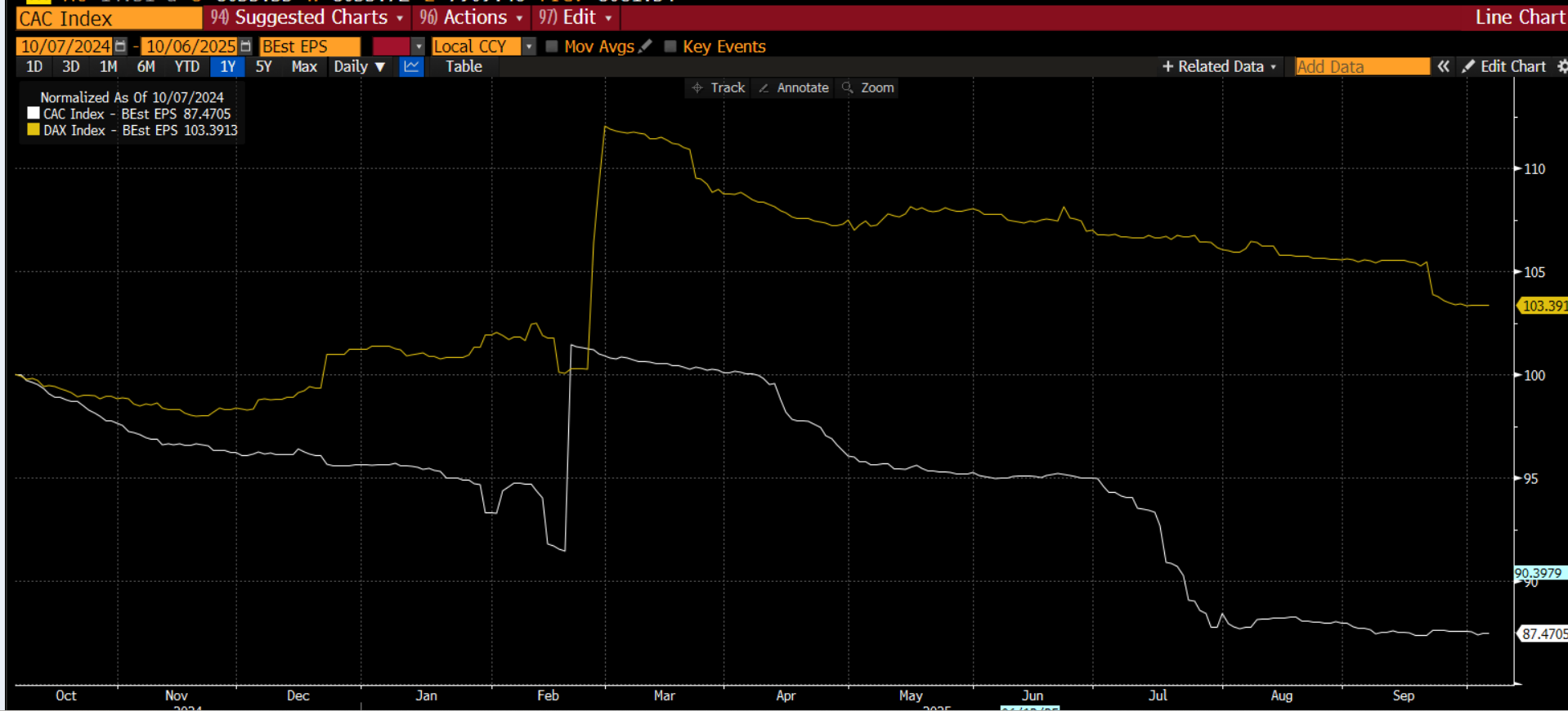
Earnings are also an issue for the Cac 40. Analysts are pessimistic on the outlook for the Cac 40’s earnings growth. The chart below shows the Q3 2025 earnings estimates for the Cac 40 and the Dax 30. As you can see, there is a growth gap between the Dax and the Cac, with analysts expecting stronger earnings per share growth for German corporates, relative to their French peers. This could also act as a drag on the Cac going forward.
Cac and Dax EPS Q3 2025, normalized to show how they move together
Source: XTB and Bloomberg
To conclude, a political risk premium could be added to the Cac by its international investor base, and the French index may struggle to close the gap with its peers for the rest of this year. The fact that earnings growth is lagging other European indices is not helping to boost its performance, and it could be a tough Q4 for this index.
Author
Kathleen Brooks
XTB UK
Kathleen has nearly 15 years’ experience working with some of the leading retail trading and investment companies in the City of London.