Why more Americans are turning to Gold IRAs for their retirement planning

As the US economy goes through a period of volatility and political uncertainty, more and more Americans are reviewing their long-term savings strategy. For many, this means re-evaluating Gold's place in their portfolio – and particularly within their Individual Retirement Account, or IRA.
What is an IRA and why is it important?
An IRA, or Individual Retirement Account, is a personal retirement account that allows Americans to build long-term tax-advantaged savings. There are several types, the most common being the traditional IRA, where contributions can be deducted from taxes (withdrawals are taxed at retirement), and the Roth IRA, where contributions are not deductible, but withdrawals are tax-free if certain conditions are met.
IRAs are popular because they enable independent retirement planning, complementing employer-sponsored 401(k)-type plans. They also offer greater freedom in the choice of assets: stocks, bonds, funds, and even... precious metals.
While Social Security provides a basic retirement income for most Americans, IRAs allow you to build additional savings and achieve greater financial independence in retirement planning.
Gold IRA: An increasingly attractive option
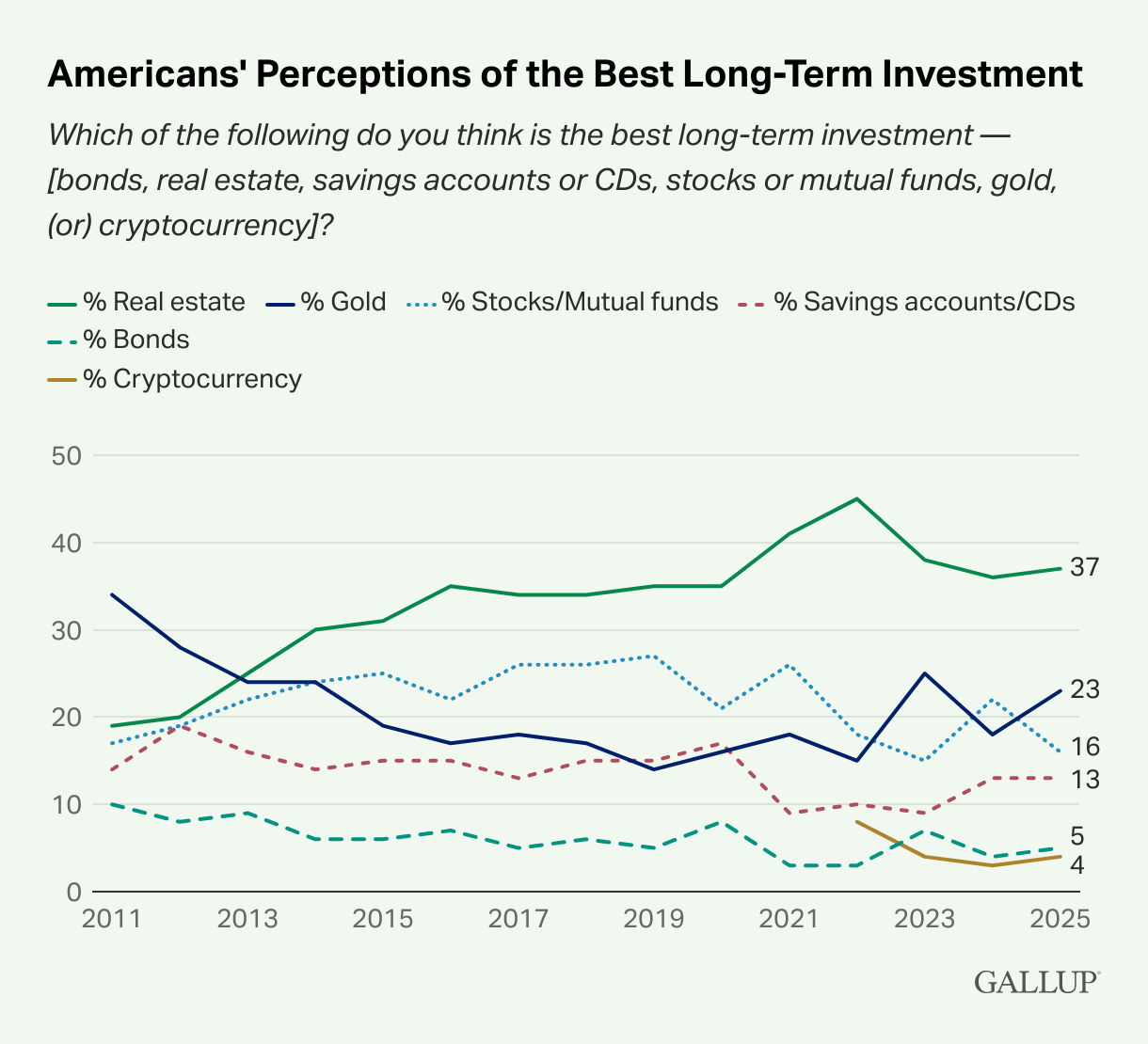
According to a recent Gallup poll conducted in April, 23% of Americans now consider Gold to be one of the best long-term investments, just behind real estate (37%), but ahead of stocks (16%). This is a significant increase from the 18% who chose Gold in 2024.
Why this renewed interest in the yellow metal? It is based on a combination of factors:
- High stock market volatility, accentuated by the Trump administration's new tariff policies.
- Persistent inflationary fears.
- Gold topped $3,500 an ounce in the first half of 2025, reaching all-time highs.
In this uncertain climate, Gold is regaining its safe-haven status. And for savers concerned about their retirement planning, it is becoming a serious option, notably via Gold IRAs.
Gold IRAs: When Gold becomes part of the retirement plan
A Gold IRA is a specific type of retirement account authorized to hold physical metals (ingots and coins of Gold, Silver, etc.), provided they meet certain purity standards set by the IRS.
These accounts must be managed by an authorized custodian, and the metals must be stored in a secure warehouse.
Why choose a Gold IRA?
- Diversification: Incorporating tangible assets reduces correlation with equity and bond markets.
- Protection against inflation: Gold has historically been a good bulwark against the loss of purchasing power.
- Perceived security: In times of economic or geopolitical turmoil, Gold is reassuring.
It is important to note, however, that Gold IRAs also carry specific fees (storage, management), and do not pay out income like dividend-paying stocks or bonds.
Gold IRAs aren't risk-free either, since if the price of Gold falls, so does the value of your savings.
A marked phenomenon across socio-economic categories
The renewed interest in Gold is particularly marked among low-income households. Among those earning less than $50,000 a year, 27% prefer Gold, compared with just 17% among those earning over $100,000.
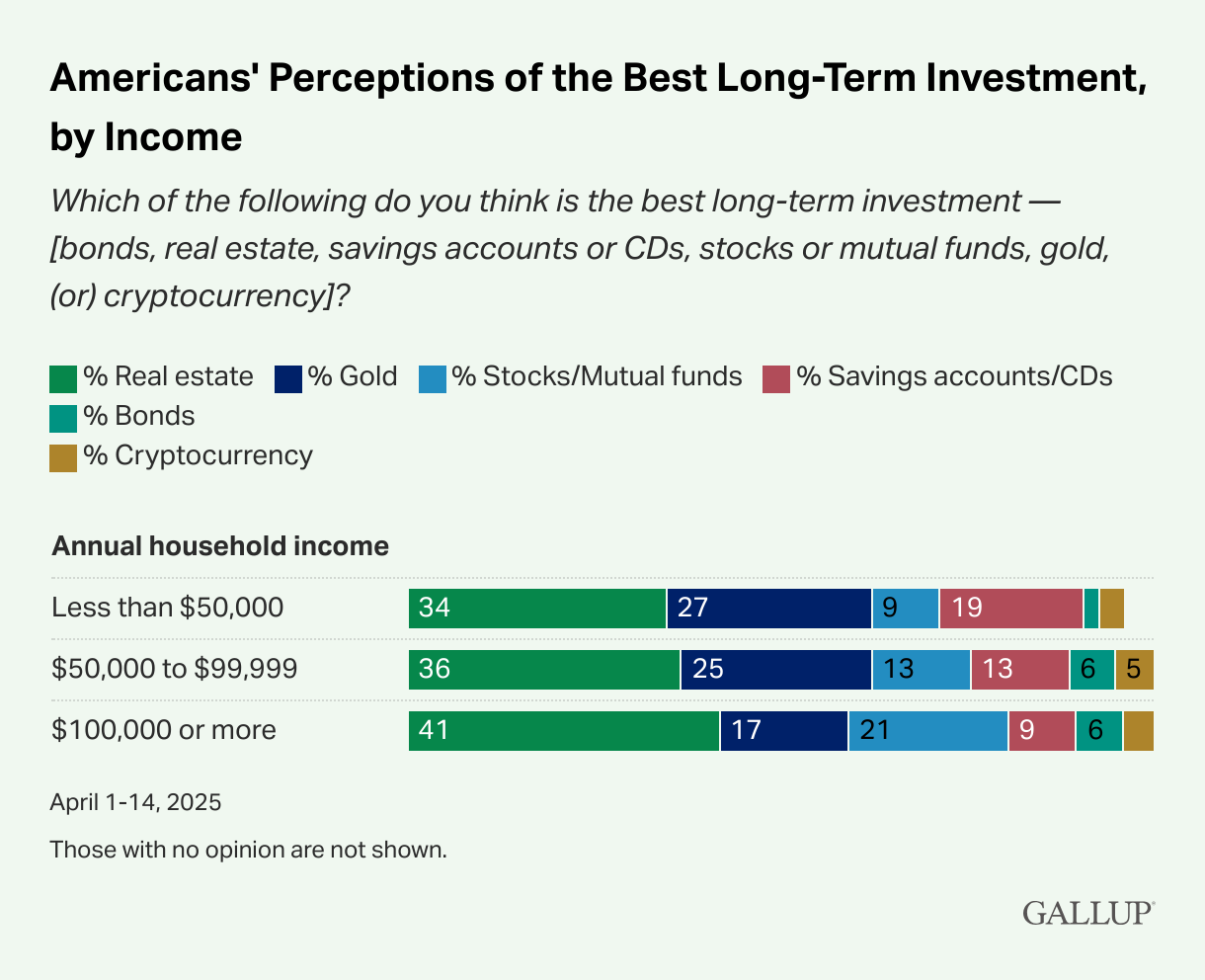
This is partly due to increased risk aversion and less confidence in traditional financial markets.
A response to retirement worries
Despite a relatively stable IRA or 401(k) ownership rate (around 59%), the fear of not getting a good return on one's investments is very present.
More than half (53%) of Americans surveyed by Gallup say they are worried about their long-term financial performance. For those who already own stock market assets, this concern rises to 62%.
For many, Social Security alone will not be enough to maintain their standard of living after retirement. That’s why private savings, including IRAs, play such a critical role, and why assets like Gold are gaining popularity within these plans.
In this context, for some people, including Gold in their IRAs is a rational response: better a tangible, stable asset than an uncertain return on equity markets.
Will Gold continue to shine in retirement portfolios?
While Gold has yet to regain the record level of popularity it achieved in 2011 (34% of those polled), its current ascendancy testifies to a profound change in perception among American savers.
As long as stock market volatility and economic tensions persist, interest in Gold IRAs could continue to grow.
However, Gold should not be seen as a quick fix. It is part of a broader strategy of diversification and risk management. Like any asset, it has its limitations, notably the absence of a regular return and specific taxation in the event of withdrawal.
Gold IRAs for retirement planning suit the economic environment better
Gold's return to favor in American retirement planning reflects, above all, an adaptation to an uncertain economic environment.
Thanks to IRAs, and Gold IRAs in particular, investors now have a flexible tool for securing their financial future, especially as questions grow around the long-term sustainability and adequacy of Social Security benefits.
But it's important to understand the advantages, constraints and trade-offs involved in making IRAs a true long-term ally.
Gold Market Movers: Price moves away from one-week top amid modest USD strength
Gold price edges up during the European session on Wednesday, trading slightly below the one-week top at $3,358 touched on Tuesday.
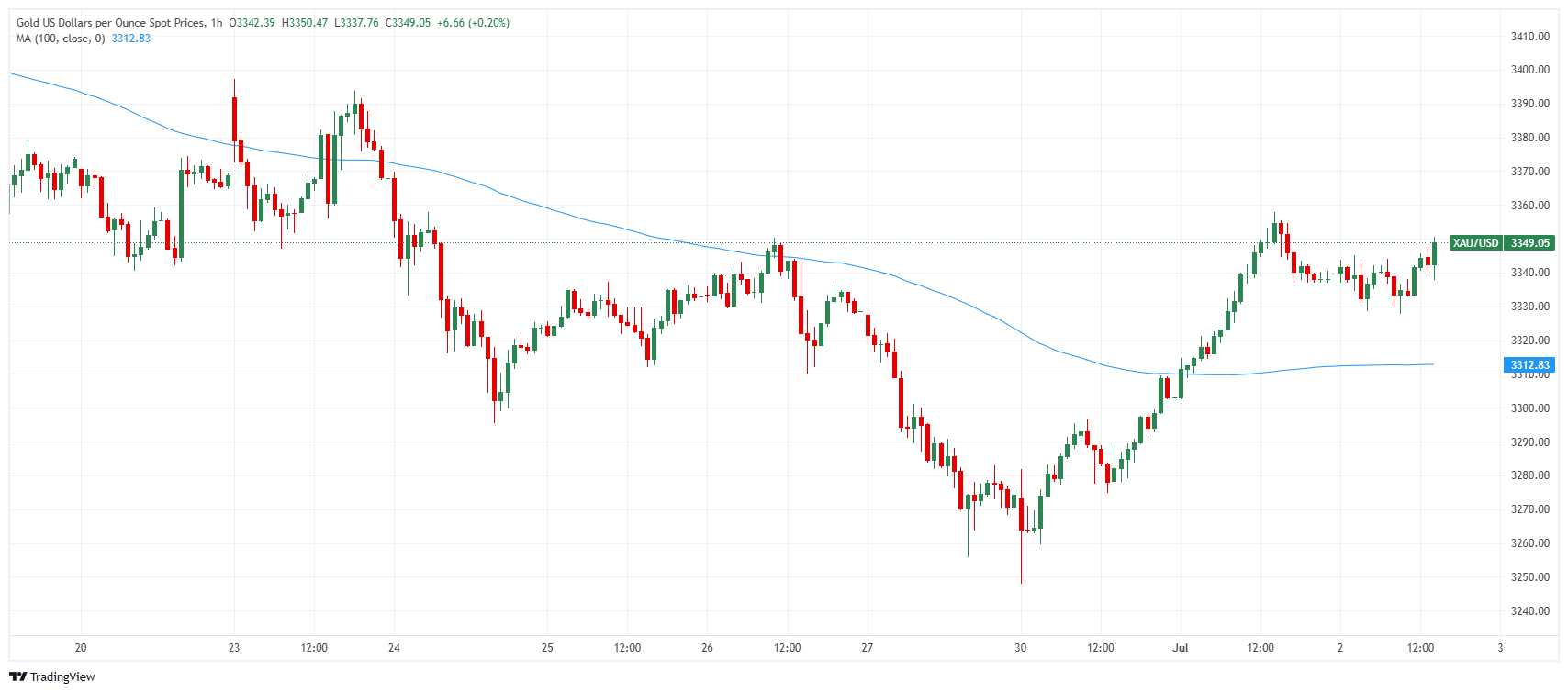
Gold price chart. Source: FXStreet.
Gold’s valuation is closely related to the US interest-rate outlook. In this regard, Fed Chair Jerome Powell said on Tuesday that the US central bank would have already cut interest rates by now if not for the highly uncertain economic path created by US President Donald Trump’s tariff policies.
When asked if July would be too soon for markets to expect a rate cut, Powell answered that it’s going to depend on the data. Nevertheless, traders are pricing in over a 20% chance that the Fed will cut rates at the July meeting.
More significantly, there is a nearly 75% probability of a 25 basis point rate reduction by the Fed at the September monetary policy meeting. This caps any further USD recovery and supports the non-yielding yellow metal.
On the economic data front, the ADP report on private-sector employment showed that the US economy shed 33,000 jobs in June against expectations of a 95,000 gain. The data weighed on the US Dollar and further supported Gold prices ahead of the official Nonfarm Payrolls (NFP) report on Thursday.
On Tuesday, the Institute of Supply Management (ISM) reported that economic activity in the US manufacturing sector contracted for the fourth consecutive month, though at a slower pace in June.
Separately, the Job Openings and Labor Turnover Survey (JOLTS) revealed that the number of job openings stood at 7.769 million on the last business day of May, up from 7.395 million in April and 7.3 million anticipated.
Trump threatened to impose higher tariffs on Japanese imports over the latter's alleged unwillingness to buy American-grown rice. This comes ahead of the July 9 deadline for Trump's reciprocal tariffs and fuels uncertainty.
Author

Ghiles Guezout
FXStreet
Ghiles Guezout is a Market Analyst with a strong background in stock market investments, trading, and cryptocurrencies. He combines fundamental and technical analysis skills to identify market opportunities.