Gold price jumps as US inflation knocks the US Dollar off its pedestal
- US June CPI cools sharply, cutting year-end Fed tightening bets.
- Warsh warns one benign print does not finish inflation fight.
- Higher Oil keeps July inflation risks alive amid Iran hostilities.

Gold price surges by some 1.50% on Tuesday as US consumer inflation data came in below estimates, easing pressure on the Federal Reserve (Fed) to further tighten ahead of 2026. The XAU/USD trades at $4,050 after bouncing off daily lows of $3,983.
XAU/USD rebounds as softer CPI weakens Dollar and yields
The yellow metal is trimming some of its Monday losses, supported by the drop in the US Consumer Price Index (CPI). June’s CPI missed estimates, dipping from 4.2% to 3.5% YoY, beneath estimates for a slowdown of 3.8%, an indication that aggressive rate hikes by the Fed are not needed. Underlying inflation did not approach the Fed’s 2% goal but eased from 2.9% to 2.6%, also below forecasts of 2.8%.
Investors promptly reduced Fed hawkish bets. On Monday, money markets expected over 35 basis points (bps) of tightening towards year-end, but as of writing, stand at just 18 bps, implying a 72% chance of a rate hike in 2026, according to Prime Terminal data.
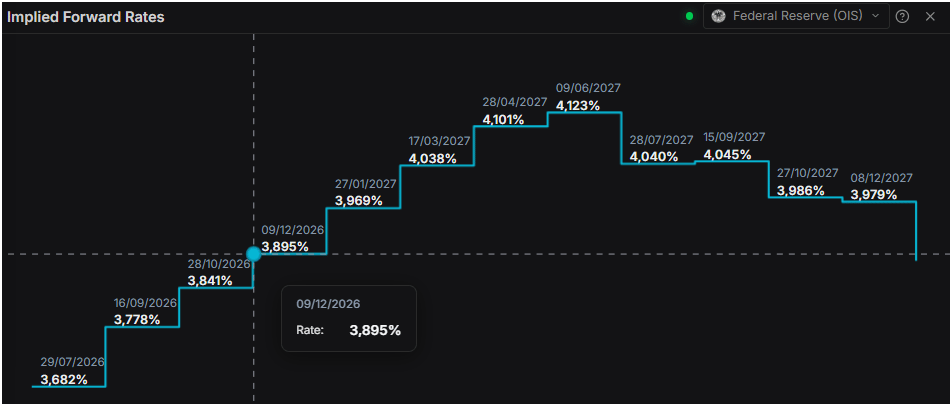
In the short term, the conclusion is that US inflation is edging lower. However, the resumption of hostilities in the Middle East has pushed Oil prices higher, with West Texas Intermediate (WTI), the US Oil benchmark, up 1% in the day and 10.27% in July. This means that June’s inflation dip — worth noting that it's the lowest monthly reading since 2020—could be short-lived due to the jump in energy prices.
Fed officials encouraged by data; yet job is not done
Fed Chair, Kevin Warsh, testified before the US Congress. In prepared remarks, he emphasized that the US central bank has no tolerance for “persistently elevated inflation,” reaffirmed that the Fed is committed to achieving the 2% goal. Regarding June’s CPI, he said it doesn’t mean the mission was accomplished and that he doesn’t want to overread to just one month of data.
In the meantime, the US Dollar Index (DXY), which measures the buck’s value against six currencies, is down 0.35% at 100.92, a tailwind for Gold. A weaker US Dollar benefits Bullion, making it cheaper for foreign investors.
The yellow metal benefits from lower US Treasury yields, and the US 10-year T-note yield did descend lower, nearly four-and-a-half bps to 4.581%.
Other Fed officials crossed the wires. Chicago Fed President Austan Goolsbee commented that June’s CPI “was surprisingly benign” but added that he never wants to overreact to one month of data. Goolsbee added that after several months of readings like this, the Fed would be in a better place regarding monetary policy.
Meanwhile, geopolitics continued to grab the headlines as the US and Iran exchanged fire, with the latter launching attacks on a US air base in Jordan. Meanwhile, Washington continued to attack military targets aimed at dismantling Iran’s military infrastructure, aimed to disrupt safe sailing through the Straight of Hormuz.
Prolonged hostilities could increase the likelihood of a prolonged period of keeping interest rates higher for longer, which could dent the appetite for the non-yielding metal.
This week, the US economic calendar includes the June PPI, expected to fall from 6.5% to 6.2%, and the core PPI, anticipated to rise from 4.9% to 5.2%. Traders will also watch Fed speeches by Chair Warsh, Governor Cook, and NY Fed President Williams.
XAU/USD price forecast: Gold remains bearish despite testing $4,100
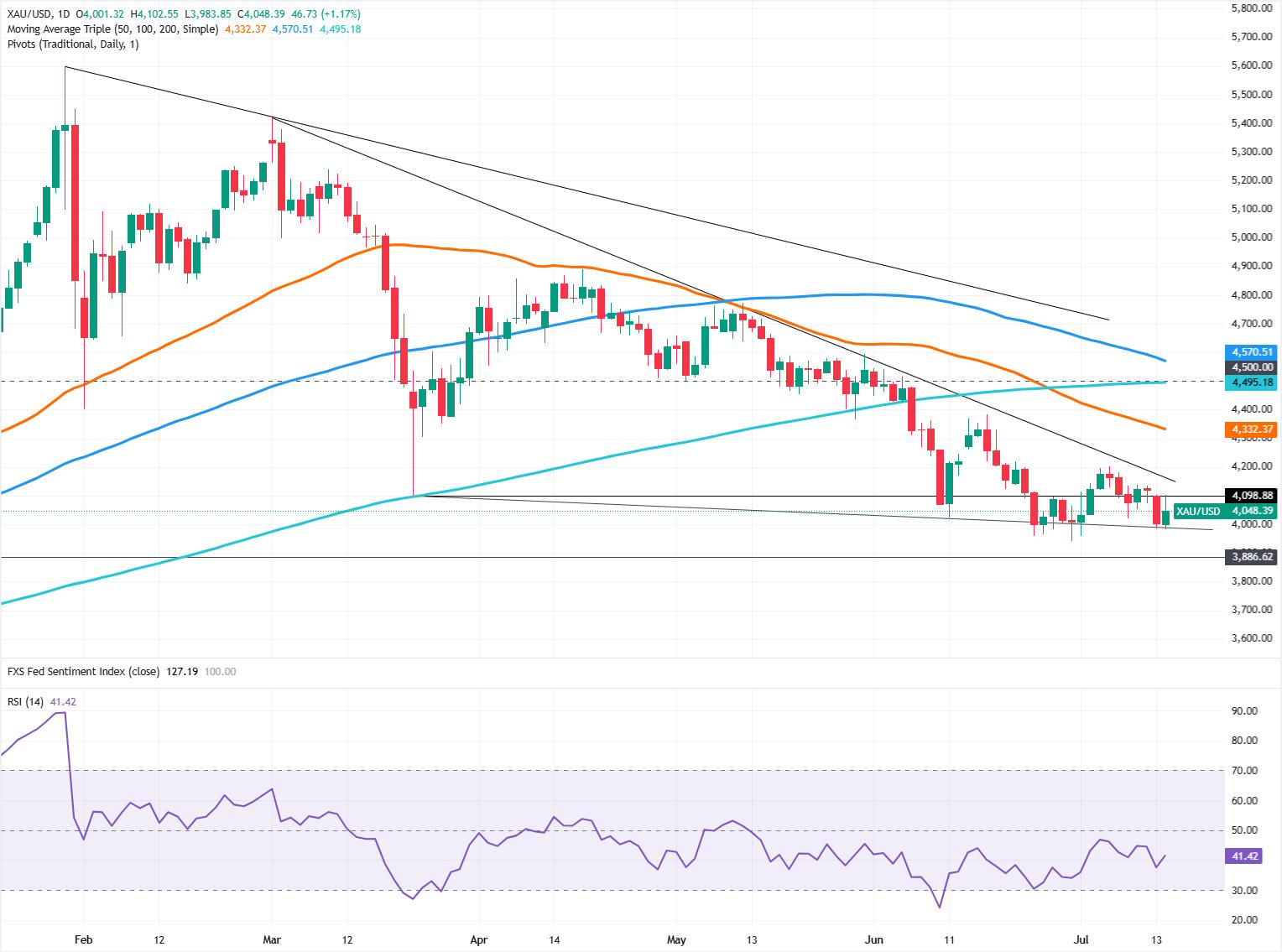
Gold’s overall trend remains downward despite trimming some of its Monday losses near 3% due to the inflation data. However, the rally has been contained, with XAU/USD retreating toward the $4,050 area after peaking at$4,109.
Momentum, as measured by the Relative Strength Index (RSI), suggests further downside, but in the short term, buyers are moving in, keeping Gold prices above the $4,000 threshold.
For a bullish resumption, Gold must clear the day's high at $4,109, so buyers could potentially test $4,150. On further strength, the next resistance level would be a downslope resistance trendline at around $4,160, followed by the psychological $4,200 mark.
Downwards, the first support is at $4,000. Below lies the year-to-date (YTD) low of $3,941. A breach of the latter will expose the October 28, 2025 swing low at $3,886, ahead of a drop toward $3,500.
Gold FAQs
Gold has played a key role in human’s history as it has been widely used as a store of value and medium of exchange. Currently, apart from its shine and usage for jewelry, the precious metal is widely seen as a safe-haven asset, meaning that it is considered a good investment during turbulent times. Gold is also widely seen as a hedge against inflation and against depreciating currencies as it doesn’t rely on any specific issuer or government.
Central banks are the biggest Gold holders. In their aim to support their currencies in turbulent times, central banks tend to diversify their reserves and buy Gold to improve the perceived strength of the economy and the currency. High Gold reserves can be a source of trust for a country’s solvency. Central banks added 1,136 tonnes of Gold worth around $70 billion to their reserves in 2022, according to data from the World Gold Council. This is the highest yearly purchase since records began. Central banks from emerging economies such as China, India and Turkey are quickly increasing their Gold reserves.
Gold has an inverse correlation with the US Dollar and US Treasuries, which are both major reserve and safe-haven assets. When the Dollar depreciates, Gold tends to rise, enabling investors and central banks to diversify their assets in turbulent times. Gold is also inversely correlated with risk assets. A rally in the stock market tends to weaken Gold price, while sell-offs in riskier markets tend to favor the precious metal.
The price can move due to a wide range of factors. Geopolitical instability or fears of a deep recession can quickly make Gold price escalate due to its safe-haven status. As a yield-less asset, Gold tends to rise with lower interest rates, while higher cost of money usually weighs down on the yellow metal. Still, most moves depend on how the US Dollar (USD) behaves as the asset is priced in dollars (XAU/USD). A strong Dollar tends to keep the price of Gold controlled, whereas a weaker Dollar is likely to push Gold prices up.
Author

Christian Borjon Valencia
FXStreet
Markets analyst, news editor, and trading instructor with over 14 years of experience across FX, commodities, US equity indices, and global macro markets.