Why midcap stocks can outperform in the global rally

2026 has started with a bang, geopolitics, commodity price volatility and the return of the AI trade has had a big impact on financial markets and we’re only mid-way through January.
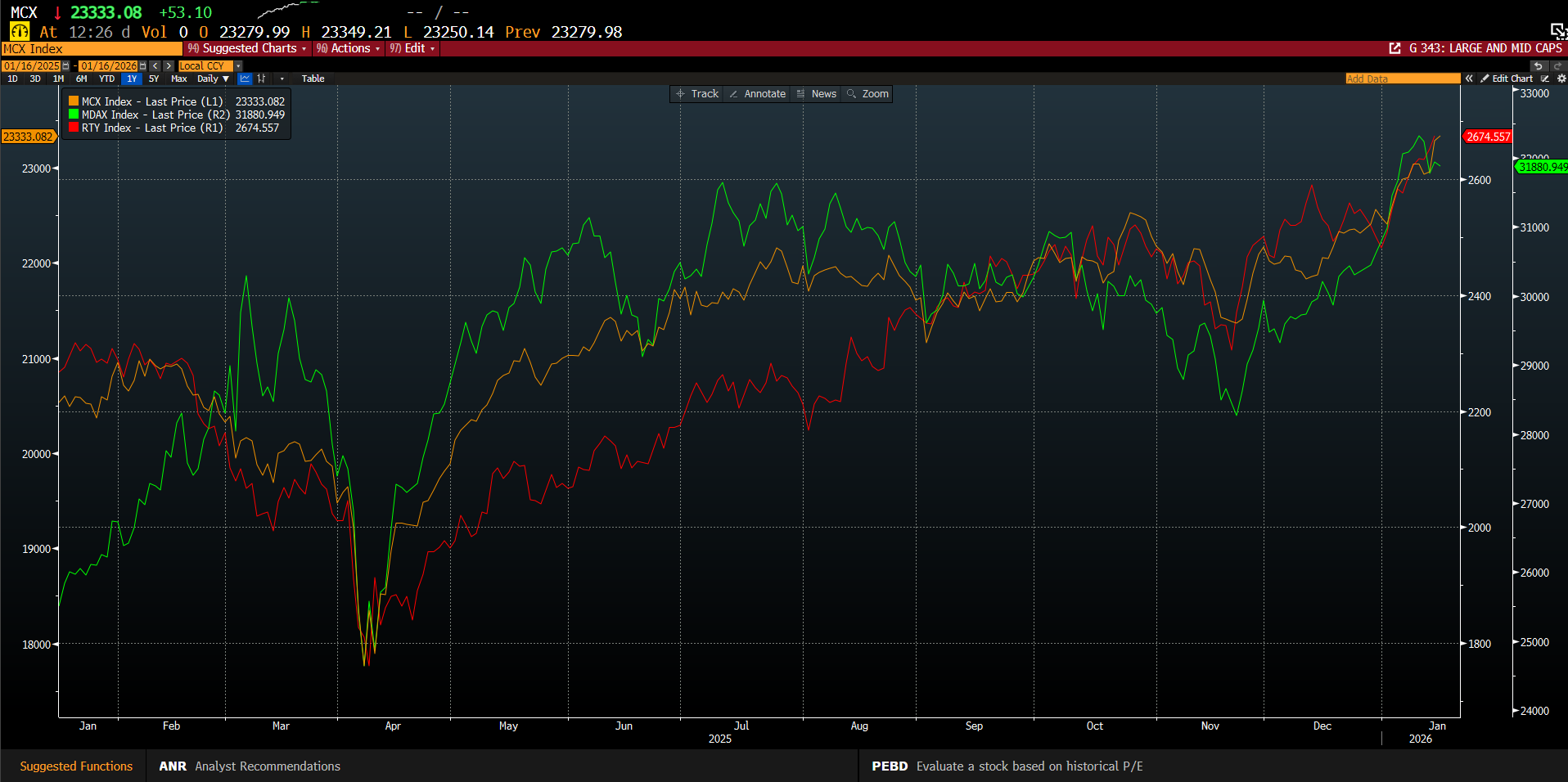
The FTSE 100, the Dax and the S&P 500 have all made record highs this year, and the mid-caps are keeping up after underperforming the blue-chip indices in recent years. The Russell 2000 has already made a record high for 2026, the FTSE 250 is close to the record highs from September last year, and the MDAX recently broke above the key 30,000 level, which opens the door to last year’s highs.
There are three specific reasons why we like midcaps this year:
1. Momentum is on their side, as you can see in the chart below. Added to this, if you strip out the biggest trillion-dollar tech giants from US indices, stocks have been driven higher by high quality value stocks so far this year. Positive earnings revisions are also a key driver, and strong liquidity is boosting demand for equities outside of mega cap blue chip names.
2. Tech risks: The S&P 500 has been driven by the tech sector so far in 2026, and the best performing stock is memory chip maker Sandisk. This stock is higher by 72% this year. The semiconductor sector has surged by 25% so far this year, outperforming the overall S&P 500 index by a wide margin, it only up 1.4%. This suggests that concentration risk is real for US blue chip stocks once again this year and if investor enthusiasm for the AI trade sours, then the S&P 500 could sell off sharply.
In contrast, there is a broader group of top performers on the Russell 2000, for example, the top performing sectors include basic materials, energy and telecoms. Tech is only the fourth top performing sector. The top performing stock on the Russell 2000 is Erasca, a pharma company that develops early stage cures for cancer. This stock could be resilient if the tech story starts to unwind.
3. Commodity price volatility: the FTSE 100 has been led higher by a mix of miners and defense firms. While we expect defense to be a powerful investment theme for the rest of this decade, miners are at risk from geopolitics and commodity price volatility, as well as M&A as Rio Tinto makes another attempt to buy Glencore.
In contrast, the top performers on the FTSE 250 are more diversified. They include Ocado, Ashmore Group, Jupiter Fund Management and Oxford Biomedica. This does not reduce the risk for investors, but it does spread it around. 2026 is turning out to be an unpredictable year, and diversification can be the best line of defense for investors in UK equities.
Added to this, the FTSE 250 is more domestically focused than the FTSE 100. 45-55% of annual revenue generated by the FTSE 250 each year is from domestic sources, compared to 25-30% for the FTSE 100. Thus, as the UK economy picks up, November growth already surprised on the upside, the FTSE 250 could benefit.
Chart 1: Russell 2000, FTSE 250 and Mdax, midcap stocks have started the year strong
Author

Kathleen Brooks
XTB UK
Kathleen has nearly 15 years’ experience working with some of the leading retail trading and investment companies in the City of London.