What to expect from the Q4 earnings reporting season
-
The Q4 reporting season is shaping up to be the worst since the pandemic began.
-
The outlook for Q1 and Q2 are in decline.
-
The biggest risks for the market are the FOMC, interest rate hikes and downward revisions for 2023.


If the Q3 earnings reporting season can be used as a guide the Q4 season will the worst since the pandemic began. At face value, the S&P 500 (NYSEARCA:SPY) was able to post earnings growth in Q3 but the internals are tepid, very tepid.
At only 2.5%, the pace of growth in Q3 was not only the lowest it’s been since the pandemic began (and even for a time before) but it is also weaker than what the analysts were expecting at the start of the quarter.
On September 30th, 2022 the consensus for the S&P 500 was 2.9% which means the index earnings growth rate shed 40 basis points by the end of the reporting period versus a tendency to gain. This is the first quarter the S&P 500 has not outperformed its expectations in many years, since well before the pandemic, and it is possible this phenomenon will turn into a trend.
Q4 will see S&P 500 earnings contract
The consensus outlook for the Q4 period is sitting near -2.5% for the S&P 500 and it is trending lower. This figure is down from the 10.10% growth that was expected mid-year and it is very possible the final tally will be worse than currently predicted. On a sector basis, there are only 4 sectors expected to see earnings growth and the only one of significance is the energy sector (NYSEARCA: XLE).
The remaining 3 growth sectors won’t see better than 38% growth (the industrials and this is due to the post-pandemic rebound) and all 10 sectors other than Energy have their consensus earnings figures in decline.
The most important sector for the Q4 holiday shopping period is the Consumer Discretionary Sector (NYSEARCA:XLY). The Consumer Discretionary Sector is not only expected to have the 2nd worst earnings contraction of all the 11 S&P 500 sectors and the expectation for the decline has more than doubled in the last 2 months from about -7.0% to worse than -18%.
Assuming this trend continues and there is no reason to expect it to change, the Discretionary Sector could easily see its earnings contract more than 20% by the time the season is over.
The biggest risk to the market is downward revisions to the 2023 outlook
Right now the market is expecting to see earnings growth resume in 2023 but there is a very big risk to that outlook. Up until now, analysts have been hesitant to lower their outlook for even just the very next quarter and this can be seen in the data. The outlook for Q4 did not start imploding until after the start of the Q3 reporting cycle and we can expect this to happen again in Q4.
Once the Q4 reporting period gets going the analyst are going to start revising their outlook for Q1 2023 and, by extension, all of 2023. If those revisions are downward as they are most likely to be the S&P 500 will resume its downward slide as well.
On a sector basis, the Consumer Discretionary Sector is expected to be the big winner in 2023 which is where the risk is centered. The top 2 holdings of the XLY are Amazon (NASDAQ:AMZN) and Tesla (NASDAQ:TSLA), both of which are highly exposed to the impact of higher interest rates on the consumer.
The FOMC is expected to slow the pace of its interest rate hiking but not the duration. If anything, the committee will hike rates to above 5.0% by the middle of next year and that will cut deeply into Tesla and Amazon sales.
The technical outlook: The S&P 500 bear market is not over
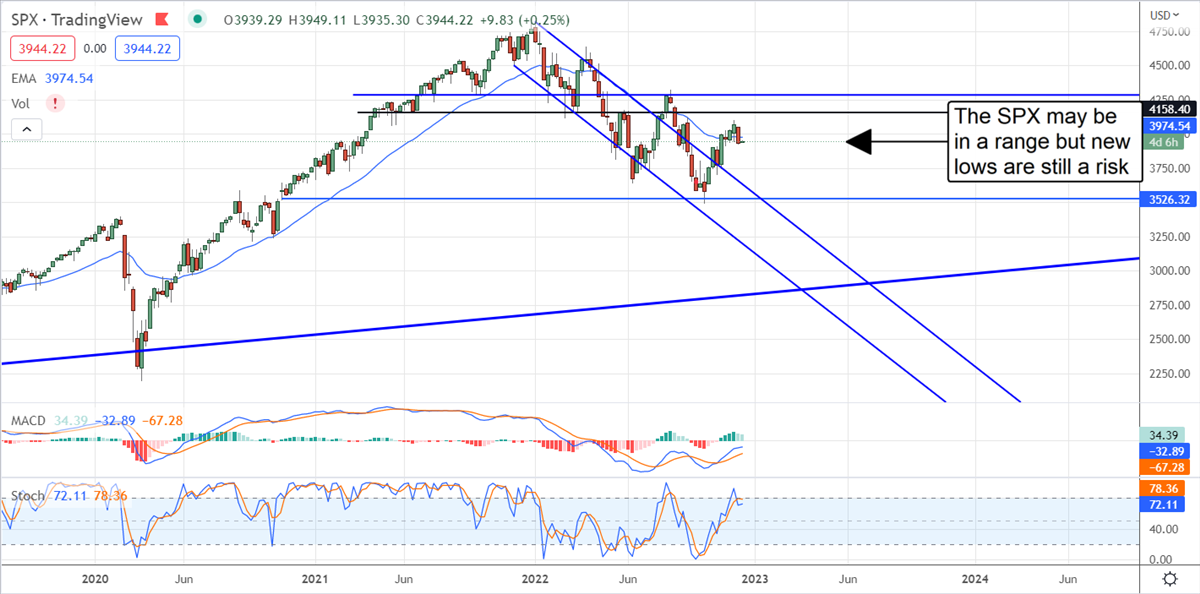
The S&P 500 hit a bottom in early October and may have entered a trading range but the downtrend is not over by a long shot. While the original down channel has been broken, at this time, it is more likely the downtrend was shifted forward than ended. As it is, the S&P 500 index is still well below key resistance at the 4,160 level and it looks like a peak has been reached.
The next down leg in the market could begin before the onset of Q4 reporting because of inflation and the FOMC. While the outlook for earnings is what is driving the index, it is inflation and the FOMC that are driving the earnings outlook.
Author
Jacob Wolinsky
ValueWalk
Jacob Wolinsky is the founder of ValueWalk, a popular investment site. Prior to founding ValueWalk, Jacob worked as an equity analyst for value research firm and as a freelance writer. He lives in Passaic New Jersey with his wife and four children.