What Intel and Qualcomm Q2 earnings can tell us about the state of semiconductor stocks
- Intel and Qualcomm both gave pessimistic guidance during last week's earnings calls.
- Last year's chip crunch has turned into an oversupplied environment.
- PC and data center demand is dropping, worsening outlook for semiconductor stocks.

My oh my, how things change. This time last year all the semiconductor talk was about how chip customers were waiting a year for shipments and how some auto manufacturers were producing stripped-down models without all the necessary chip-required bells and whistles. In this case, a year makes a world of difference.
Also read: Nvidia Stock Deep Dive Analysis: NVDA price target at $205 with strong revenue growth
Both Intel (INTC) and Qualcomm (QCOM) unveiled second-quarter earnings last week that stoked fear in the markets. What had been robust demand in 2021 and in the first quarter appeared to be melting away. Both companies lowered guidance for the back half of the year in a sign that semiconductor stocks have a rocky road ahead despite versions of the CHIPS Act passing both the House and Senate.
Intel stock news
Intel (INTC stock) missed estimates for its fiscal second quarter by a quite unexpected margin of 64 cents. In fact, the GAAP loss came in at $-0.11 and was the first GAAP loss since FQ4 2017. To make matters worse, that quarter nearly five years ago only produced a loss due to a one-time charge for changes in the tax code regarding foreign earnings. In addition, and much more worrisome to analysts, Intel missed the quarter's revenue projection by $2.6 billion, something no one had been expecting.
Intel CEO Pat Gelsinger, in an unusual move for chief executives, was contrite and took the blame for the quarter's shortfall. "Q2 results were disappointing, below the standards we have set for the company and below the commitments, we have made to you, our shareholders," Gelsinger said. "The sudden and rapid decline in economic activity was the largest driver of the shortfall, but Q2 also reflected our own execution issues."
PC chips segment weakness was at center stage, which underwhelmed the expectations of company executives.
"As a result of macro weaknesses, we now expect the PC TAM to decline roughly 10% in calendar year 2022, characterized by broadening consumer weakness and relative strength in enterprise and higher-end skews," Gelsinger said. "Importantly, our Q2 PC unit volume suggests we are shipping below consumption as some of our largest customers are reducing inventory levels at a rate not seen in the last decade."
Intel's data center business saw revenue drop 16% YoY, despite the fact that data center owners like Amazon's AWS and Microsoft's Azure did not show a pullback in capex during the recent quarter. All told Intel missed data center & artificial intelligence segment sales projections by nearly a quarter. Intel Chief Financial Officer David Zinsner blamed the shortfall mostly on the macro environment as well as heavy capex investment that should help the company in future quarters. To help Intel regain its composure, Zinsner said Intel will clip capex by $4 billion in the second half of 2022.
Intel now expects earnings of $0.35 a share on revenue between $15 and $16 billion, which is well below the $18.7 billion that analysts had been targeting. The new company projections now put full-year EPS at $2.30 instead of $3.39.
Qualcomm stock news
Qualcomm (QCOM stock) had a similar issue to Intel during the quarter. Though it beat analyst consensus – GAAP EPS of $3.29 beat by 81 cents, while revenue of $10.93 billion beat by $75 million – worries about smartphone demand hobbled the stock last week. Qualcomm has made a largescale bet on becoming less reliant on the smartphone market and growing its share of the automotive and internet of things markets. However, smartphones still command 70% of Qualcomm's revenue, and the major Apple supplier said storm clouds are on the horizon for the fourth quarter.
Apple, Qualcomm's biggest customer for modems and chipsets, is designing its own modem and will likely reduce its reliance on Qualcomm licenses in the coming years. Qualcomm has already reduced its guidance for 5G handset units by 75 million for the full year. QCOM CFO Akash Palkhiwala said handset units would fall by the "mid-single digits" this year and blamed mid-priced Android handsets for the demand decline. In a good sign though, Qualcomm has extended its licensing agreement with Samsung through 2030.
Qualcom CEO Cristiano Amon put EPS between $3 and $3.30 for the quarter and said that revenue was projected internally between $11 billion and $11.8 billion. Wall Street had been expecting EPS of $3.26 on sales of $11.92 billion.
CHIPS Act headed to Biden's desk
The US House of Representatives passed the Creating Helpful Incentives to Produce Semiconductors in America Act, better known as the CHIPS Act, last Thursday. The bill had only been passed by the Senate a day earlier. Intel is expected to benefit majorly from the legislation, which sets aside $52 billion for domestic semiconductor production. Additionally, the new bill has $24 billion written in as an investment tax credit for investing in and building new chip foundries. 243 of the 435 members of the House voted for the bipartisan bill. The new legislation also boosts scientific research over the next 10 years by as much as $200 billion, though most of that is not related to semiconductor research.
Intel has already broken ground on a new giant foundry in Ohio that it says will eventually place it among the leading chip manufacturing firms like Samsung and Taiwan Semiconductor. Already it has signed a deal to produce chips for MediaTek. What most analysts are taking away is that despite the CHIPS Act being a big deal, the benefits will take years to trickle down.
Intel stock forecast: Breaking down support
Intel stock broke through long-term support around $37.60 by losing 8.6% on Friday to close at $36.31. INTC stock has not traded here since late 2018. By breaking through support at $37.60, INTC will likely trade within a broad volume channel that worked in 2017 and 2018. This demand zone goes from roughly $27.60 to $37.60. There are no certainties that shares will drop below $30 at all, but INTC stock has been trending down since 15 months ago, and unfortunately for shareholders, it does not look like it is about to reverse.
The monthly chart below shows the Moving Average Convergence Divergence (MACD) indicator dropping off a cliff below the zero threshold. The five-month moving average is producing more distance between itself and the 15-month moving average, and there is simply no nearby support that looks likely to hold up. With analysts moving their price targets down the $40 area, do not expect a quick turnaround for this name.
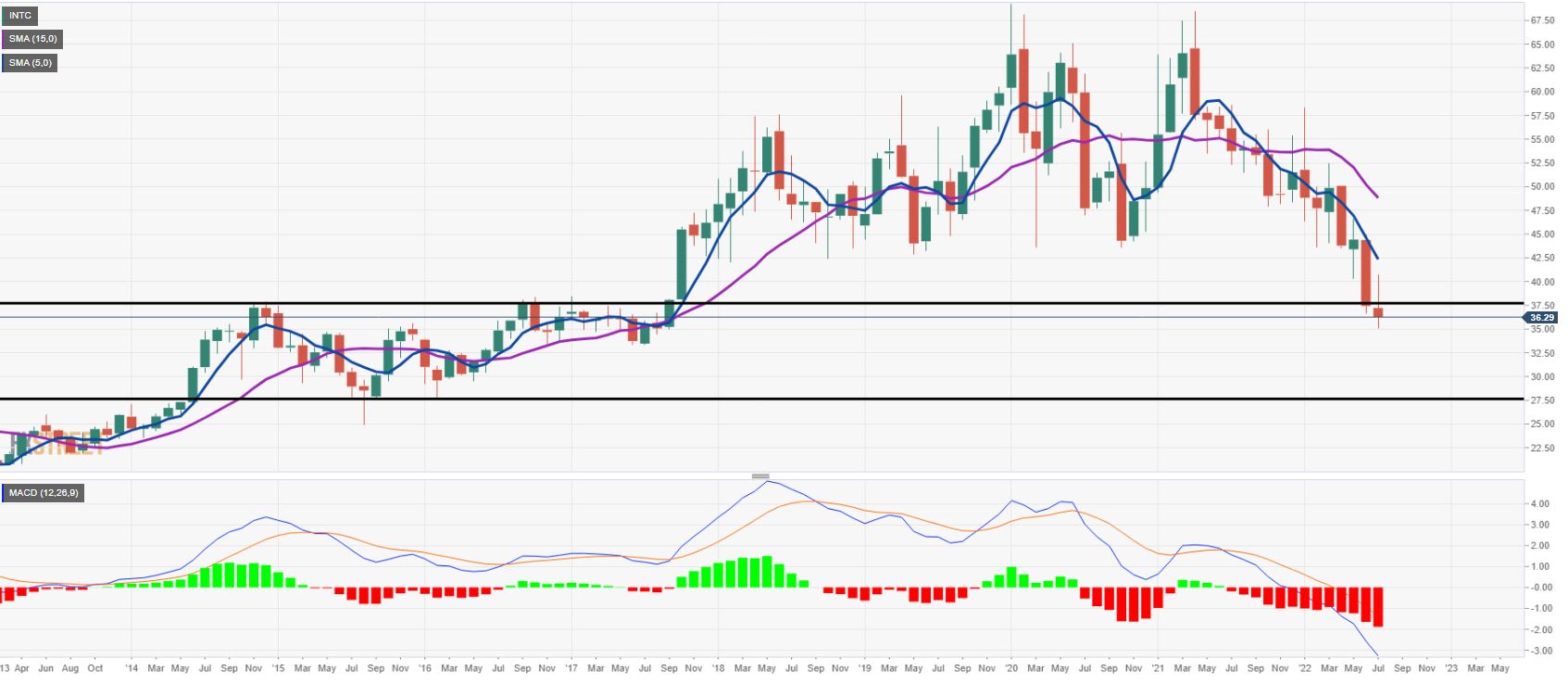
INTC monthly chart
Qualcomm stock forecast
Qualcomm stock only just broke out of its six-month downtrend three weeks ago. The top line of that downtrend is likely to act as support now. As you can see from the weekly chart below, that support is most likely at or near $130. Due to the 9-week and 21-week moving averages sitting between $135 and $140, QCOM stock could also discover support around there.
QCOM stock has an average analyst price target is near $195, and the latest price target updates are closer to $180. Poor guidance more than a quarter ahead, in this case Q4, typically works well in halting upward price movements, however. Most investors and institutions will take a wait-and-see approach with QCOM for now.
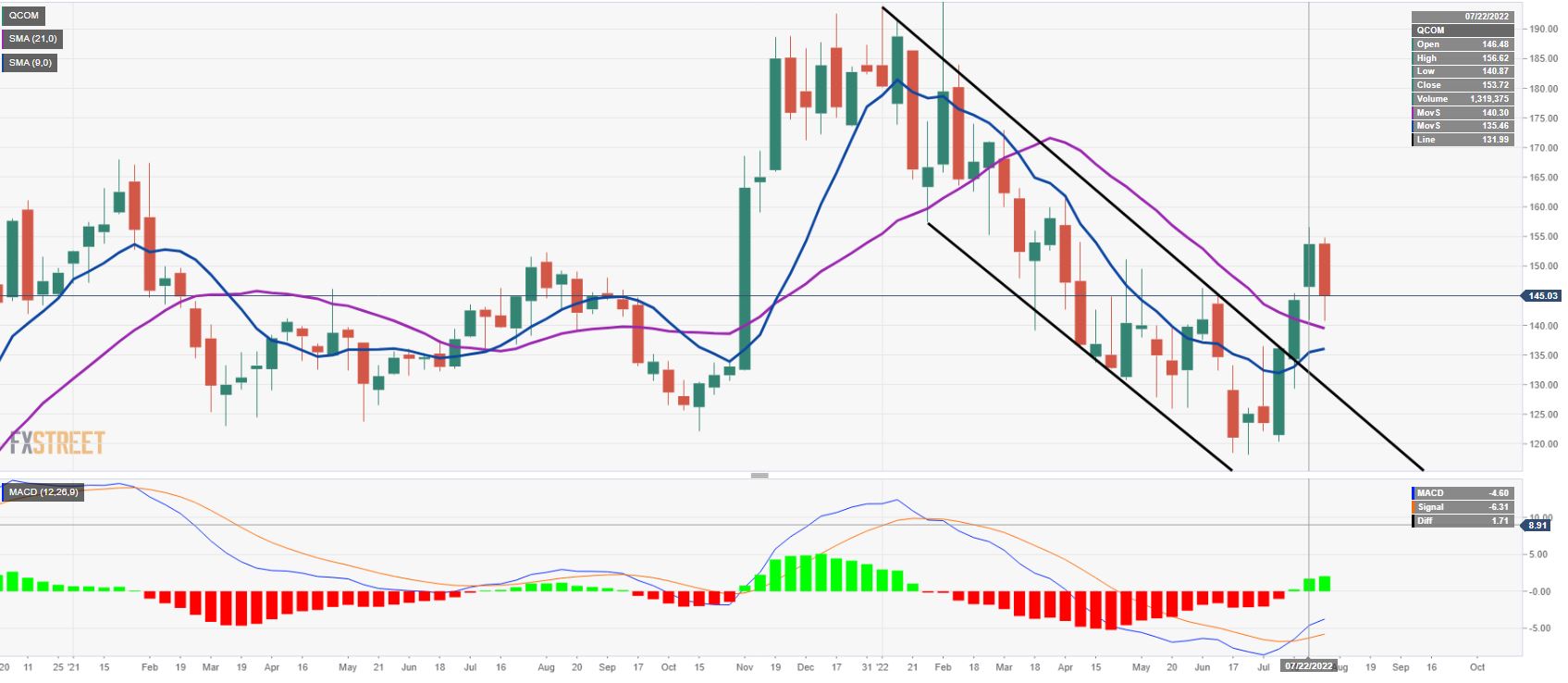
QCOM weekly chart
Premium
You have reached your limit of 3 free articles for this month.
Start your subscription and get access to all our original articles.
Author
Clay Webster
FXStreet
Clay Webster grew up in the US outside Buffalo, New York and Lancaster, Pennsylvania. He began investing after college following the 2008 financial crisis.

















