|

USD/TRY Price Analysis: Holds ground above 27.00, aligns to a support at 38.2% Fibo

  • USD/TRY trades above 27.00 due to the Fed’s hawkish stance regarding the interest rate trajectory.
  • Momentum indicators suggest that bullish sentiment prevails in the market.
  • The pair could find the key resistance around the monthly high at 27.75.
USD/TRY Price Analysis: Holds ground above 27.00, aligns to a support at 38.2% Fibo

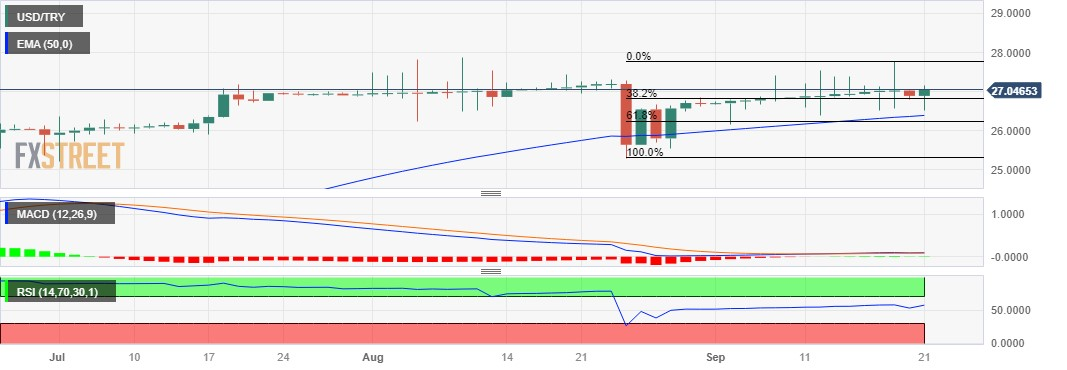
USD/TRY holds ground above the 27.00 psychological level aligned to the immediate support level of 38.2% Fibonacci retracement at 26.82 during the European session on Thursday.

A firm break below the latter could exert pressure on the USD/TRY pair to navigate the region around the 50-day Exponential Moving Average (EMA) at 26.38, followed by the 61.8% Fibonacci retracement at 26.24 aligned to the 26.00 psychological level.

The US Dollar (USD) is receiving upward support against the Turkish Lira (TRY) as a result of the US Federal Reserve's (Fed) hawkish stance regarding the trajectory of interest rates. This is attributed to the robust economic growth and inflationary pressures in the United States (US).

On the upside, the USD/TRY pair could face a challenge around the monthly high at 27.75, followed by August’s high at 27.88 level.

The Moving Average Convergence Divergence (MACD) line remains above the centerline and the signal line. This configuration suggests that the momentum in the underlying asset's price is relatively strong.

However, the momentum in the pair indicates that bullish sentiment prevails in the market as the 14-day Relative Strength Index (RSI) remains above the 50 level.

USD/TRY: Daily Chart
Author

Akhtar Faruqui

Akhtar Faruqui is a Forex Analyst based in New Delhi, India. With a keen eye for market trends and a passion for dissecting complex financial dynamics, he is dedicated to delivering accurate and insightful Forex news and analysis.


More from Akhtar Faruqui
Share:

Editor's Picks

AUD/USD sits at fresh 10-month lows, nears 0.6700

AUD/USD refreshes ten-month lows below 0.6750 and approaches 0.6700 in Wednesday’s Asian session. Fed rate-hike bets, along with fresh exchange of fire between the US and Iran, underpin the safe-haven US Dollar. Furthermore, the RBA’s dovish tilt weighs on the Aussie and the pair.

USD/JPY defends bids near 159.50 on hawkish BoJ Ueda

USD/JPY is defending bids near 159.50 in the Asian session on Wednesday, holding a three-day losing streak after hawkish commentary from BoJ Governor Ueda supports the Japanese Yen amid looming intervention risks. Meanwhile, escalating Middle East tensions revive US Dollar demand amid hawkish Fed bets, which could limit the pair's downside.


Gold battles $3,800 as downside extends ahead of FOMC Minutes

Gold continues to fall and tests the $3,800 level in the Asian session on Wednesday, hitting its lowest level since September 2025. The US Dollar sits near a 19-month high amid a fresh escalation of US-Iran tensions. This, along with firmer Fed rate-hike expectations, is underpinning the USD and weighing heavily on non-yielding bullion. Hawkish Fed commentary and strong US Retail Sales data back bets on aggressive Fed hikes.

Bitcoin consolidates, Ethereum and XRP stall
Bitcoin (BTC) remains under pressure, consolidating below $65,000 on Wednesday following a massive crash last week. Ethereum (ETH) and Ripple (XRP) followed BTC’s footsteps and are stalled below their key resistance levels.
UK CPI set to show inflation at 13-month high as fuel costs rise

The United Kingdom Office for National Statistics will publish the high-impact Consumer Price Index data for October at 07:00 GMT on Wednesday. The inflation report could determine whether the Bank of England delivers another interest-rate hike in December, significantly impacting the British Pound.

Gold isn't being sold for thew reason most people think
Gold (XAU/USD) remains under heavy selling pressure on Monday, hitting its lowest level in 13 months. The precious metal is struggling to recover despite escalating geopolitical tensions in the Middle East, a backdrop that would normally encourage investors to seek protection in safe-haven assets. However, the main driver behind Gold's decline is not the geopolitical uncertainty itself.