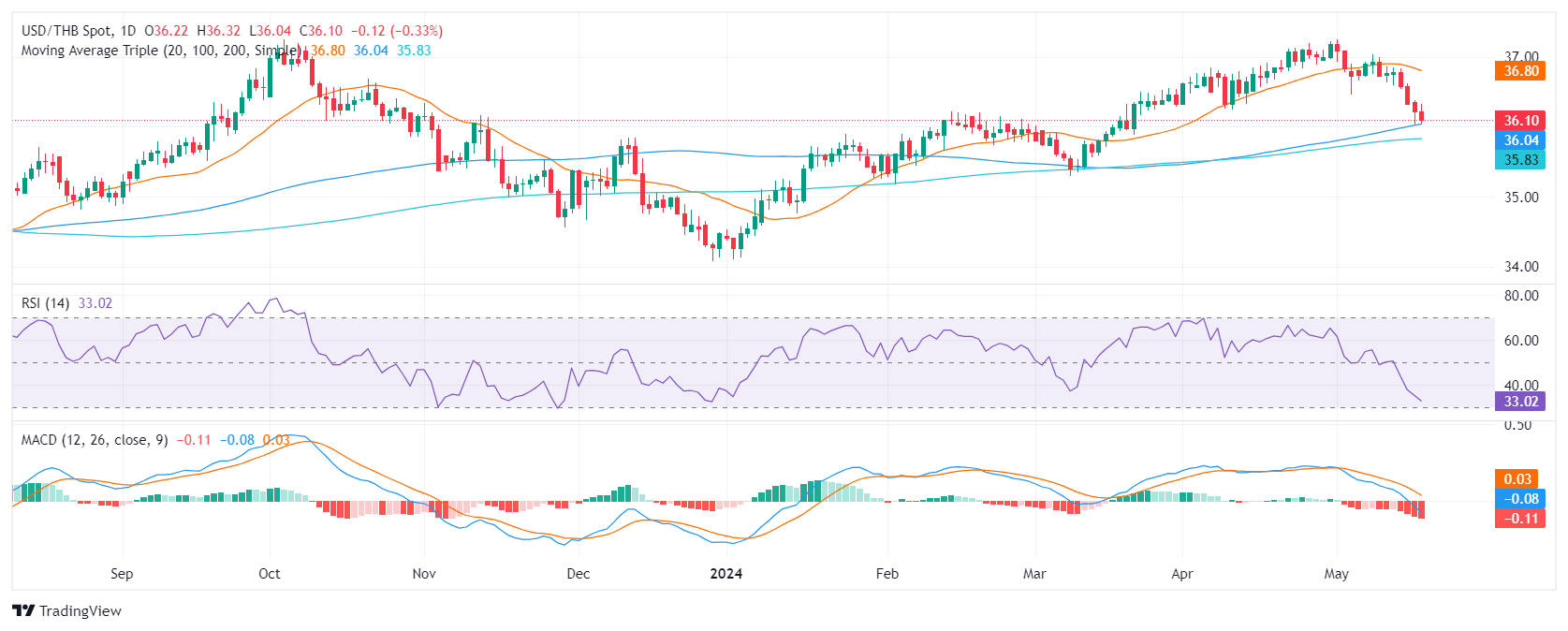
USD/THB plunges and approaches the 100-day SMA, USD cushioned by Fed officials
- USD/THB edged lower in Friday's session to stand at 36.10, showcasing a loss of 0.36%, as the bears maintain steady control.
- Data released during the week indicates a weak US economy, igniting market predictions for early interest rate cuts from the Federal Reserve.
- The hopes of sooner rate cuts were offset by the cautious tone of the Fed officials.

The USD/THB continued to lose ground on Friday despite the cautious tone seen in the latest Federal Reserve (Fed) officials' words.
US economic data published over the course of the week revealed signs of a potential economic slowdown. The indicators in question included April's Consumer Price Index (CPI) and Retail Sales figures as well as mounting weekly unemployment claims - all of which momentarily pushed the US Dollar into a selling pressure spiral. Nevertheless, the USD regained traction as Fed officials including Atlanta’s Fed President Raphael Bostic and his Cleveland Fed counterpart, Loretta Mester, reassured markets of their satisfaction with the unfolding inflation scenario and its accordance with the current monetary policy expressing that they need further confidence to start cutting. However, if data continues to underperform, the USD might see further losses.
USD/THB technical analysis
The daily Relative Strength Index (RSI) for the pair reveals a trend toward negative territory and approached oversold conditions. Simultaneously, the Moving Average Convergence Divergence (MACD) histogram presents flat red bars, signaling negative momentum with no expected substantial shift for the session.
USD/THB daily chart
Expanding to the broader picture, the USD/THB is situated beneath its 20-day Simple Moving Average (SMA). This indicates a robust sign of inherent bearish sentiment in the short term. Regardless of the short-term pessimistic view, the pair's ability to stay above its 100 and 200-day SMAs remains essential to keep the positive, long-term trend intact.
Author

Patricio Martín
FXStreet
Patricio is an economist from Argentina passionate about global finance and understanding the daily movements of the markets.