|

USD/RUB Price Analysis: Eyes further losses on break of five-week-old support

  • USD/RUB consolidates recent losses around weekly low, remains below the key support trend line.
  • Bearish MACD, trend line break directs bears towards 50-DMA.
  • 21-DMA, 61.8% Fibonacci retracement level restrict recovery moves.

USD/RUB consolidates weekly losses around 98.25, up 1.55% intraday during Thursday’s Asian session.

The Russian ruble pair dropped to the lowest in one week after breaking an ascending trend line from mid-February.

As the trend line breakdown joins bearish MACD signals, the USD/RUB prices are likely to fade the latest corrective pullback.

Hence, the 50-DMA surrounding 91.40 and the 90.00 threshold gain the seller’s attention ahead of the last monthly bottom near 75.00.

Alternatively, further recovery needs to cross the previous support line, close to 102.15 at the latest, to convince buyers.

Even so, 61.8% Fibonacci retracement level of February-march upside, around 105.00, will precede the 21-DMA figures close to 111.25 to challenge the USD/RUB bulls.

USD/RUB: Daily chart
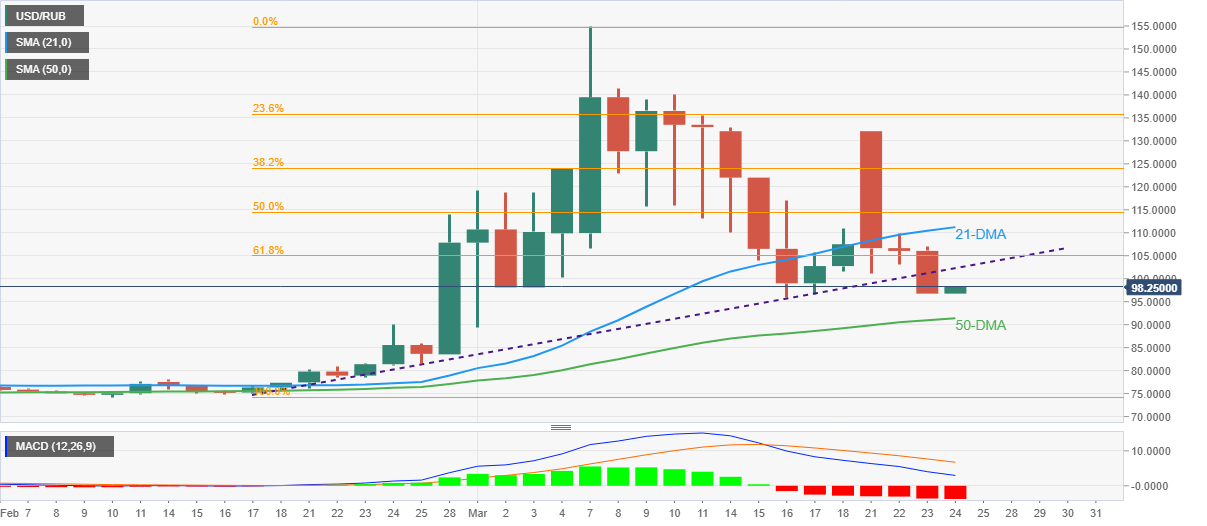
Trend: Further weakness expected

Additional important levels

Overview
Today last price98.25
Today Daily Change1.5000
Today Daily Change %1.55%
Today daily open96.75
 
Trends
Daily SMA20111.8751
Daily SMA5090.9471
Daily SMA10082.3806
Daily SMA20077.6403
 
Levels
Previous Daily High107
Previous Daily Low96.75
Previous Weekly High133.005
Previous Weekly Low95.9999
Previous Monthly High114
Previous Monthly Low74.254
Daily Fibonacci 38.2%100.6655
Daily Fibonacci 61.8%103.0845
Daily Pivot Point S193.3333
Daily Pivot Point S289.9167
Daily Pivot Point S383.0833
Daily Pivot Point R1103.5833
Daily Pivot Point R2110.4167
Daily Pivot Point R3113.8333

Author

Anil Panchal

Anil Panchal

FXStreet

Anil Panchal has nearly 15 years of experience in tracking financial markets. With a keen interest in macroeconomics, Anil aptly tracks global news/updates and stays well-informed about the global financial moves and their implications.


More from Anil Panchal
Share:

Editor's Picks

AUD/USD sits at two-month lows near 0.6950 after Australian CPI data

AUD/USD is sitting at two-month lows near 0.6950 in the Asian session on Wednesday, as below-expectations August Australian underlying CPI data pours cold water on expectations for further RBA interest rate hikes. Chinese PMI data also fail to inspire the Australian Dollar, despite a pause in the US Dollar advance.

USD/JPY stays weak below 157.00 amid Japanese intervention risks

USD/JPY keeps losses below 157.00 in the Asian session on Wednesday, as hawkish BoJ expectations, along with intervention risks, underpin the Japanese Yen, countering dismal domestic factory output and retail sales data. Meanwhile, a broad US Dollar retreat also collaborates to the pair's downside.

Gold surges above $4,200 after US inflation data

Gold extends its recovery early in the American session, trading above the $4,200 mark. Falling US bond yields drag the US Dollar away from the two-month high, touched on Tuesday, and act as a tailwind for the commodity. Softer than anticipated US inflation, as measured by the PCE Price Index, adds to the broad US Dollar's weakness.

Crypto Today: Bitcoin holds $83K as Ethereum remains below $2,700 and XRP consolidates

Bitcoin trades lethargically on Wednesday, with bulls battling to defend the immediate $83,000 level as immediate support. Ethereum trades in tandem with Bitcoin, holding below key levels of $2,700 on the upside and $2,600 on the downside. Ripple, meanwhile, hovers near $1.50,

Germany annual CPI inflation rises to 3.3% in September

Inflation in Germany, as measured by the change in the Consumer Price Index, climbed to 3.3% (preliminary) in September from 2.9% in August, Germany's Destatis reported on Wednesday.

Silver is more volatile than Gold ahead of PCE and NFP. This chart shows the positioning gap
The market’s attention is focused on American data this week, but there’s something only those with a trained eye may be looking at: Gold and Silver positioning gap. Financial markets are moving on fears, mostly related to persistently high energy prices driven by the Middle East war. Sure, the US Dollar (USD) is strong, but at what cost?