|

USD/NOK recovers following NB hawkish hold.

  • Norges Bank kept rates steady at 4.5%, as expected.
  • The bank is delaying the easing to Q1 of 2025.
  • As long as the NB policy diverges with its peers the NOK might see further upside.

On Friday, the USD/NOK recovered towards 10.575 and cleared most of Thursday's losses. That being said, the NOK is holding strong against its peers as the Norges Bank will likely start the easing in Q1 of 2025.


The Norges Bank announced on Thursday that it will maintain its interest rate at 4.5%, a decision that was widely anticipated. This move is considered hawkish as the bank has delayed its initial rate cut projection to the first quarter of 2025, previously set for the third quarter of 2024. According to the new forecast, the policy rate will stay at 4.50% until the end of the year and will then begin to decrease gradually. This contrasts with the more aggressive rate-cutting strategies of neighboring central banks, which are grappling with different economic challenges. 

Regarding the economic outlook, Norges Bank expressed concerns that reducing the rate too soon could lead to prolonged inflation above the target level despite the latest economic challenges. As a result, market expectations for a rate cut within the next six months have nearly vanished, with approximately 50 basis points of easing anticipated over the following half-year which fueled a rise of the Krone against its peers. 

USD/NOK technical analysis

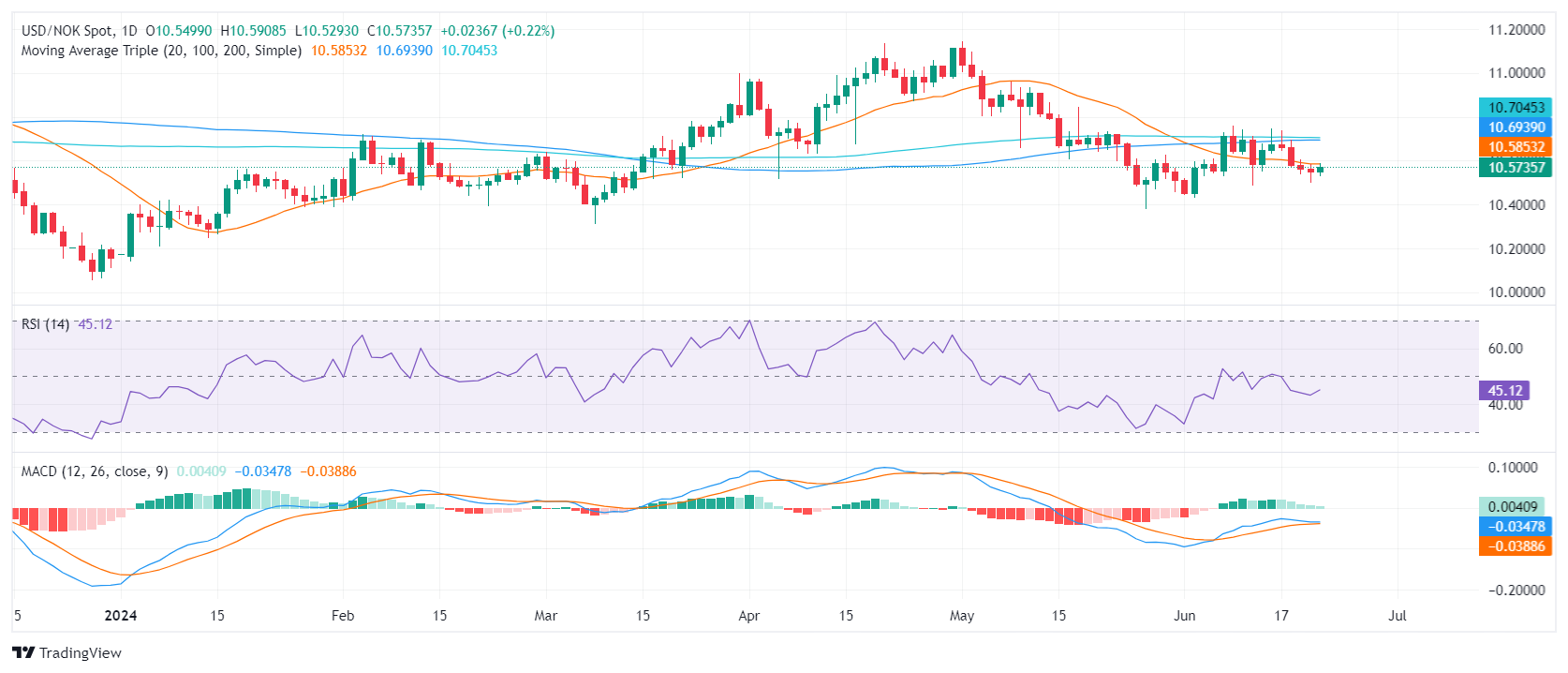
According to the daily chart, the outlook of the pair remains bearish with indicators flashing bearish signals. The Relative Strength Index (RSI) stands below 50 while the Moving Average Divergence Convergence (MACD) prints steady red bars.

The most clear of the bearish signals is that the pair has recently dipped below the 20,100 and 200-day Simple Moving Averages (SMA) as lost over 1% in the last four sessions.

USD/NOK daily chart
Author

Patricio Martín

Patricio is an economist from Argentina passionate about global finance and understanding the daily movements of the markets.


More from Patricio Martín
Share:

Editor's Picks

GBP/USD declines as market caution lifts US Dollar

GBP/USD extends its gains for the second successive day, trading around 1.3200 during the Asian hours on Wednesday. The currency pair depreciated as the US Dollar gained momentum, driven by a combination of robust domestic economic data and a complex, mixed geopolitical landscape.

EUR/USD hits one-year low, eyes 1.1350 as bullish USD offsets oversold RSI

The EUR/USD pair drifts lower for the third straight day – also marking the fifth day of a negative move in the previous six – and drops to over a one-year low during the Asian session on Wednesday. Spot prices currently trade around the 1.1365 area, down nearly 0.15% for the day, and seem vulnerable to slide further amid a bullish US Dollar.

$4,050: Gold dives to fresh two-week low as Fed rate hike bets boost US Dollar

Gold drifts lower for the second straight day – also marking the fifth day of a negative move in the previous six – and drops to a nearly two-week low during the Asian session on Wednesday. Despite easing inflationary concerns in the face of the recent fall in Crude Oil prices, traders have been pricing in a greater chance of a rate hike by the US Federal Reserve. 

Dogecoin tests a key make-or-break point amid waning retail support

Dogecoin trades below $0.08000 maintaining a steady decline for the seventh straight week. The meme coin is losing its retail strength as DOGE futures Open Interest drops 10% in 24 hours, while institutional demand remains muted with zero inflows so far this week.

"Rearranging the deckchairs on the Titanic": UK's fiscal crisis outlasts another Prime Minister

Keir Starmer's resignation as the UK Prime Minister comes ten years after the Brexit referendum vote, a coincidence that financial markets have been quick to note. The British Pound trades around 1.3220 against the US Dollar on Thursday.

Regime change: Inside Kevin Warsh's first move to make the Fed unreadable on purpose

The rate did not move. That was the least interesting thing about Kevin Warsh's first meeting in charge of the Fed. The FOMC held its benchmark at 3.50%-3.75% for the fourth straight meeting, exactly as priced, and then the new chair used his first press conference to dismantle the machinery the market has leaned on for a decade.