|

USD/MXN trades below 17.50 for the first time in 14 months
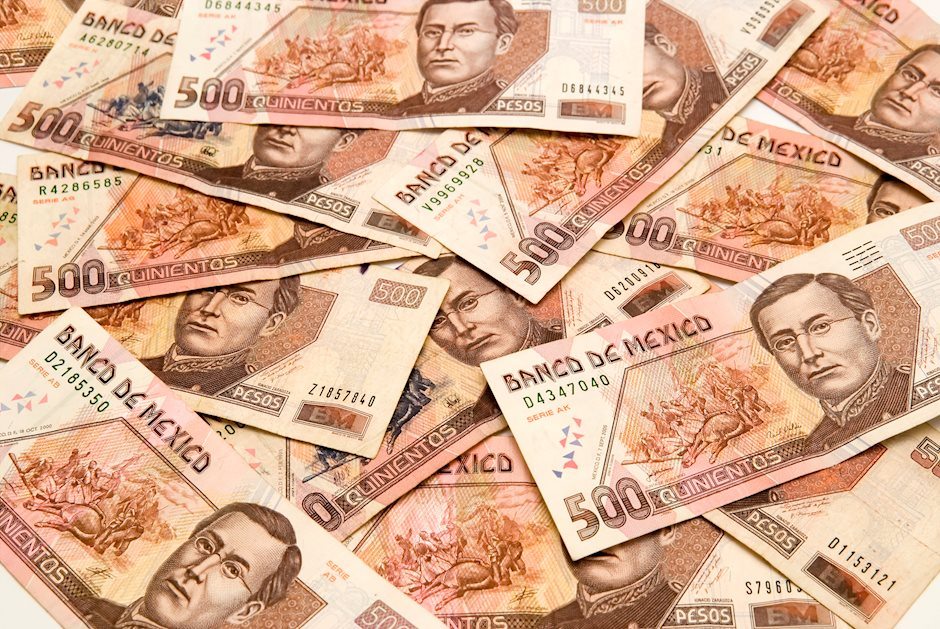
The Mexican peso is rising against the US dollar on Tuesday, resuming the upside after a consolidation day on Monday. It reached a fresh 14-month high as it continues to rally. 

Between a weak USD and NAFTA

Since January the USD/MXN has been falling constantly. The downside gained momentum last week and today is falling for the seventh time out of the last eight trading days. 

The pair remains week on the back of a decline of the greenback across the board, with the US dollar index at the lowest since September, affected by the latest US economic data and, more recently by the failure of the Trump administration to repeal Obamacare. 

The Mexican peso gained momentum after Trump’s administration released its plan for renegotiating the North American Free Trade Agreement (NAFTA). Some economists noted no major changes. They highlighted US intention to reduced the trade deficit with Mexico and Canada. Markets appear to be discounting that a new agreement is likely. 

USD/MXN at 17.50 

The pair currently is trading at 17.50, 2.40% below where it was a week ago. Today it bottomed at 17.47, the lowest since May 3, 2016. 

From a technical perspective, the area around 17.45/50 could be considered as a relevant support level. A consolidation below would clear the way for an extension of the slide. On the upside, any recovery of the US dollar at this point would likely be seen as a correction. Resistance levels might lie at 17.80 (June lows), 17.89 (20-day moving average) and 18.30/35 (May lows). 

Author

Matías Salord

Matías started in financial markets in 2008, after graduating in Economics. He was trained in chart analysis and then became an educator. He also studied Journalism. He started writing analyses for specialized websites before joining FXStreet.


More from Matías Salord
Share:

Editor's Picks

EUR/USD struggles to hold above 1.1800 ahead of US data

EUR/USD finds it difficult to gather recovery momentum and retreats below 1.1800 in the second half of the day on Thursday. The US Dollar (USD) stays resilient against its peers after the hawkish surprise in FOMC Minutes, weighing on the pair ahead of the next batch of US data.

GBP/USD recovers above 1.3500 amid better mood

GBP/USD finds fresh demand and rises back above 1.3500 in the European session on Thursday. Improving risk sentiment and renewed US Dollar weakness are helping the pair recover ground ahead of mid-tier US data releases and Fedspeak. 

Gold retreats from daily highs, trades below $5,000

Gold finds it difficult to stabilize above the $5,000 psychological mark on Thursday and trades slightly below this level in the early American session. Escalating geopolitical tensions in the Middle East help XAU/USD hold its ground, while the broad-based USD strength caps the pair's upside.

Injective token surges over 13% following the approval of the mainnet upgrade proposal

Injective price rallies over 13% on Thursday after the network confirmed the approval of its IIP-619 proposal. The green light for the mainnet upgrade has boosted traders’ sentiment, as the upgrade aims to scale Injective’s real-time Ethereum Virtual Machine architecture and enhance its capabilities to support next-generation payments. The technical outlook suggests further gains if INJ breaks above key resistance.

Hawkish Fed minutes and a market finding its footing

It was green across the board for US Stock market indexes at the close on Wednesday, with most S&P 500 names ending higher, adding 38 points (0.6%) to 6,881 overall. At the GICS sector level, energy led gains, followed by technology and consumer discretionary, while utilities and real estate posted the largest losses.

Injective token surges over 13% following the approval of the mainnet upgrade proposal

Injective price rallies over 13% on Thursday after the network confirmed the approval of its IIP-619 proposal. The green light for the mainnet upgrade has boosted traders’ sentiment, as the upgrade aims to scale Injective’s real-time Ethereum Virtual Machine architecture and enhance its capabilities to support next-generation payments.