USD/MXN falls as inflation in Mexico cools down, Fed’s decision looms
- The Mexican Peso gains momentum after Mexico’s mid-month July CPI outperforms estimates, increasing by 4.79% YoY.
- S&P Global data suggests US manufacturing activity rebound, softening the impact of the service sector’s PMI decline.
- Future trajectory of USD/MXN hinges on the upcoming Fed’s policy meeting, with potential hawkish remarks threatening to push it beyond the 17.00 mark.

USD/MXN erased last Friday’s gains amid a data dump from the United States (US) and Mexico, bolstering the emerging market currency as the Mexican Peso (MXN) advances on an inflation report. At the time of writing, the USD/MXN is trading at 16.8277 after reaching a daily high of 17.0091.
Markets anticipate Fed’s decision amid surging US manufacturing activity, mixed economic data
As previously mentioned, the Instituto National de Estadistica, Geografia e Informatica, known as INEGI, revealed that Mexico’s mid-month July Consumer Price Index (CPI) rose by 4.79% YoY, above estimates of 4.7%, but below the prior’s 5.18% reading. Regarding core CPI, data came at 6.76% YoY, above forecasts of 6.73% though it dipped from 6.91%.
Given the fact that the Bank of Mexico, also known as Banxico, decided to keep rates on hold twice after peaking at 11.25%, the data could trigger a shift if core inflation stickiness continues to be an issue keeping inflation from reaching Banxico’s plus/minus 3% target. A source cited by Reuters commented, “The increase in the services component was ‘mainly due to higher airfares and tourist package.’”
In the US, S&P Global revealed that manufacturing activity improved from 46.3 in June to 49 in July, exceeding estimates. That cushioned the fall in services, with its PMI sliding to 52.4 from 54.4 last month. Consequently, the Composite PMI index dropped to 52 in July from 53.2 in June and slowed to a five-month low, reflecting the impact of 500 bps of tightening by the US Federal Reserve (Fed).
On Tuesday, the Fed would begin its two-day monetary policy meeting. Market participants expect the US central bank to deliver a 25 bps rate hike, but as most economists foresee, that would be the last increase; hawkish remarks by the Fed Chair could lift the USD/MXN toward the 17.00 mark and beyond. Otherwise, a dovish stance, and interest rates differentials, favor the MXN as the carry trade prolongs the emerging market currency gains. Hence, further USD/MXN downside is expected.
USD/MXN Price Analysis: Technical outlook
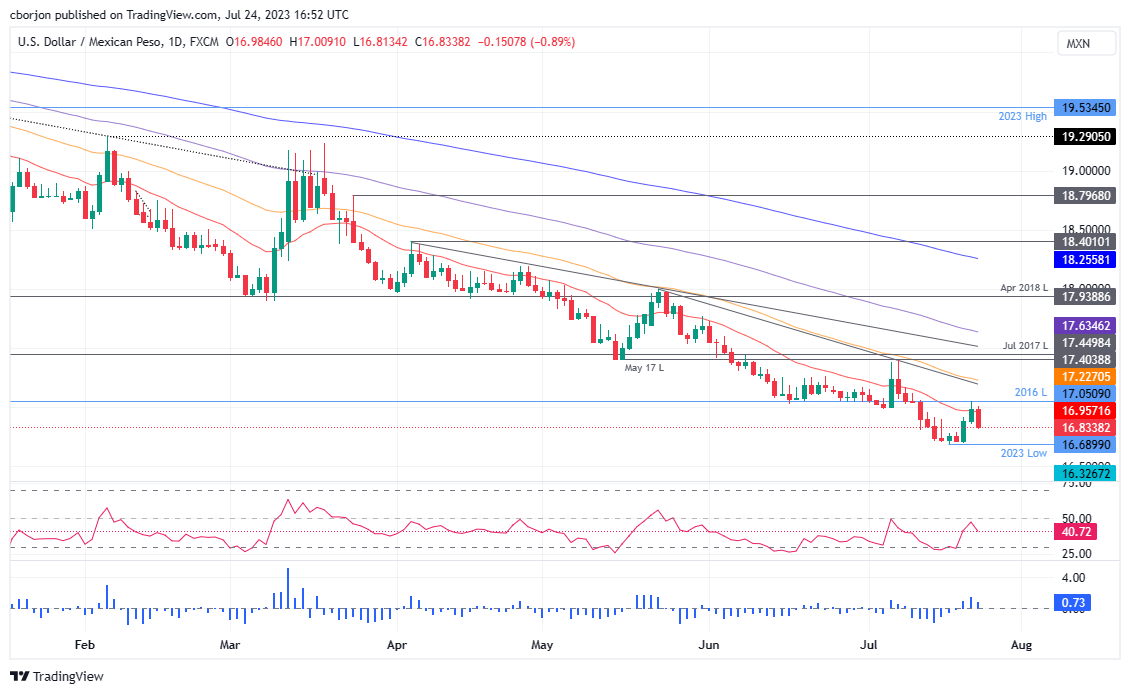
The USD/MXN daily chart favors further downside, as today’s price action, coupled with last Friday, is forming a bearish-engulfing pattern, warranting further downside. Unless the Fed’s decision on Wednesday surprises the markets with a hawkish hike, the USD/MXN could challenge the October 2015 daily low of 16.3267, followed by the 16.00 mark. But firstly, USD/MXN must dive below 16.5000. Conversely, the USD/MXN could threaten the 20-day Exponential Moving Average (EMA) at 16.9567, followed by the 17.0000 figure. A breach of the latter will expose the 50-day EMA at 17.2269.
Author

Christian Borjon Valencia
FXStreet
Markets analyst, news editor, and trading instructor with over 14 years of experience across FX, commodities, US equity indices, and global macro markets.

















