|

USD/MXN drops sharply as the Mexican Peso eyes 17.0000

  • USD/MXN trades at 17.0741, down 0.19%, as the pair slides below the 20-day Moving Average, targeting the psychological 17.0000 level.
  • Mixed US data, including a drop in inflation expectations, leaves investors uncertain about further Fed tightening beyond September.
  • Technical outlook suggests downside risks below the 50-DMA at 17.0079 while reclaiming the 100-DMA at 17.2271 could spur a recovery.

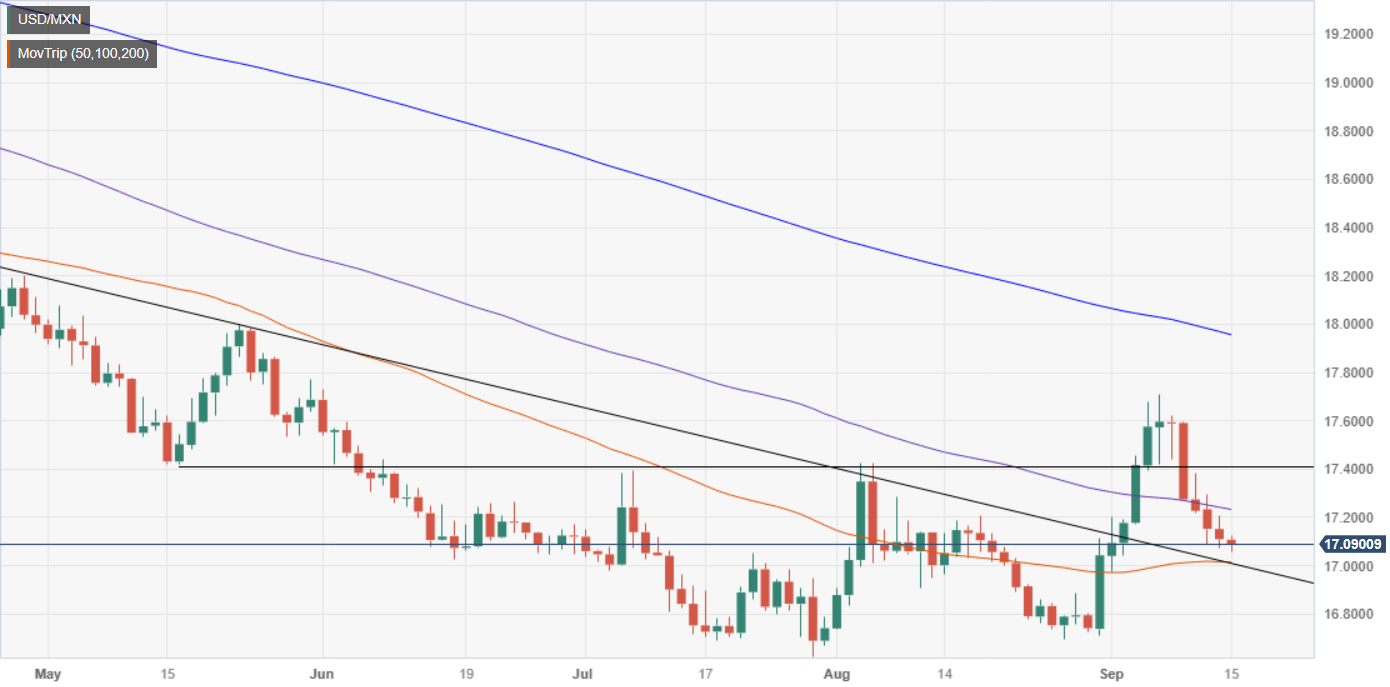
The Mexican Peso (MXN) extends its gains versus the US Dollar (USD), and prolongs its rally to five consecutive days, with USD/MXN bears setting their sight on the 17.0000 psychological level after sliding below the 20-day Moving Average (DMA) at 17.0921. The pair exchanges hands at 17.0741, down 0.19%.

USD/MXN slips further as mixed US data fails to lift the Greenback, while traders eye a packed economic calendar in Mexico next week

Data from the United States (US) so far failed to bolster the Greenback (USD) as inflation expectations dropped the most in two years, as revealed by the University of Michigan (UoM) Consumer Sentiment poll. Inflation is expected to climb at a 3.1% pace, down from August 3.5%, and estimate a 2.7% jump over a 10-year period. Despite America’s optimism on inflation, sentiment fell to 677 below estimates of 69.1, blamed on high food and energy prices.

Before Wall Street opened, Industrial Production in August rose by 0.4% MoM, below July’s 1% increase but above the 0.1% estimated by the consensus, as the US Federal Reserve revealed. That depicts consumers taking a breather as retailers posted limited orders on manufacturers, struggling with higher borrowing costs and uncertainty on demand.

At the same time, the New York Fed revealed its Manufacturing Index, which expanded this month from -21 to 1.9, exceeding forecasts of -10. Given the amount of data posting positive surprises about the US economy, investors remain hesitant that the US Federal Reserve would continue to tighten monetary policy past the September meeting.

Across the border, a scarce economic docket left USD/MXN traders adrift to market sentiment and US Dollar dynamics. Nevertheless, next week’s agenda will be busy, with the release of Private Spending, Aggregate Demand, Retail Sales, Economic Activity, and inflation for the first half of September.

USD/MXN Price Analysis: Technical outlook

The USD/MXN remains neutrally biased despite printing a new multi-month high. After reaching 17.7074, the pair’s pullback could offer buyers a better entry price than last week’s close. However, downside risks remain and emerge slightly below the 50-DMA at 17.0079. Once cleared, a test of the August 28 swing low of 16.6923 is on the cards. On the other hand, if buyers reclaim the 100-DMA at 17.2271, that would exacerbate a recovery towards September’s high of 17.7074.
USD/MXN

Overview
Today last price17.0887
Today Daily Change-0.0215
Today Daily Change %-0.13
Today daily open17.1102
 
Trends
Daily SMA2017.0975
Daily SMA5017.0163
Daily SMA10017.2425
Daily SMA20017.9696
 
Levels
Previous Daily High17.209
Previous Daily Low17.0734
Previous Weekly High17.7094
Previous Weekly Low17.0447
Previous Monthly High17.4274
Previous Monthly Low16.6945
Daily Fibonacci 38.2%17.1252
Daily Fibonacci 61.8%17.1572
Daily Pivot Point S117.0527
Daily Pivot Point S216.9952
Daily Pivot Point S316.9171
Daily Pivot Point R117.1883
Daily Pivot Point R217.2664
Daily Pivot Point R317.3239

Author

Christian Borjon Valencia

Markets analyst, news editor, and trading instructor with over 14 years of experience across FX, commodities, US equity indices, and global macro markets.


More from Christian Borjon Valencia
Share:

Editor's Picks

AUD/USD keeps range near 0.6950 after Australian trade data

AUD/USD consolidates near a two-month low, trading around mid-0.6900s in the Asian session on Thursday amid a bullish US Dollar. The US PCE data tempered October Fed hike bets, though oil-driven inflation fears remain supportive of elevated US bond yields. Meanwhile, Australia's trade surplus shrank sharply in August to AUD495M, having limited impact on the Aussie Dollar and the pair.


USD/JPY sits at weekly top above 158.00 as bullish USD counters intervention risks

USD/JPY is sitting at the top end of its weekly range above 158.00 in the Asian session on Thursday. Despite the softer US PCE data, oil-driven inflation risks keep US bond yields elevated near multi-year highs. Moreover, the US-Iran standoff benefits the safe-haven US Dollar and supports the pair. Broad US Dollar strength counters hawkish BoJ expectations and Japanese intervention risks.

Gold sticks to modest gains; remains below $4,200 as bullish USD limits upside

Gold attracts some dip-buyers near the $4,139 region during the Asian session, stalling the previous day's pullback from the $4,220 area, touched in reaction to softer-than-expected US inflation data. However, elevated US bond yields remain supportive of the prevailing strong bullish sentiment surrounding the US Dollar and should keep a lid on any meaningful appreciation for the non-yielding yellow metal.

Hyperliquid pares gains as ETF outflows cap tentative bullish recovery

Hyperliquid (HYPE) is down 2% at press time on Thursday, trimming its 5% gains from the previous day. Institutional demand is easing, with $5 million in outflows on Wednesday, weighing on near-term investors' sentiment. The technical outlook for HYPE indicates a near-term mixed tone as the price remains capped below $90.

The Euro is near a one-year low: Inflation could trigger its rebound, not its fall

EUR/USD has fallen to its lowest level since May 2025, but a fresh inflation shock in the Eurozone could give the Euro an unexpected lifeline. The pair hit 1.1312 on Wednesday and trades well below the January peak of 1.2082. The decline reflects a powerful combination of US Dollar strength, geopolitical uncertainty and renewed concerns about Europe's exposure to higher energy prices.

The Euro is near a one-year low: Inflation could trigger its rebound, not its fall

EUR/USD has fallen to its lowest level since May 2025, but a fresh inflation shock in the Eurozone could give the Euro (EUR) an unexpected lifeline. The pair hit 1.1312 on Wednesday and trades well below the January peak of 1.2082.