USD/MXN climbs on hawkish Fed, unfazed by strong retail sales in Mexico
- USD/MXN climbs to 17.1637, up 0.43%, fueled by the Fed’s hawkish hold and upward revisions of future interest rates.
- Mixed US economic data contrasts with strong consumer spending in Mexico, but the Greenback maintains its upward momentum.
- The pair’s trajectory is influenced by multi-year highs in US Treasury bond yields and solid labor market conditions in the US.

The Greenback stages a recovery vs. the Mexican Peso on Thursday, spurred by a hawkish hold by the US Federal Reserve. Although economic data from Mexico showed consumer spending remains strong despite higher interest rates, the pair edges higher. The USD/MXN is trading at 17.1637, up 0.43% after printing a low of 17.0363.
USD/MXN rises 0.43% as the Fed delivers a hawkish Fed, foreseen rates above 5% in 2024
On Wednesday, the US central bank decided to keep rates at their current level while updating its economic forecasts. The monetary policy statement acknowledged a strong labor market, tightening credit conditions, and expanding economy. They emphasized that “Inflation remains elevated” due to the last two inflation readings witnessing an uptick.
However, most market participants were looking for the rest of the year and future projections, as the Fed revealed its Summary of Economic Projections (SEP). Policymakers foresee an additional rate hike in 2023 while revising the Federal Funds rate (FFR) for 2024, with the median seen rates at 5.1%, up from 4.6%.
That has been the main driver of price action since yesterday. The USD/MXN extended its gains, while US Treasury bond yields along the short and medium end of the curve reached multi-year highs, a tailwind for the American Dollar (USD). The US Dollar Index (DXY), a gauge of the buck’s value vs. a basket of peers, remains at 105.39, almost flat, following post-Fed’s reaction.
The US economic agenda recently featured Initial Jobless Claims for the last week came in at 201,000, beating the 225,000 estimates, reflecting a solid labor market. However, the September Philadelphia Fed Manufacturing Index dropped significantly to -13.5, well below the expected -0.5. US Existing Home Sales also fell short of expectations, declining by -0.7% month-on-month, while a 1.5% expansion was projected.
Across the border, the Instituto Nacional de Estadistica Geografia e Informatica (INEGI) revealed that Mexican Retail Sales came at 0.2% MoM in June, aligned with estimates and 5.1% YoY, exceeding 4.9% forecasts.
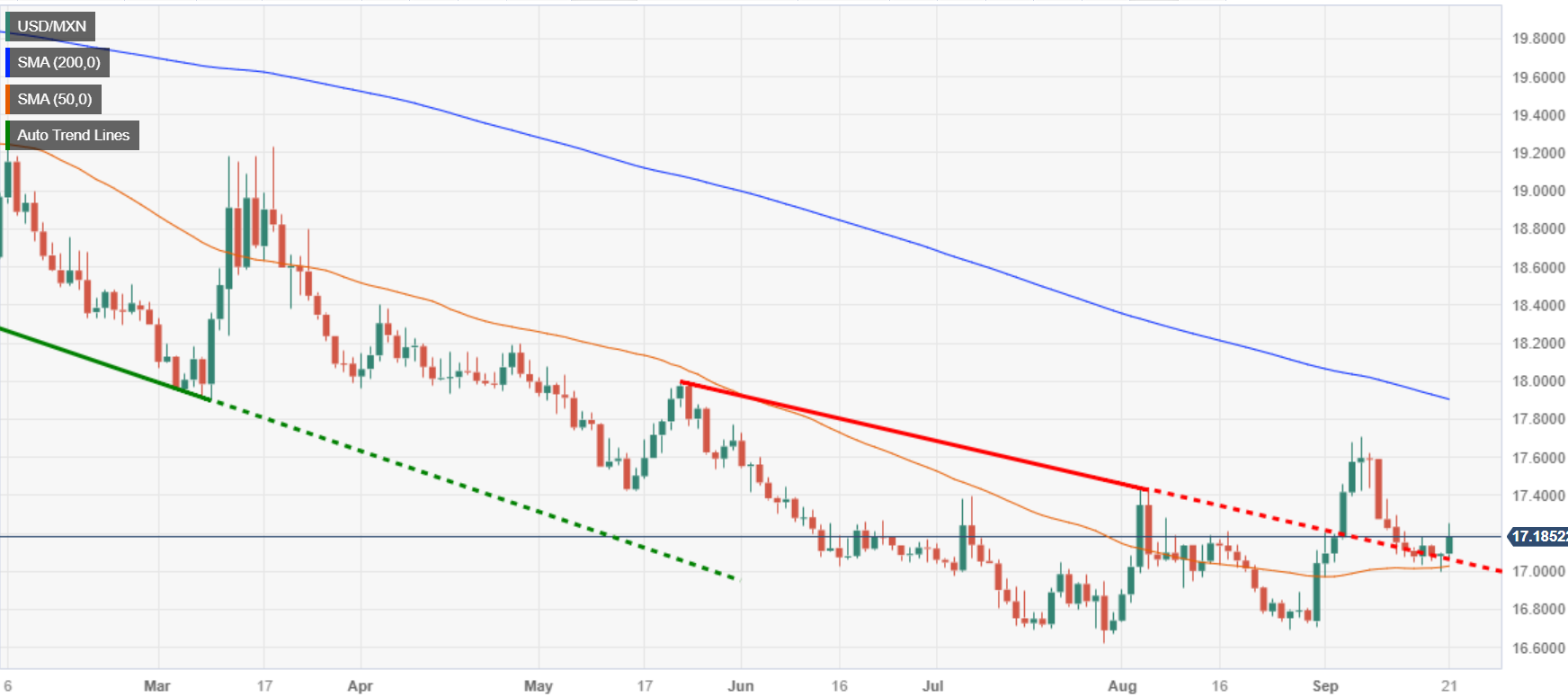
USD/MXN Price Analysis: Technical outlook
After the Fed’s decision, the USD/MXN pierced the 17.00 figure before rallying sharply toward the 17.10 area. Since then, the pair seesawed around 17.0500/17.1000 and rallied, reclaiming the 20-day moving average (DMA) at 17.1402, eyeing the 100-DMA at 17.1941. In the outcome of achieving a daily close above that level, the exotic pair could test the September 7 daily high at 17.7074 before challenging 18.0000. On the downside, a drop below the 20-DMA could exacerbate a dip to the 17.0000 psychological level.
Author

Christian Borjon Valencia
FXStreet
Markets analyst, news editor, and trading instructor with over 14 years of experience across FX, commodities, US equity indices, and global macro markets.
















