|

USD/MXN ascends on back of a strong USD due to solid US economic data

  • USD/MXN trades sideways but shifts toward daily highs, with a 0.16% gain, as the US Dollar finds strength.
  • A faster-than-expected GDP rise and lower Jobless Claims fuel the USD, causing US Treasury bond yields to surge.
  • Anticipation of additional Fed rate hikes due to strong US economic performance affects USD/MXN.

USD/MXN traded sideways on Thursday after reaching a daily low of 17.0463, but data from the United States (US) bolstered the US Dollar, lifting the USD/MXN pair toward its daily highs. Nevertheless, as the greenback stabilized, the USD/MXN retreated from its high, exchanges hands at 17.1136, gains 0.16%.

Growing speculations for Fed tightening stirs greenback rise, underpins the USD/MXN

US economic data revealed that the country grew faster than expected, with the Gross Domestic Product (GDP) for the first quarter rising by 2.0%, above prior’s readings of 1.3%. At the same time, Initial Jobless Claims for the last week rose by 239K, below estimates of 265K, halting three consecutive reports trend of 260K plus claims, which erroneously suggested the labor market was cooling.

Consequently, US Treasury bond yields surged, with the 2-year note yield reaching 4.9%, its highest level since March 15, while the US Dollar Index (DXY), a measure of the greenback’s value against a basket of peers, advanced 0.33%, up at 103.302, a tailwind for the USD/MXN.

Given that US economic data is proving solid during the last month, expectations had grown about further tightening by the US Federal Reserve (Fed). During the Eurozone (EU) session, Fed Chair Jerome Powell crossed newswires emphasizing that the majority of the Federal Reserve Open Market Committee (FOMC) expects two additional rate hikes towards the year’s end amidst high inflation data and a tight labor market.

Odds for a 25 bps rate hike in July increased to 87%, while traders shifted their view of only one rate increase as chances for the November meeting augmented to 33.7%, according to the CME FedWatch Tool.

Across the border, Mexico’s lack of economic data keeps USD/MXN traders leaning into the US Dollar dynamics and market sentiment, which turned risk-averse after US data.

USD/MXN Price Analysis: Technical outlook
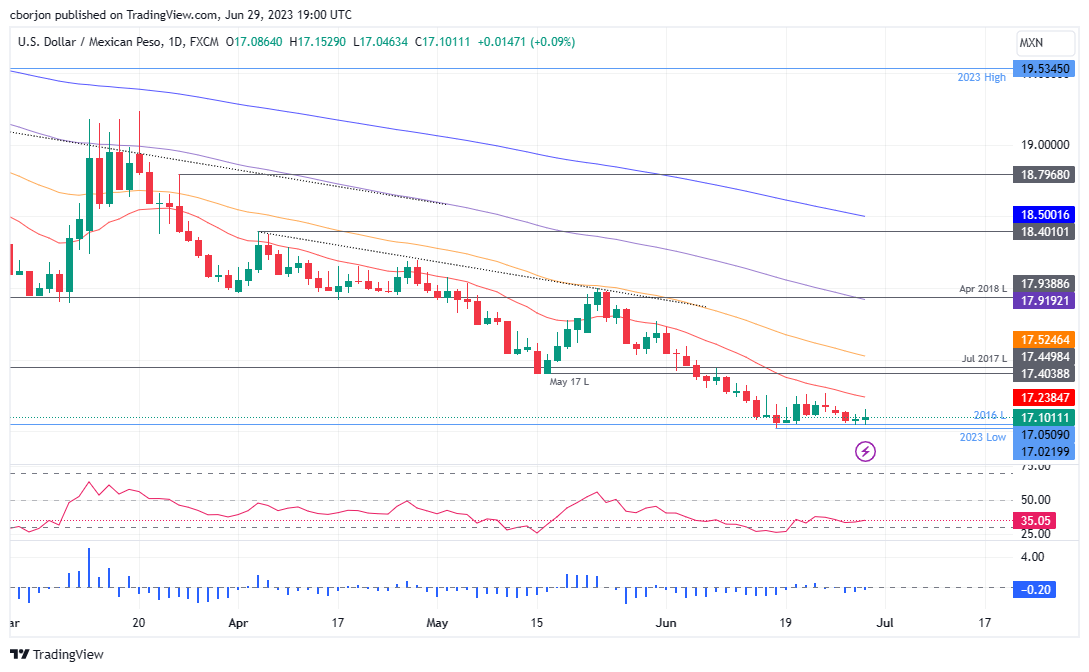
USD/MXN Daily chart

The USD/MXN is trading sideways, nearby the lows of the year, reached on June 16 at 17.0219. Even though oscillators suggest that further downside is expected, the Relative Strength Index (RSI) indicates buyers are entering the market. However, they lack the strength to lift the pair towards its most important resistance level, the May 17 daily low of 17.4039. A breach of the latter could increase buying pressure and lift the USD/MXN to test the 50-day Exponential Moving Average (EMA) at 17.5247. Otherwise, a drop below 17.1000 would keep sellers eyeing the 17.00 mark.

USD/MXN

Overview
Today last price17.1017
Today Daily Change0.0097
Today Daily Change %0.06
Today daily open17.092
 
Trends
Daily SMA2017.2444
Daily SMA5017.5813
Daily SMA10017.9628
Daily SMA20018.7329
 
Levels
Previous Daily High17.124
Previous Daily Low17.046
Previous Weekly High17.2656
Previous Weekly Low17.061
Previous Monthly High18.078
Previous Monthly Low17.4203
Daily Fibonacci 38.2%17.0942
Daily Fibonacci 61.8%17.0758
Daily Pivot Point S117.0507
Daily Pivot Point S217.0094
Daily Pivot Point S316.9728
Daily Pivot Point R117.1286
Daily Pivot Point R217.1653
Daily Pivot Point R317.2066

Author

Christian Borjon Valencia

Markets analyst, news editor, and trading instructor with over 14 years of experience across FX, commodities, US equity indices, and global macro markets.


More from Christian Borjon Valencia
Share:

Editor's Picks

AUD/USD keeps the red near 0.6950 after weak Aussie jobs data

AUD/USD holds losses near 0.6950 on disappointing Australian jobs data, extending the previous day's retracement slide from the monthly high and hitting a fresh weekly low during Thursday’s Asian session. Meanwhile, declining US bond yields drag the US Dollar away from the April 2025 high, touched after Wednesday's hot US CPI, helping limit losses for the currency pair.

USD/JPY slides back below 158.00 as USD reverses post-CPI gains

USD/JPY extends the previous day's pullback from a three-week high, attracting follow-through selling and sliding below 158.00 during Thursday's Asian session. Traders remain on high alert amid speculation that authorities will step in to prop up the Japanese Yen. The US Dollar, meanwhile, reverses Wednesday's hot CPI-led gains to April 2025 highs as US bond yields retreat on China bond-buying talk, further pressuring the pair.

Gold: Upside remains capped by $4,200

Gold regains the smile and leaves behind three consecutive days of losses, advancing to the $4,170 region per troy ounce on Thursday. The precious metal’s recovery comes amid the fresh offered stance in the Greenback and declining US Treasury yields while investors remain cautious ahead of the Fed’s Warsh speech on Friday.

Ripple clings to $1.30 support as downside risks intensify

Ripple is stuck in a bearish trend, trading near $1.30 on Thursday. The remittance token’s bearish shift reflects the broader cryptocurrency market, which remains under heavy selling amid concerns about accelerating inflation in the US.

Budget preview: Is Healey impressing the bond market?

There is less than 2 weeks to go before the Chancellor delivers his first budget. Unusually for the UK, the economic and financial backdrop to this budget is upbeat. UK bonds have been rallying, the FTSE 100 is the top performing major stock index this week, and the Pound is also stabilising versus the Dollar.

Everyone's dumping Gold after hot US inflation. Here's why $4,100 could be a floor, not a cliff
Gold (XAU/USD) is recovering from a sharp sell-off triggered by hotter-than-expected United States (US) inflation data released on Wednesday. The precious metal briefly plunged toward $4,073 as investors increased their bets on further Federal Reserve (Fed) interest rate hikes before recovering as US Treasury yields and the US Dollar (USD) reversed their initial gains.















