USD/JPY trims recent losses, nearing 154.00 with US data on tap
- The US Dollar's pullback finds support at 153.00 and crawls towards 154.00.
- The cautious tone of the BoJ's minutes has increased pressure on the Yen.
- US ADP data is expected to show a mild increase on net employment in October.

The US Dollar is trimming some losses against the Japanese Yen, returning to levels near 154.00 on Wednesday's European session, after hitting lows right below 152.00 on Tuesday. The Dollar's rebound, however, remains frail amid the risk-averse market mood, with all eyes on US employment and services activity data, due later today.
The cautious tone of the minutes of October's Bank of Japan (BoJ) Monetary Policy meeting has put some pressure on the Yen as some members remained wary about hiking interest rates further amid the downside risk to the economy stemming from US tariffs.
Earlier on Wednesday, Japan's top FX diplomat, Atsushi Mimura, warned that the recent Yen moves deviate from fundamentals, as the pair reaches levels that triggered BoJ interventions in 2022 and 2024.
The US Dollar remains firm in risk-averse markets
Risk aversion keeps driving markets on Wednesday as investors pare back bets of further Fed monetary easing in December, while the US government shutdown enters its fifth week without an end in sight and is on track to become the largest in history.
The US Dollar Index, which measures the value of the Greenback against a basket of currencies, remains steady near three-month highs, with investors awaiting the release of October's ADP Employment Report for further clues about the Fed's rate path.
Private employment is expected to have increased by 25,000, after a 32,000 decline in September. Still well below the 150,000 monthly new jobs averaged from 2010 to 2025.
Somewhat later, the US ISM Services PMI is expected to show a moderate rebound to 50.8 in October, from 50 in September.
Bank of Japan FAQs
The Bank of Japan (BoJ) is the Japanese central bank, which sets monetary policy in the country. Its mandate is to issue banknotes and carry out currency and monetary control to ensure price stability, which means an inflation target of around 2%.
The Bank of Japan embarked in an ultra-loose monetary policy in 2013 in order to stimulate the economy and fuel inflation amid a low-inflationary environment. The bank’s policy is based on Quantitative and Qualitative Easing (QQE), or printing notes to buy assets such as government or corporate bonds to provide liquidity. In 2016, the bank doubled down on its strategy and further loosened policy by first introducing negative interest rates and then directly controlling the yield of its 10-year government bonds. In March 2024, the BoJ lifted interest rates, effectively retreating from the ultra-loose monetary policy stance.
The Bank’s massive stimulus caused the Yen to depreciate against its main currency peers. This process exacerbated in 2022 and 2023 due to an increasing policy divergence between the Bank of Japan and other main central banks, which opted to increase interest rates sharply to fight decades-high levels of inflation. The BoJ’s policy led to a widening differential with other currencies, dragging down the value of the Yen. This trend partly reversed in 2024, when the BoJ decided to abandon its ultra-loose policy stance.
A weaker Yen and the spike in global energy prices led to an increase in Japanese inflation, which exceeded the BoJ’s 2% target. The prospect of rising salaries in the country – a key element fuelling inflation – also contributed to the move.
Technical Analysis: USD/JPY remains bullish while above 153.00
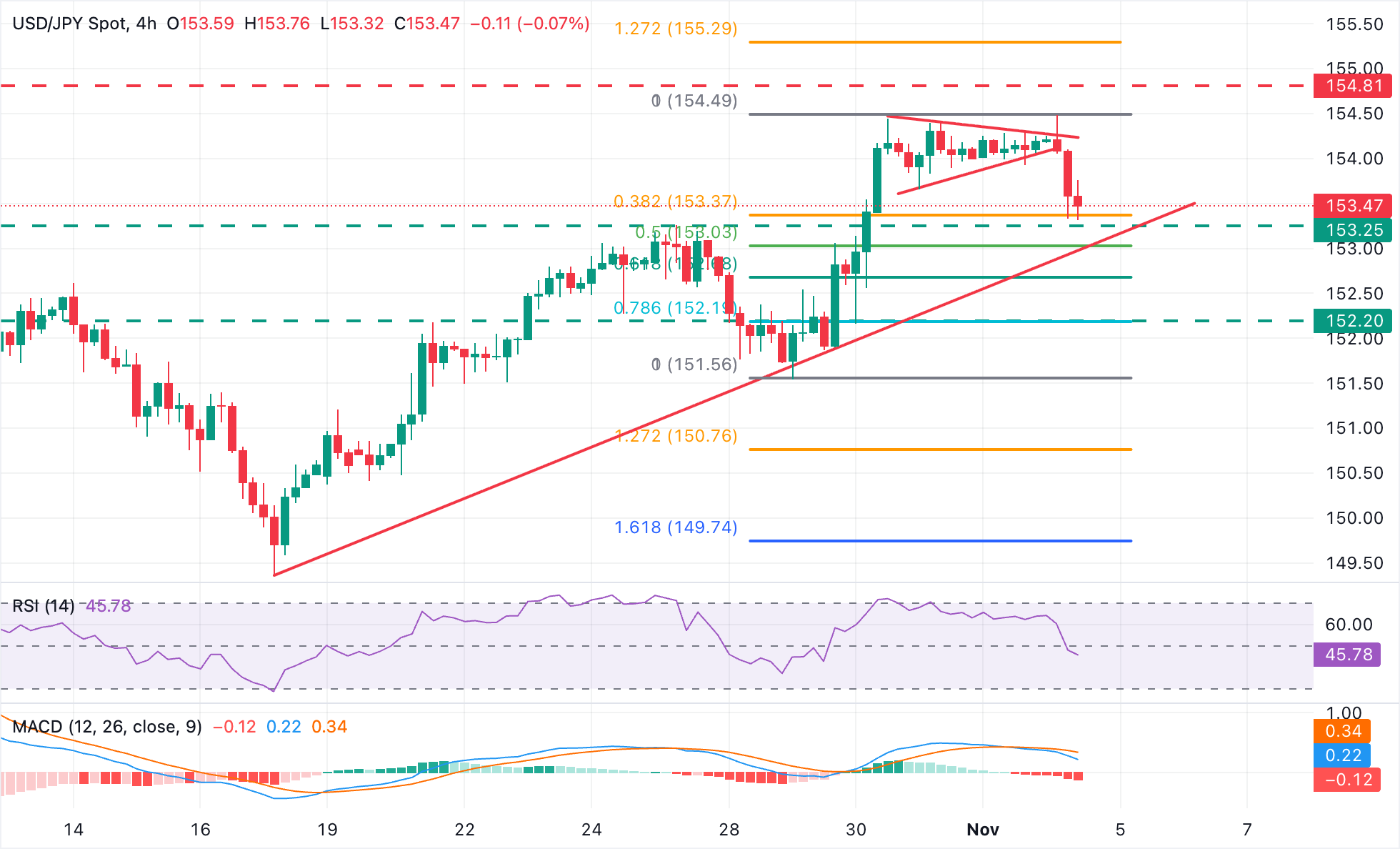
The pair has broken the small triangle pattern around 154.20 and is now testing support at a previous resistance area at 153.00. Technical indicators are turning lower, as the Relative Strength Index dipped below the 50 level, but the bullish structure from mid-September lows remains in place.
Bears should push prices below the 153.00 area, where the 61.8% Fibonacci retracement of the October 29-30 bull run crosses trendline support. A confirmation below here would increase pressure towartds the October 30 low, at 152.20.
To the upside, the October 30 and November 4 highs, near 154.50, are likely to challenge bulls ahead of the February 13 high, at 154.85. Further up, the 127.2% extension of last week's rally, at 155.30, emerges as a potential target.
Author

Guillermo Alcala
FXStreet
Graduated in Communication Sciences at the Universidad del Pais Vasco and Universiteit van Amsterdam, Guillermo has been working as financial news editor and copywriter in diverse Forex-related firms, like FXStreet and Kantox.














