USD/JPY surges on Trump's tariff threats on Japan and increased demand for US Dollar
- USD/JPY surges in response to rising US Dollar strength and reduced demand for the safe-haven Yen.
- The United States imposes a 25% tariff on Japanese imports, which is set to take effect in August 1.
- USD/JPY bullish outlook strengthens above 146.00.

USD/JPY surges past 146.00 as trade tensions between the US and Japan escalate and US yields rise.
The US Dollar (USD) is gaining traction against the safe-haven Japanese Yen (JPY) on Monday, driven by rising Treasury yields and escalating trade hostilities between Washington and Tokyo.
At the time of writing, USD/JPY has gained over 1% to trade above the 146.00 psychological level, as Japan prepares for a 25% increase in all Japanese imports to the United States (US) starting August 1.
US President Donald Trump posted a letter on his Truth Social account addressed to Japanese Prime Minister Ishiba Shigeru, informing him that his administration will start charging a 25% tariff on Japanese imports. Trump warned he would raise his tariffs if Japan imposes retaliatory tariffs on US goods.
This follows bilateral trade talks, which were derailed last month due to Japan’s reluctance to import rice from the US.
Although Japan’s lead trade negotiator, Ryosei Akazawa, in charge of trade talks, held negotiations with US Commerce Secretary Howard Lutnick over the weekend, there has yet to be a significant breakthrough.
In contrast, Treasury yields in the United States continued to rise, supported by last week's favorable Nonfarm Payrolls (NFP) figures and broader interest rate repricing.
Stronger labor market indicators have eliminated the possibility of a swift rate reduction by the Federal Reserve (Fed), and market participants have shown greater regard for the US Dollar in comparison to the low-yielding Japanese Yen.
The 10-year United States Treasury note yield rose above 4.45% in continued support for the greenback on Monday.
In sharp contrast, the Japanese Yen remains soft as a dovish Bank of Japan (BoJ) and weak domestic economic indicators continue to apply pressure. Japanese wage increases in the most recent revision were disappointing and tempered expectations that the BoJ would move towards policy normalization in the immediate term.
Technical outlook supports USD/JPY bulls above 146.00
From a technical standpoint, USD/JPY continues to trade with a bullish bias, with the pair convincingly breaking key resistance at 145.00
Support remains solid at the 23.6% Fibonacci retracement of the January-April decline at 144.70. Below that is the 50-day Simple Moving Average (SMA) near 144.58, which would bring the psychologically significant 144.00 round number into play.
Resistance is also forming in the region of the psychological 146.00 mark.
A hold above this region would unleash additional appreciation towards 147.00, barring a resolution of trade tensions.
USD/JPY daily chart
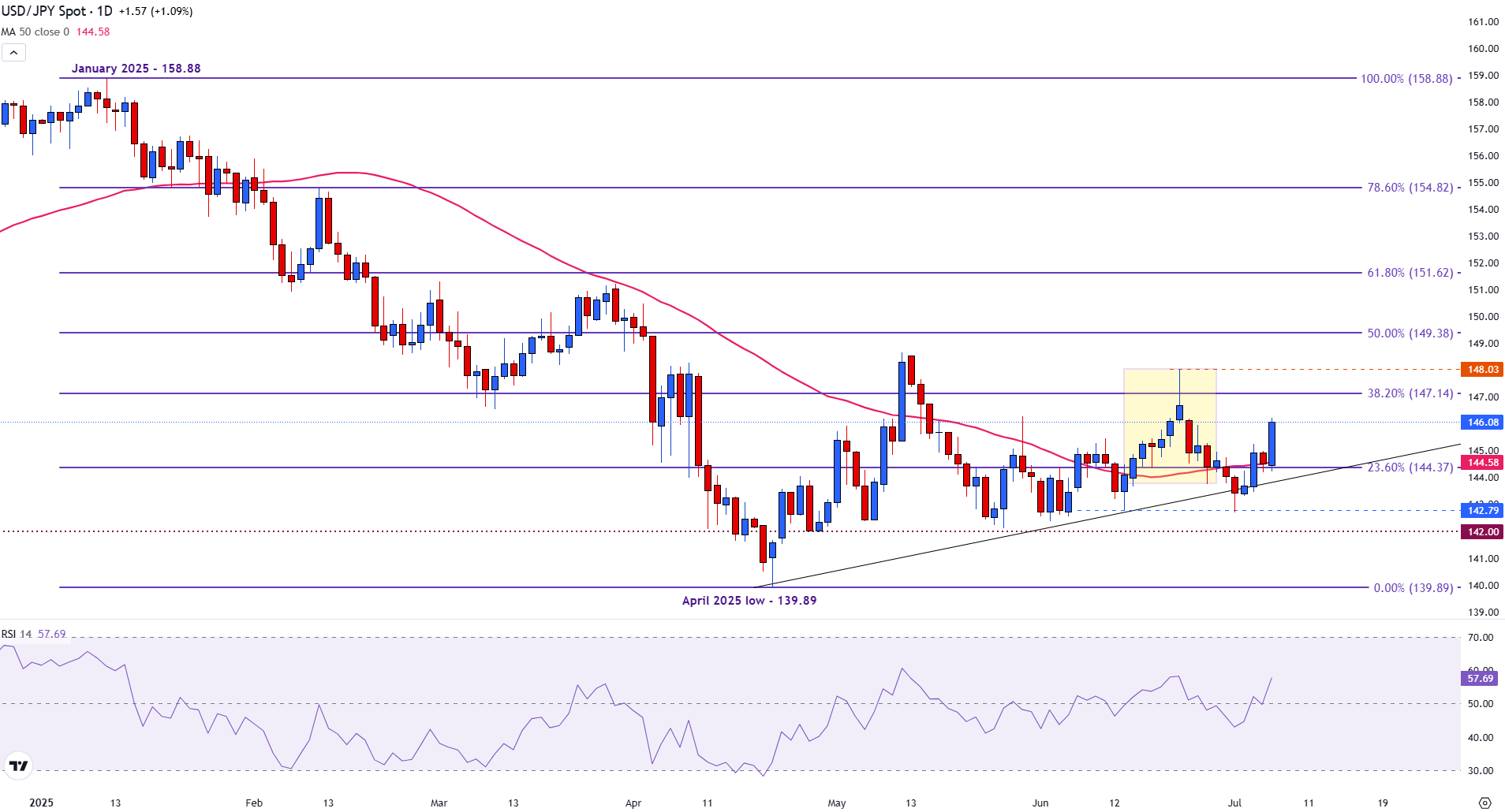
Upward movement is supported by a rising trendline from the April low of 139.89, indicating a solid structure of higher lows. Momentum indicators also align with this view, as the RSI has climbed toward 58, showing strengthening bullish sentiment while still allowing room for further gains before reaching overbought levels.
Key resistance now stands at the 38.2% Fibo level at 147.14 , followed by the June swing high of 148.03 and the 50% retracement level at 149.38.
As long as the pair holds above 144.37 and the ascending trendline, the short-term outlook remains bullish.
Japanese Yen FAQs
The Japanese Yen (JPY) is one of the world’s most traded currencies. Its value is broadly determined by the performance of the Japanese economy, but more specifically by the Bank of Japan’s policy, the differential between Japanese and US bond yields, or risk sentiment among traders, among other factors.
One of the Bank of Japan’s mandates is currency control, so its moves are key for the Yen. The BoJ has directly intervened in currency markets sometimes, generally to lower the value of the Yen, although it refrains from doing it often due to political concerns of its main trading partners. The BoJ ultra-loose monetary policy between 2013 and 2024 caused the Yen to depreciate against its main currency peers due to an increasing policy divergence between the Bank of Japan and other main central banks. More recently, the gradually unwinding of this ultra-loose policy has given some support to the Yen.
Over the last decade, the BoJ’s stance of sticking to ultra-loose monetary policy has led to a widening policy divergence with other central banks, particularly with the US Federal Reserve. This supported a widening of the differential between the 10-year US and Japanese bonds, which favored the US Dollar against the Japanese Yen. The BoJ decision in 2024 to gradually abandon the ultra-loose policy, coupled with interest-rate cuts in other major central banks, is narrowing this differential.
The Japanese Yen is often seen as a safe-haven investment. This means that in times of market stress, investors are more likely to put their money in the Japanese currency due to its supposed reliability and stability. Turbulent times are likely to strengthen the Yen’s value against other currencies seen as more risky to invest in.
Author

Tammy Da Costa, CFTe®
FXStreet
Tammy is an economist and market analyst with a deep passion for financial markets, particularly commodities and geopolitics.